
Guru's visit to New Zealand
On the 1989 trip to New Zealand when Guru met our Prime Minister, there were many uncertainties and we spent much of our time in a sea of anxiety. With Guru though, things always seem to work out, and even in the many inadvertent, unscripted moments things still seem to work out. Here is a photograph of Subarata with the famous David Lange cake, our gift to him, the likeness of our Prime Minister etched with great fidelity in the veneer of icing.
Learning that the New Zealand disciples were outside in the main airport – hopeful of a glimpse of Guru inside in the international lounge – Guru astonished everyone by picking up the David Lange Prime Ministerial cake and marching out through a no-exit route, effectively entering New Zealand without going through Customs and Immigration and apparently invisible to the authorities.
It was extraordinary. There in broad daylight Guru calmly walked out the wrong way through the entry-only section, carrying the large box and some prasad. In response to our great surprise Guru commented: “Where there is heart, always there is a way."
Then after our excited troupe had taken prasad, Guru walked back into the in-transit lounge, bypassing all officialdom, un-challenged, still surely invisible and with no documentation or processing. We were speechless for days.
The cake was later forgotten in the Prime Ministerial scramble until Guru said to Subarata, “But where is the cake?" Once found and placed reverently in the back of Guru’s car, it was nearly sat upon by Subarata in our rushed ride to our next engagement.
Guru praised our PM lavishly, especially his achievement in orchestrating New Zealand’s pioneering “nuclear-free" legislation in the face of huge opposition. Guru saw that our country’s stance would inspire the whole world.
Prior to his meeting with David Lange, Guru went shopping for gifts at a local market and bought hair clips for the visiting girl disciples. The hair clips all had popular western names attached—Helen, Margaret, Emily and so forth—and Guru had great fun remembering the original name of each intended recipient.
In a nearby bookstore, Guru enquired of the shop owner the location of a particular title he wanted. The owner did not know where in the shop it was, so Guru placed both hands against a long wall of books, closed his eyes and concentrated for a minute. Then he walked along the aisle and simply pulled out the desired title! Subarata and I were amazed.
Guru also bought me a bright yellow tie with drawings of sheep all over it, and I wore this unconventional appendage at several of our VIP meetings. The tie created a smiling light- heartedness on its various outings, the playful lambs perhaps reminding us that life, after all, is only a game.
An Indian gentleman who helped arrange our meeting with New Zealand’s Prime Minister David Lange requested a private meeting with Guru near the end of this wonderful visit, and Guru kindly agreed. Both Subarata and one of our visiting disciples had noticed that our Indian friend—a doctor by profession—was wearing a thinly disguised wig. It was one of those snippets of absolutely useless information that somehow fascinate and arouse a disproportionate amount of interest and humour and charm. The fact was somehow relayed to Guru, and then this trifle quite forgotten.
Guru and the doctor disappeared into a side room for a serious interview, emerging some twenty minutes later looking quite grave. After the doctor had departed, Guru turned to us and confided, “You are right. He does have a wig!"
It gave us so much joy to imagine Guru, free to roam in all those higher worlds, examining the good doctor’s hair for those tell-tale signs of a toupee.
In 1989 a one-mile loop around the spacious acres of the Auckland Domain was dedicated as a Sri Chinmoy Peace Mile, and our city mayor, parks authorities and various Olympians and notables came to welcome Guru. The brass band from a local girls’ school had also been invited to add a little colour to the occasion – unwisely, as it turned out – and they belted out a series of strangely incongruous Christmas carols, months away from Christmas and all hugely out of tune. At every apparent lull in the proceedings they would start up again, as though responding to some invisible cue – we often had to wave our arms at them to stop! As well, one zealous player always ended her efforts with a loud protesting blast on the trombone as if someone had trodden heavily on her toes. The intensity of Guru’s presence was mixed with a comical element, as though two different worlds had confusingly come together – though Guru himself was hugely relaxed, seeming to enjoy this strange mélange.
Subarata had also invited a clown, another bizarre yet somehow rather endearing oddity, and in all the video footage of this great occasion, there he is in his multi-coloured striped trousers and oversized red shoes, juggling happily or cheek-and-jowl with the mayor or waving at the camera. All of this created an air of informality, a light and spontaneous touch in which Guru himself was complicit. Guru walked and jogged around our newly dedicated Peace-Blossoms mile and organized a spontaneous series of races for the disciples and others present. The mayor demurred, excusing herself from athleticism by pointing to her high-heeled shoes.
I had almost completely lost my voice – the tax from sleepless nights and stress – and my opening remarks on this wonderful occasion, little more than a few inaudible, whispered croakings, rivaled the brass band’s curious contribution. I invited Guru to speak and he took the microphone as though to do so – then he simply meditated for quite a long time.
The power and unexpectedness of Guru’s long silence, his calm disregard for convention, his absolute spiritual authority and composure and the sudden surprise of his meditation swept everything else away and restored the occasion to what it was meant to be, something momentous and deep and lovely – for a great Master had just passed through our little world. Later Guru said, “My silence is my highest offering.”
Over the years Auckland’s Sri Chinmoy Peace Mile has witnessed a number of interesting events. Some of our Peace Runs have started here, innumerable races held, and 50-mile tribute runs undertaken to honour some of Guru’s achievements. Once Subarata and Bhuvah walked over twenty painful miles on tall stilts in some other commemorative outing.
Our Centre car was also stolen from here, metres from where Guru had stood. Subarata contacted our main national newspaper with an ingenious and true account of her alter-ego life as Cleo the clown and what the loss of her car would mean to doting child audiences and her livelihood, and a sympathetic reporter ran a Front Page story. The endearing photo of Subarata in full clown regalia, looking suitably woeful, made our car too hot to keep for its morally bankrupt new owners and, in a remarkable instance of grace, the car was quickly abandoned, turning up a short while later in a parking lot and none the worse for it all.
In summer, the parklands surrounding our Sri Chinmoy Peace Mile are carpeted with acorns, lovely fields of them spreading away under the deep aerial greens of towering oaks. You can pick them up in handfuls and marvel at how perfect they are, how different each is from any other. A little seasonal miracle. Out jogging one morning I composed a little jubilatory acorn ode in my head—back home, searching for a pen before I forgot:
In drifts and banks
of burnished gold
they mass, those tawny
roly-poly nuts
that crunch and crackle
underfoot in glades you stroll,
weaponry in the warrior feuds
of boys. When pigs
can fly they’ll flock
squealing into this parkland paradise
gorge, fossick, glut,
pig-heaven, utopia of nuts
hand painted each by autumn’s
lovely brush, a palette
of browns and bronzes, coppery hues
hardened in the kiln of sun.
All night long they tumble down
rattle and patter, clutter
my eaves, bounce and clatter
like playful garden gnomes
lie winter long
in the nurseries of my gutters
and while I sleep
burst quietly into leaf
take root in loam
next spring march out
reclaim their sylvan dynasty.
Go forth my leafy legions
repopulate the barren vales
those former hills of home.
Discarded Careers
In the mid-’80s, Subarata landed a job teaching vegetarian cooking in an adult education college course. This was during a time in New Zealand when you could do almost anything you wanted, with absolutely no experience or qualifications at all. If you knew how to boil a few potatoes you could be a chef; pass your student license and you were a taxi driver; prune back your old apple tree at home and you could apply for a position as a horticulturalist’s research assistant. Subarata would swat up on untried recipes a few hours before each evening’s course, then turn her students loose in the college kitchens, attributing the strangeness of the ensuing dishes simply to beginners’ inexperience. Many new career paths were explored in these heady, carefree days.
I could still bend at the waist then and found a job teaching yoga and meditation, bought some leotards and did a home-study crash course in the asanas (“postures,” to the uninitiated) from a helpful book called Yoga Made Easy. My course was called “Paths to Tranquillity” and was supposed to run for three full terms – a challenge which initially caused me some mild concern at the amount of material I would need to know. But armed with my new wealth of knowledge and a mastery of several of the fifty or so asanas in Yoga Made Easy, I began my new career. To establish my professional credibility early on, I would meticulously demonstrate the three or four asanas I had mastered, then run through them slowly and patiently with my students at the beginning of each class. Proficiency in these, I assured my spellbound and riveted audience, and longevity and super-health would all be theirs.
When it came to those asanas I couldn't do, I would simply call up a volunteer and then, my own mastery already a given, instruct them on how to adopt the various poses while I cajoled, instructed, prodded and pushed. Had I even attempted these contortions myself, the tearing of sinews would have been audible. But as the weeks wore on, my housewife-students became increasingly restive and rebellious, especially during the protracted silence of meditation practice, and “Paths to Tranquillity” began to take on an uneasy and decidedly un-tranquil air.
By mutual consent between students and teacher, my introductory yogic teachings never ran into term two. The housewives jumped ship and enrolled in “Integral Yoga with Alison” on another night.
Neither Subarata nor I felt inclined to pursue these careers any further – I became disillusioned with yoga and took up running, while Subarata moved into a whole new realm of cuisine, the exciting world of takeaways.
How we met
Those long ago peregrinations that led to discipleship owe much to a dear and now departed companion, my wife Subarata. I first met Subarata in the mid-1970s in New Zealand, our two lives intersecting in what seemed a chance occurrence in a very random, fortuitous universe.
Irish-born and fiercely independent, she had asked her parents for a one-way ticket to New Zealand as a 20th birthday present, and they had consented – and so it was that I first met her in 1975 in the city of Hamilton. Through chance or fate, she knew somebody that I knew and on this particular day both of us decided to visit this mutual friend. I hitchhiked 400 miles, she had flown 13,000 miles – and when we met on that summer afternoon long ago, in an instant we became friends.
Beautiful Collision
There is a song I like called “Beautiful Collision” by a popular New Zealand musician who describes these everyday, arbitrary intersections of lives, the chance encounters, the endless possibilities of life weaving and colliding all around us. The song reminds us of how the little moments of impulse or choice shape our endless tomorrows. If we had lingered here a little longer, started that conversation, said “yes” instead of “no,” perhaps “no” instead of “yes,” taken a chance, placed a bet, passed through that door, smiled in response, made the hard choice… it might all have turned out differently. Subarata was one of the beautiful and fateful collisions that did occur in my life.
She had blue sky in her eyes and questing in her heart, a little wildness in her. I saw that Subarata was a nomad, a wanderer, that we shared the same journey – I knew I had met a kindred spirit. In a shoulder bag she carried Lao Tzu’s mystic teachings, the Tao Te Ching – she had underlined things, words and phrases, grasping at the heart of the book and devouring its wisdom hungrily. She was responding to the same things as I was, searching for her way forward, stumbling through the maze.
There are probably thousands of people out there in this world with whom we share deep similarities of interest and temperament, inner connections and spiritual kinship, people who could have filled our whole lives in the other endless possibilities of existence, the beautiful collisions that might have taken place. Mostly, we never get to know them – but we see them in our meditation classes, meet them on journeys, pass them in any street, our unknown family within the larger human race. Subarata was one of those that I actually met.
Animal friends
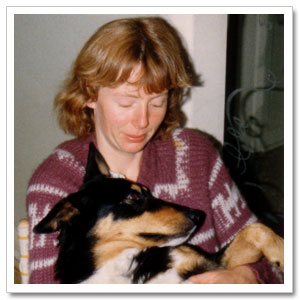
Reclusive by nature we lived in remote places, often going for months without seeing anybody. Subarata loved animals – in one mountain hideaway she acquired three pet wild pigs, two beautiful Border Collie dogs called Scruffles and Scobie, a white Palomino horse named Trigger, four nameless and disapproving hens, some zebra finches and a madly eccentric pet lamb called Darley. Goats also lurked, and once a pet fawn – unsnared from a fence – stayed for a brief convalescence. (I wrote a story called Animal Friends »)
A formality
When Subarata's visa expired the Immigration Department gave her three days to leave New Zealand, so in the small South Island town of Motueka we got married in a registry office. We were both indifferent to marriage, so there was no ring, no flowers – it was as meaningless as signing a bank deposit slip, but it enabled her to stay.
Unseen by us, the simple act of scribbling our careless signatures on a piece of paper heralded a deeper commitment. It was a postscript from some past, the prelude to some future, both a consequence and a beginning in a much greater fabric of time. We were setting forth together on a much greater journey than all of our wanderings of the earth, yet the journey’s beginnings, we felt, lay elsewhere in a faraway time.
We did not bother telling anyone of this formality – it meant nothing to us. Only years later, when the two of us were driving with my parents to a faraway town, I turned to my mother and said, “By the way, did I ever tell you we are married?” My mother, Anne, was astonished, then a little rueful we had not told her earlier. But then she laughed and turned to Subarata the nomad, the gypsy, with a great smile, hugged her and said, “You are a brave girl to marry my son, and I love you for it!” My mother loved us too much to be upset for long.
The Past is Dust
In the sweet long-ago we tried many jobs – fruit-picker, security van driver, hotel domestic, arborist, back-country farm manager, labourer, demolition worker, secretary, bogus night auditor, bored ministerial speechwriter, river rafting guide, baker’s assistant, landscaper, geological mapper – and those rootless years were littered with abandoned careers. I had a talent for writing glowing personal testimonials about ourselves, fake references and employment histories too good to see us turned away, and work came easily.
For two seasons we chased the blue skies of summer, picking fruit up and down New Zealand, our clothes stained with the red blood of raspberries, the purple of blueberries, yellow juice of pears and peach, green sap of crushed leaves. We lived in a hired caravan, worked from dawn’s fading stars till dusk’s darkening skies, the green globes of apples and other fruits melting back into the orchards’ deepening shadows. When that wandering feeling came, we simply moved on, stopped at road junctions and tossed a coin – north, west, east?
One by one we were discarding all the usual choices of life, the hypnotic lies of material happiness, like a tick-sheet of unwanted possibilities and selves: not this, not this; no, not that. We took refuge in constant change, as though discoveries would be made and happiness found simply through perpetual motion. Restlessness, a sense of relentless questing, ran like a strong undercurrent through our lives. The future was open-ended, the blank slate of tomorrows held no certainties – whimsy, chance or the murky nudgings of fate would decide.
Years later, we sat with our Guru - Sri Chinmoy - in a restaurant on Auckland’s Ponsonby Road, and he asked us a little about the bygone years. Guru somehow knew a little of my own regrettable past, the safari and hunting days, and he asked what animals I had eaten!
Before I could go into any awkward detail, Guru now mentioned all of the furred and feathered things he had once eaten – the fish, birds, animals of his childhood. Then he looked at Subarata and, with a lovely smile, confided to her, “Once I even ate some pigeon.” Before she received her soul’s name, Subarata’s name had been Pidgeon Cunningham! Guru remembered very well, enjoying this little ambiguity.
For me, Guru’s knowledge of my past unburdened me of remorse and karmic wonderings. That door was now firmly closed and the past now truly dust, even if there was a lot of it. When Guru and God – are they not perhaps the same? – came into our lives and tapped us on the shoulder, we saw that everything else had been a readying, a preparation for discipleship. One kind of freedom had been replaced by the possibility of another, the great freedom of God-discovery.
Subarata's Book
The following selection of stories about Subarata were written by her husband, brother and friend Jogyata Dallas.
Introduction
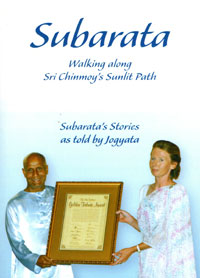
Most of the stories in this collection recount moments and memories from the life of Guru’s disciple Subarata, who left this world in March of 2000 after a sad illness. Time often mythologises and sanctifies the lives of the departed, but in spite of her human foibles – her quick emotions and puzzling quirkiness, her famous candour, her humour and sometimes her melancholy – Subarata touched and enriched all of our lives in an overwhelmingly positive way. And the essence of the soul, that memorable, unique beauty, finally stands above and apart from the human cloak of personality to deserve our smiling praise and fond reminiscing.
Mythology might offer a truer summation of people and events after all, a capturing of some essence like a field of grapes distilled into a bottle of wine; or the painting of a golden summer, the canvas splashed with bright memorial colours without attempting the scribble of trees or clear definitions of landscape; or the perfume left in a room after the guests have all departed.
For the most part these stories and memories have been prompted by very random events – a photograph, a chance remark, reminiscing with friends or sudden “Oh! Yes!” recollections. I have tried to keep a light touch and a little humour wherever possible as well, so that these anecdotes from her life are also happy ones.
Guru always reminded us that the past is dust, so I wonder a little at these gathered stories – why bother, why this peering back over our shoulder? I really don’t know, but perhaps if you smile a little here and there it might be enough.
Happy 95th Birthday, Madiba!
Today is President Nelson Mandela's 95th birthday, and the Sri Chinmoy Centre would like to add its best wishes to the millions of birthday greetings from all around the world. Sri Chinmoy was a great admirer-friend of President Mandela, and the two had several warm and significant meetings.
Sri Chinmoy wrote a book called Nelson Mandela: The Pinnacle-Pillar of Mother Earth in his honour - below are some of the poems from the book:
“He tells poorer than the poorest human beings
In every possible way:
'Let us dream together.
The Golden Dawn
Will soon burst forth!'”
“President Mandela's very name
Builds a hope-cathedral
In the heart of despair-flooded humanity.”
Sri Chinmoy -
"I cannot express in words my joy! What you are doing is in the interest of the entire humanity and the world." - Nelson Mandela to Sri Chinmoy, meeting in South Africa, 1996
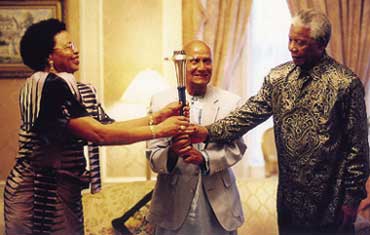
The above photo shows Sri Chinmoy and Nelson Mandela and his wife, Mama Graca holding the torch of the Sri Chinmoy Oneness-Home Peace Run, which Sri Chinmoy founded in 1987. While holding the torch President Mandela said: "We are with you in upholding peace, which brings solace to many people throughout the world. It doesn't matter what language they speak. I think peace is one of the things that is going to save the world."
In a statement released on his birthday, President Mandela's health is reported to be steadily improving.
Eternal peace flame in Oslo
At a ceremony in Oslo, there was a re-dedication of the Eternal Peace Flame - a powerful symbol and hope for peace. The Eternal Peace Flame was offered to the city of Oslo by Sri Chinmoy in 2001. For many years, the Eternal Peace Flame had a temporary home on the sea front. Now a permanent place has been found in a beautiful surroundings of Holmenkollen - overlooking the city. Next to the flame, there is now also a statue of Sri Chinmoy - a powerful work of art to represent the peace-loving life and spirit of Sri Chinmoy, the founder of the Oneness-Home Peace Run.
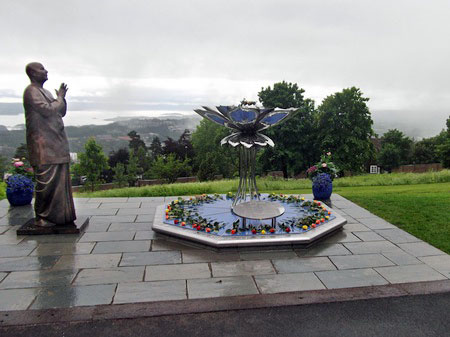
The ceremony was joined by members of the Peace Run, and several dignitaries.
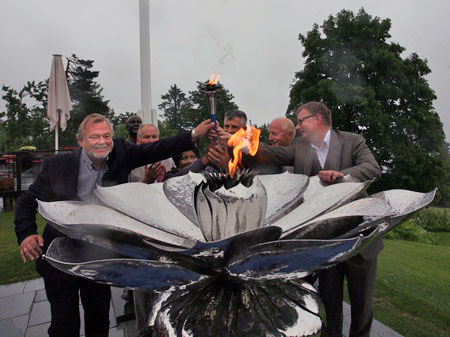
With the peace run torch by the Eternal Peace Flame
The Eternal Peace-Flame Holmenkollen, Norway
Dedicated by Sri Chinmoy: Dreamer of World-Peace
The Eternal Peace-Flame Mankind's Oneness-Game. Here in Norway's Oslo, The smiles of the world glow.
May humanity's aspiration-heart Find here the Beauty and Fragrance Of real PEACE. -- Sri Chinmoy
Oslo, June 27th, 2013- Peace Run - report
- Eternal peace flame
- Oslo statue
Dublin Songs of the Soul concert
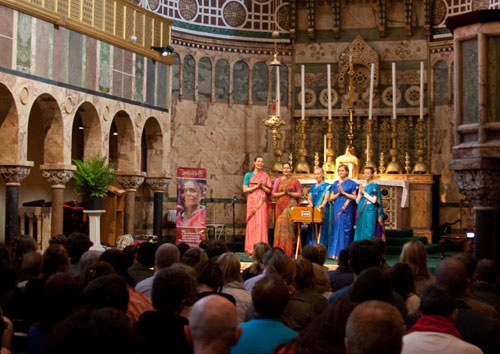
On June 28th, the Dublin Sri Chinmoy Centre promoted a well received Songs of the Soul concert at the beautiful Newman University Church in the centre of Dublin.
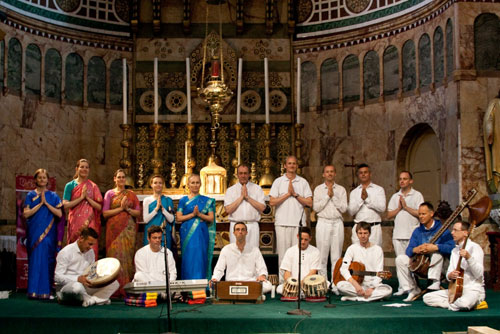
Several groups performed the music of Sri Chinmoy including Kanala & Sadanand, Ashru Dharar, Mangala's Group, and Adarsha & Ananda. After a rousing finale of the song 'Akashe Amar' - a large enthusiastic audience of around 230 people, offered their generous appreciation of the concert.
English Translation:
My infinite consciousness-light Pervades the sky and ether. Today I shall strike and destroy in a twinkling The world’s intense sufferings.
- Sri Chinmoy (Score)
Related- ‹ previous
- 108 of 337
- next ›

Except where explicitly stated otherwise, the contents of this site are licensed under a Creative Commons Attribution-NonCommercial-NoDerivs 3.0 Unported License. read more »
SriChinmoyCentre.org is a Vasudeva Server project.