
World Harmony Run - John O'Groats to Lands End
In the UK, the World Harmony Run is travelling the entire length of the country from John O'Groats in Scotland, to Lands End in the tip of Cornwall in South England.
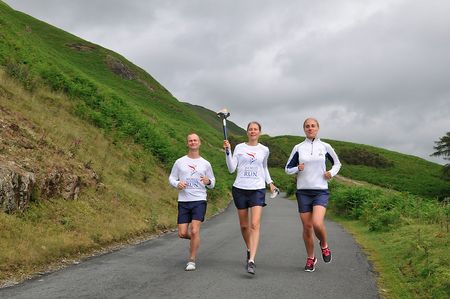
Members of the World Harmony Run team running through the Lake District.
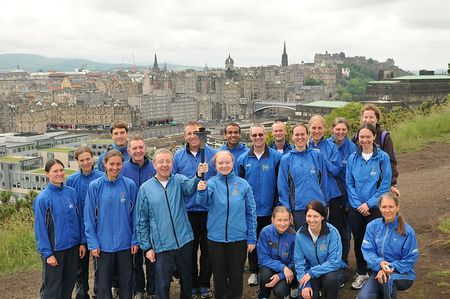
Members of the World Harmony run team in Edinburgh
The World Harmony Run was founded by Sri Chinmoy to promote the ideal of peace, harmony and friendship.
Harmony shall echo
And re-echo
Throughout the length
And breadth of the world
When each human being
Values the beauty
And divinity
Of self-offering.
- Sri Chinmoy [1. Sri Chinmoy, My God-Commitments, Agni Press, 1992.]
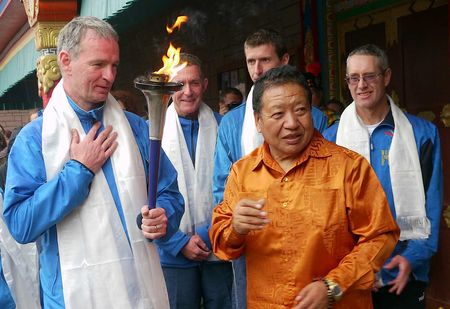
On route, the World Harmony Run team visited the largest Tibetan monastery in Europe.
- Recent World Harmony Run posts
- View: World Harmony Run GB
Tribute To Pranavanta
Pranavanta John Montefiore, a student of Sri Chinmoy, was an exceptional artist who developed a strong reputation for his innovative and marathon artworks.
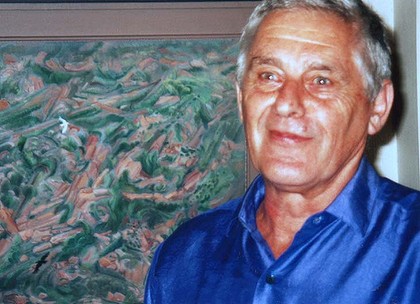
Pranavanta became a meditation student of Sri Chinmoy in 1985. Studying under the tutelage of Sri Chinmoy (who himself was an artist) gave Pranavanta artwork a renewed spiritual energy. A tribute to his life was recently published in the Sydney Morning Herald.
...Montefiore was an aficionado, someone who could wax lyrical on many aspects of the world: not just the beauty that he strived to portray in his artwork but also the sweet sounds of music, the aroma of a flower, even the joy of a terrible pun. Montefiore's altarpiece in Christ Church Cathedral, Newcastle.
When people say ''Words can't express it'', they obviously never accompanied their words with the enthusiasm of Montefiore. His marathon artworks were best accompanied by his own commentary, as he guided you through the story he was telling with his work. Every dot of paint, its position and shape, had profound significance...
Read more at Sydney Morning Herald
Being Single
Writing always begins with the blank page, blankness in the mind. We sit awhile in contemplation, an attentive waiting, looking for the genesis of words, the scattered seeds of language, a spark to kindle inspiration or a touch of grace, the gift of insight. And today, waiting for something to come, when at last it does I am being lured away from the proposed Inspiration-Letters theme of 'time', veering off course and thinking instead about the value of celibacy. Well, let me follow these thoughts and see where they will take me...
In a society where the idolatry of romantic relationships has become obsessive and unchallenged, the choice of celibacy is widely perceived as a strange and bemusing one. Usually associated with cloistered religious communities – Benedictine monks, convents of pale, otherworldly women renunciates, Indian ascetics, archaic Christian orders – celibacy is a mystery to a culture that has never really questioned it's own idealisation of physical love, soul mates, partnering, marriage and remarriage. Celibacy brings these notions skidding to a halt, challenges our Western promiscuity, irritates even feminists who see it either as male misogyny or a denial by women of the capacity to love. It undermines our traditional notions of happiness and puzzles mainstream society through it's extreme disregard for what is considered normal.
True celibacy though is not a negative state of repression, deprivation or incompleteness, nor is it a contraction of love. It is instead a state of great potential where the soul can make room for God. It allows the development of a deep sense of self grounded in a relationship with one’s chosen divinity, Christ, the Buddha, Sri Krishna, one's guru or some personal sense of Deity. It is a singleness of heart, an ability to stay centered, an inner marriage to one's ideal. Celibacy in discipleship is the outer expression of a commitment to God, a singleness of purpose.
For most of us, celibacy may bring an intensification of the human loneliness that we all know. But we also know that loneliness is never finally assuaged by others, for human relationships are a shadow of the soul’s deeper quest for yoga, union with God, and only this final union can satisfy us. "It is the union with God that is the original," writes M. Marnau in Revelations of Divine Love, "and the human union that is the imitation..."
In our choice of aloneness we create space for our guru or God. And as this inner union comes to life, becomes more real to us, we expand our capacity to love. We come to understand too our karmic responsibility to not disturb the spiritual quest of others; we slowly come to a love that is desireless and free of need or expectation; we sublimate our desires in the recognition that what is most beautiful in others is only the God that we seek within ourselves.
Marriage and partnerships are another valid way to also achieve these goals, merely different paths to the same destination. My own guru, Sri Chinmoy, helped me to understand the spiritual dimension in my own marriage, its twenty years and endlessly recurring chances to widen and deepen love, practise a fledgling selflessness in the front lines of often fiery dispute, work at reconciliation and a deep caring. To wear down the ego in otherness, weep at another's tears, despise and pray to be rid of one's own unkindness.
Celibacy too has much to offer us. I value my growing capacity for genderless friendships that recognise and honour the sacredness of the spiritual lives of others, requiring a renunciation of self-interest, reminding me as Sri Chinmoy reminded us all to always see God in everyone around us. Not a repression of love but an expansion of love and it's redirection to a higher level of existence. Celibacy deepens our talent for relationships, that we can love without desire, listen with genuine caring, serve without need of gain, shift love upward from eros to caritas and agape, the divine love of the great masters and servers. Sri Chinmoy calls this ‘purity’.
Celibacy is a rejection of the pervasive, consumerist model of relationships. It allows an accommodation of all others in our heart, allows us to relate to people as human beings and to give up the pursuit of others as possessions. In celibate love we are more available to others, learning to listen more deeply and without possessiveness or need. Those who embody a celibate’s consciousness, one that is inwardly assured and grounded, are often gracious and pleasing and empathetic, making us feel appreciated and valued for what we are. They recognise and respect the boundaries of propinquity, safeguard themselves and protect others from themselves, placing relationships into a spiritual context that dignifies and brings out the best in us.
Celibate love lights up the heart. It sublimates vital energies into sympathy, tenderness or deep concern, and after such encounters we always feel better about ourselves and the world, uplifted and somehow touched by a mysterious and novel kind of love. It's goal is not some otherworldly holiness but that hard won, great detachment that a renunciate's path finally brings – and God love, freedom from desire, an equanimity enduring through all the struggles of life, the unfettered love that at last sees only God in everything.
Human interaction is the schoolroom, the great practicing ground of celibacy; we fall in love easily, and perhaps the experience of love is the only real teacher of love. Or in the words of one Benedictine monk – "To fall in love is celibacy at work". A disciple's celibacy might at first seem a constraint, but then becomes part of a long process of personal conversion, providing the conditions and challenges in which one’s inner development can best flourish. In a lifetime of sometimes loneliness, the struggle to transform our inner longings can be painful and wrenching, but we cry harder than ever to God, pray with real tears for release and consolation. I often feel that God shields me from all the things I am most vulnerable to – since I lack the strength to cope, He simply takes them out of my way.
Celibacy means taking all our feelings and emotions and putting them where God wants them to go. It stretches and transforms our notions and abilities in love, teaches us to love non-exclusively – it's fruit is a widening hospitality of the heart. Celibacy, writes the Benedictine monk, means "not focusing on 'what I gave up' but on what being freed by what I gave up has allowed me to do in terms of my service to others..." And the goal of all love, which celibacy helps us to realise, is union with and service to God.
Marriage or relationships and celibacy are not polar opposites – there are many married celibates who have achieved restraint, purity and the sublimation of physical desires, and unmarried celibates tormented by the clamourings and impulses of mind and body, the 'wild orchestra of the hormones'. For the latter, a commitment to celibacy is the beginning of a process of rapid change, of self scrutiny, the advent of grace which effort brings, intense plea and prayer, disentanglement, the karma yogi's path of daily mindfulness, bringing pain into context and consciousness – 'celibacy at work'.
Seeing too the ability to love and to need love as also a gift from God, but slowly learning to transform this love into a celibate context, converting all relationships into one’s primary relationship with God. Understanding that falling in love is also a part of seeking God – thus having patience and renunciation, fidelity to the path, the guru.
All this effort for spiritual progress is of course hard work, the alchemy where base ignorance begets a shining liberation, but then our struggle is a microcosm of the cosmic game itself and we cannot make progress in a vacuum. Sri Chinmoy's writings speak to our daily trials with reassurance and humane advice, and remind that our efforts will in the future 'be most surprisingly rewarded'.
Fifteen hundred years ago St. Bernard asked of God wonderingly... "What are we, that You make Yourself known to us?” Today's masters tell us that we are all forgetful Gods ourselves, remembering and finding our way back home again, each of us treading our own path, playing our own leading role, all the way back through the needles eye.
– Jogyata.

Adelaide
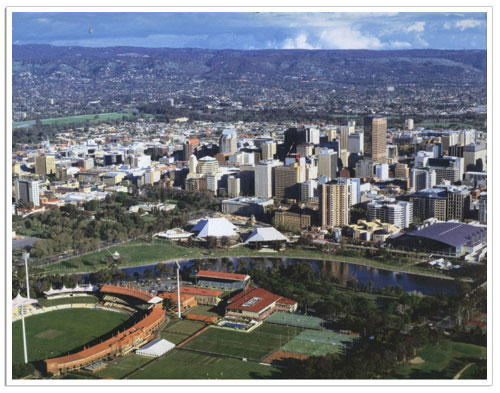 Adelaide after 30 years away. I do like this city – manageable, navigable, humane, good-natured. Feeling some sense of special occasion, the heart's hidden calendar of beginnings and endings, anniversaries, dates treasured by the soul – it was here, three decades ago, that everything started for us, two gypsies with their collie dogs.
Friday's arrival and Sipra whisks us from what has to be the best, most spacious airport on the planet to the spacious and popular Joy-Discovery vegetarian café in the city for some nourishment – then on to the Centre and a quiet evening.
Waking up early Saturday – outside the dawn gaiety of kookaburras, their parody chortlings and chucklings, caroling magpies and the frenetic cries of parakeets hurtling through the boughs of eucalypts in aerial pursuit, their screechings like pumice scraped over glass. Up into the Adelaide hills, a long slow run at sunrise. "Carry water", warns a sign, and "watch for snakes". From up here, vistas of the sprawling city, huge plains, further away the blue meadows of sea. Fragrance of gum trees and the pale orange earth, summer’s redolence.
Thirty-five people come to Saturday's workshop, all very nice. I tell them the Narada/Vishnu story, 'where is my glass of water?' – its wake up time, remember who we are, why we are really here – and we all laugh at this delightful story. How quickly we find the common things we share, the barriers tumbling down. On Sunday nearly all come back and twelve elect to try the path as disciples. 'Teaching meditation' is a misnomer – it's more a remembering through silence.
We gather on Saturday evening at a Thai restaurant. The disciples are most interesting – two Persian professors, an artist, business managers, enterprise workers, all with interesting stories and remarkable meditation stories. They have a sense of assurance in their connection with Guru, a solidity and maturity undisturbed by the outer world in which they work. New friends to like and to seek out in future.
Monday morning, 2:00am – a loud bang, the house trembles, sitting suddenly bolt upright in bed. A fallen tree, a break-in? Outside a storm is raging, foliage pelting down on to the roof, the tall branches of the gum trees flailing like scimitars. At dawn I find a thigh thick spear of eucalyptus has plowed through the tile and timber roof and ceiling and ended two feet away from my head. Plaster and broken cornice litters the floor – a close shave.
Prior to my afternoon departure Januja and Chakori drive me up to Hahndorf in the hills, a visit to their most beautiful gift store/florist/gallery – Rainbow Heart-Sky. Most stunning, full of beauty and light. Januja slips next door to the deli and buys a big bag of snacks for the plane trip, a gift or two are placed in my bag. Everywhere generous hearts in this starting place of my own journey. My profound thanks to Sipra and her wonderful team for these four most rewarding and happy days.
– Jogyata.
3100 Mile Race 2011
The 15th Annual Self-Transcendence 3100 mile race begins today, June 12th in Jamaica, Queens, NY.
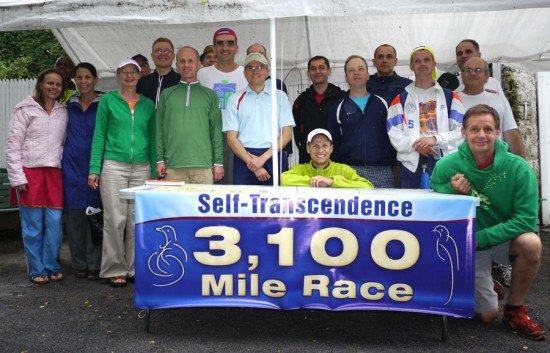
Ten runners will attempt, what the NY Times describes as the "The Mount Everest of ultramarathons" Runners will need to complete 5649 laps of a .5488 of a mile course (883 meters) in the timespan of 52 days. The course also includes a small hill. Runners will need to average 60 miles a day to complete in time. The current record for the 3100 mile race is Madhupran Wolfgang Schwerk of Germany who finished the course in 2006 in a time of 41 days 8 hours, averaging 75 miles per day.
The race was founded by Sri Chinmoy, a Spiritual Teacher keen to promote the benefits of sport and individual self-transcendence.
“Self-transcendence gives us joy in boundless measure. When we transcend ourselves, we do not compete with others. We do not compete with the rest of the world, but at every moment we compete with ourselves.”
3100 Mile Race Links
Blog- A Dream Come True - first blog post by Utpal
- 3100 Race Blog
photo top: Utpal
Human Chain of Peace and Harmony
In Budapest, 10,000 children participated in a human chain of peace and harmony around the Hungarian Parliament; the unique ceremony was part of the global World Harmony Run.
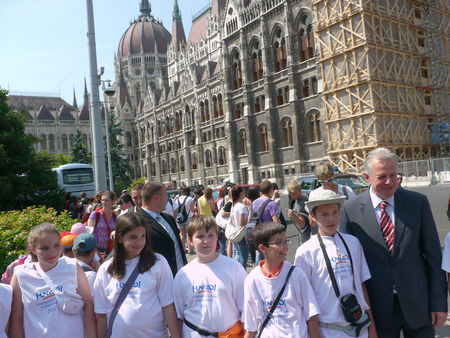
Human Chain for peace and harmony
School children came from up to 300Km away to take part in this special event at Hungary's Parliament. The event was co-ordinated by organisers of the World Harmony Run - founded by Sri Chinmoy to promote peace and understanding around the world.
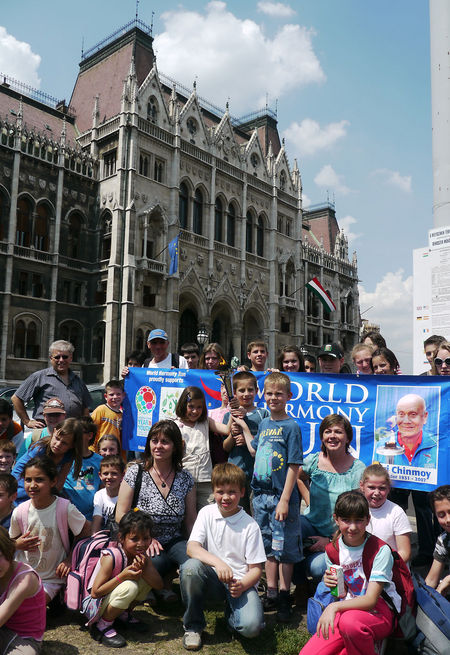
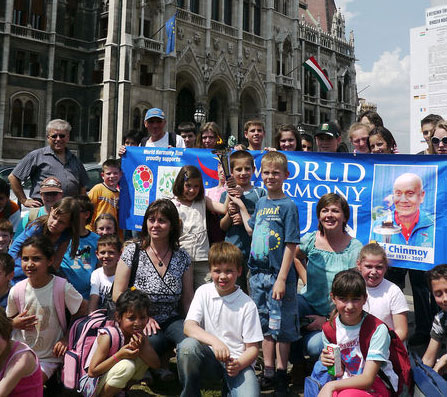
The event was covered by Hungarian TV and the school children were joined by the Hungarian president, Pal Schmitt and Vice-President Balczo Zoltan. During the day, there were many cultural activities based on the theme of harmony.
Peace we achieve
When we do not expect anything
From the world,
But only give, give, and give
Unconditionally
What we have and what we are.
- Sri Chinmoy [1. Sri Chinmoy, Quotes on Peace]
You can read more at Hungary World Harmony Run
Related- Post on World Harmony Run at Sri Chinmoy Centre News
Self Transcendence
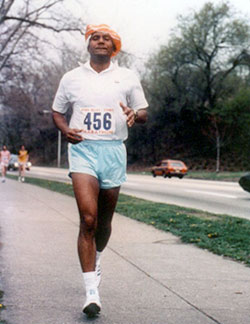
Sri Chinmoy taught a philosophy of self-transcendence - the effort and determination to go beyond our limitations and discover our own inner and outer capacities.
What gives life its value,
If not its inner cry
For self-transcendence?
- Sri Chinmoy [1. Sri Chinmoy, Twenty-Seven Thousand Aspiration-Plants, Part 54, Agni Press, 1984. ]
Through his various prolific activities in fields such as sport, weightlifting, music and writing, Sri Chinmoy is an exampel of how a life of prayer and meditation can increase our inner and outer capacities.
If we believe in our own
Self-transcendence-task
Then there can be
No unreachable goal.
Sri Chinmoy, [2. No Unreachable Goal, Agni Press, 1994. ]
Self-transcendence-joy
Unmistakably knows
No equal.
- Sri Chinmoy, [3. My Christmas-New Year-Vacation Aspiration-Prayers, Part 30, Agni Press, 2004.]
Related- ‹ previous
- 140 of 337
- next ›

Except where explicitly stated otherwise, the contents of this site are licensed under a Creative Commons Attribution-NonCommercial-NoDerivs 3.0 Unported License. read more »
SriChinmoyCentre.org is a Vasudeva Server project.