
Message of Encouragement
Davidson Hepburn, President of the General Conference of UNESCO offered a message of support and encouragement for the World Harmony Run.
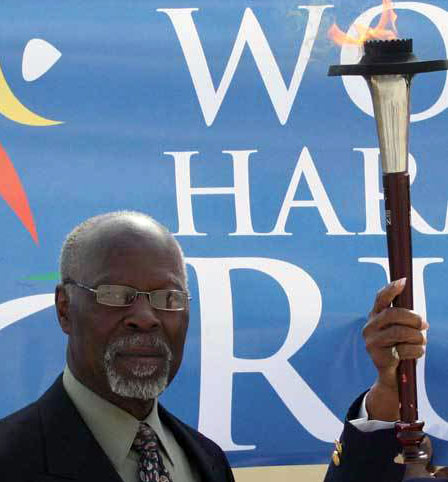
Davidson Hepburn with World Harmony Run torch
Davidson Hepburn offered his appreciation for the values, ideals and activities of the World Harmony Run, founded by Sri Chinmoy.
I note with admiration the many inspirational events supported by the World Harmony Run in over 100 countries during recent years. The Harmony Run Torch, passed from hand to hand, has encouraged millions of individuals to aspire for a world of oneness and peace.
Harmony and peace are not mere "buzzwords". As we look toward the future, I am reminded of the message of my dear friend Sri Chinmoy, founder of the Run, which can strengthen us on our way forward. He said that world harmony and world peace are "the realities, divine realities and supreme realities."
Read More of Speech and Video of Message from David Hepburn at World Harmony Run
Kaivalya Torpy's Statues
Since Sri Chinmoy's mahasamadhi in 2007, Kaivalya Torpy, a student of Sri Chinmoy has produced several statues of Sri Chinmoy which have been placed in different parts of the world.
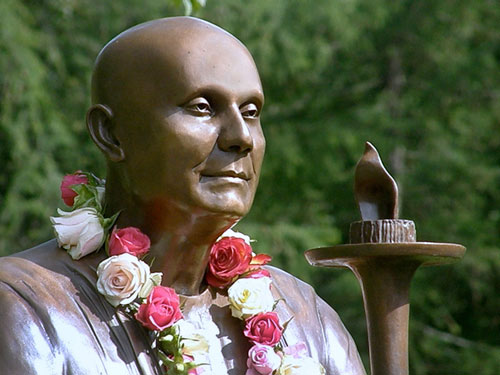
Statue of Sri Chinmoy, Vaasa
Kaivalya is actually a trained scientist who worked as a physics teacher in London. However, encouraged by his Guru, Sri Chinmoy, he become more involved in sculpting several years ago. In this interview he explains how he feels Sri Chinmoy's inspiration as he works on his art.
- Life-Voices 33 Statues of Sri Chinmoy, produced by Kedar Misani.
Inspiration Letters 22
In the early autumn of 2007, I made a pilgrimage to Leonard Bernstein's grave in the Greenwood Cemetery, located in Brooklyn, New York. I had long admired Bernstein as the greatest populariser of classical music in America, as well as a dazzlingly gifted conductor and composer in his own right. The hill where he lies is actually the highest point in New York City. A statue of Minerva stands a few yards from his grave, and bears a plaque that indicates that the plain below was the site of the first battle of the American Revolution, fought on 27 August, 1776. As I stood between Bernstein's grave and the Minerva statue, looking over the vast cemetery and the whole New York City skyline in the middle distance, the final words of Walt Whitman's Leaves of Grass came to me:
The spotted hawk swoops by and accuses me... he complains of my gab and my loitering.
I too am not a bit tamed... I too am untranslatable,
I sound my barbaric yawp over the roofs of the world.
The last scud of day holds back for me,
It flings my likeness after the rest and true as any on the shadowed wilds.
It coaxes me to the vapor and the dusk.
I depart as air... I shake my white locks at the runaway sun,
I effuse my flesh in eddies and drift it in lacy jags.
I bequeath myself to the dirt to grow from the grass I love,
If you want me again look for me under your bootsoles.
You will hardly know who I am or what I mean,
But I shall be good health to you nevertheless
And filter and fiber your blood.
Failing to fetch me at first keep encouraged,
Missing me one place search another,
I stop some where waiting for you.
People who are familiar with Whitman’s poem will be familiar with the passage where Whitman himself stood on that same hill in Brooklyn and reflected on America’s role, past and destiny.
After a few hours of visiting other famous graves, buying rare and precious vinyl from local record stores, and enjoying some excellent thin-crust Brooklyn pizza, I returned to Queens, and made it to the function just as it was concluding. Guru had asked people who had been disciples for more than thirty years to recite an aphorism. I don’t remember any of the poems, except for the last one. A lady who works at the United Nations read out the following poem from Sri Chinmoy’s Ten Thousand Flower Flame collection:
If you are going to save
Something precious for the future,
Then do not forget to put away
A large portion of your gratitude-heart
For the person who has taught you the lesson
Of self-transcendence.—Sri Chinmoy, Ten Thousand Flower-Flames, Part 47
A few days after that, Sri Chinmoy left the body. It struck me how appropriate this poem was, that it was such a beautiful valedictory for Guru. The lady told me that she feels blessed and fortunate to have selected that poem to recite for the Master.
When I think of the theme of “self-transcendence” in my own life, I realise that the most important obstacles for me to overcome are self-doubt, nervousness and fear of the unknown. I am astonished when I think of the many ways Sri Chinmoy has assisted me in crossing these hurdles.
For example, for many years I suffered from an excruciating breathing problem. It was a question of nerves. Doctors told me that if I could just relax, it would go away. Easier said than done! I discovered alcohol helped me to relax to the point where my breathing became normal. But I chose, wisely, not to go down that route!
In late October 1996, I recall sitting in Russian class. The teacher was discussing the proper conjugation of Russian verbs. It was the day before the Philadelphia Peace Concert with Sri Chinmoy, and I was excited because it would be my first opportunity to meet Sri Chinmoy in person, and to feel his physical vibration.
Suddenly, I don’t know from where, or how, but I heard a voice inside of me, saying, “Let it go, let it go, let it go.” And the terrible tension in my chest and abdomen disappeared, and I started to breathe normally. I sat up straight and looked around, smiling. Everyone else was taking notes, and didn’t understand or even notice my epiphany. After the class ended, I sat in the room for a long time, just enjoying breathing without pain. I will never forget the joy that I felt at that moment. I could breathe with perfect freedom. My life has never been the same since then. Sri Chinmoy, through that single action, improved the quality of my life beyond my capacity to express it.
I have always been afraid of getting in cars. I don’t know why. But as a child it caused my parents many problems because I hated getting in the car. I didn’t learn to drive until I was twenty-two. I know that’s really late. I learned to drive because I wanted to attend spiritual functions with Sri Chinmoy in Queens. I overcame my fear of driving so that I could participate more fully in Centre activities, and develop a closer relationship with my Master. I feel Sri Chinmoy’s compassion and grace helped me enormously in becoming a confident and competent driver. For this also, I will always be grateful.
I do not know why I suffered from fear of driving, or the actual inner reason for my breathing difficulties. But I do feel that Sri Chinmoy’s forgiveness and grace entered into my life and nullified many of my problems. It is simply empirical. I am not the person I was before I encountered Sri Chinmoy. I have run five marathons, participated in a cross-continent relay race, have written hundreds of articles, managed a restaurant for several years, and in general possess much more confidence, joy, and peace of mind than I ever felt possible. What else can I say?
Welcome, my friends, to the “Forgiveness” issue of Inspiration-Letters.
Sincerely,
Mahiruha
Title montage: Pavitrata Taylor, Sri Chinmoy Centre Gallery
View: Inspiration Letters as PDF


Bali Revisited
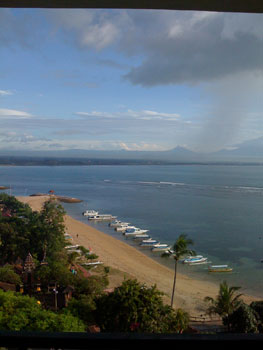 5am and the alarm chirps merrily, nags us out of sleep, out of that stupefaction of first awakening when the peregrine spirit returns to its flesh. ‘Where am I, who am I….?’, lying in the darkness reassembling the pieces before the remembering and the resumption of oneself. Oh yes ‘tis I, swaddled in white sheets in a strange room, daybreak in Bali, vacation, figuring it out, now I remember, yes this life.
Singing our daily songs with croaky voices, Jiban Debata, ‘Oh my life’s Lord Supreme, sleeplessly I invoke You to forgive me today….’ The unburdening song, wiping the slate clean, past is dust. Remembering my parents from the long ago, married for 50 years but not on speaking terms at the end. My mother unforgiving and accusing, burdened by her life’s inventory of regrets, the stinging hail of recriminations, of injustices given and received, the wasted years. My father, unforgiven, unaware that he ever had a wife, amnesia’s mothering gift of innocence and helpless as a lamb. But who are we to forgive?—except perhaps, hardest of all, forgiving ourselves. Only God can forgive, for He alone knows everything.
What I see. Daybreak swallowing the dull, dishevelled stars, then Wednesday’s sun rising from the ocean, flamingo pink, a perfect orb, then reddening behind haze, a bloodied cyclop’s eye. Seascapes blighted by man, oil derricks, a ship left to rot on the reef, humans shrunk by distance to inconsequence, the dove grey sky. The ocean floor’s green meadows, lagoons bared to the sun by the falling tide .
At the grand entrance to the Sanur Bali hotel the three old men, cross-legged and solemn, are still playing the traditional gamelan tunes of welcome as though trapped in some musical limbo, their peaceful wooden flutes and the hypnotic, mantric sounds of their bamboo scales still as enchanting as those many befores—and inside, here are the staff to greet you with their smiles, the tray of iced papaya juice, then the afternoon rumble of thunder.
Outside in the spacious grounds the gardeners are shinnying up the coconut trees, lopping with a single scimitar blow the heavy, hard clustered husks. And on the beachfront the same timeless rituals of the sea, the tide withdrawn and distant; deckchairs groaning under their pink cargo, vacationers ripening like tomatoes in the heat; the green gourds of coconuts with their bright umbrella hats; the consolation of the sun. We seem to have simply slipped back to pick up where we last were: the early run along the tiled beachfront pathway, the old women with their thatch brooms sweeping the streets free of last nights leaves, perhaps the same leaves falling in some mockery of time. And we ourselves still fumbling about with the recurrent themes and burdens of our old familiar selves. Returning is such a clear measure of how far we have come.
After the dawn the humidity quickly rises, the beachfront dogs sprawl listless as corpses, the strolling, indolent tourists perch on stools in the cafes and bars. Bali has a light touch and ‘being’ is more important than doing—the unhurried feeling is a tonic, a space in one’s life to unburden. I sit in my room most of the day like a flawed monk, enjoying solitude, a little reading, a first effort at resuscitating my poor meditations that have been so drowning in the diversions of the world. And summoning my strength again at this dawn of a new year, praying for grace, protection, forgiveness, confronting the infidelities of the mind that bar one always from holiness, looking ahead and dreaming the impossible dreams.
Today at the far end of my morning outward run there is a river, and I stop there and buy a large green coconut from a very simple family. Sometimes when I arrive early they are all in the sea, washing themselves, the women fully clothed—I sit on a plastic stool and drink my coconut juice through a straw. Then a short meditation before the return journey. Someone described meditation as ‘swallowing the sky’ and I like this simple metaphor, one so apt in this great canvas that has only sea and sky, the great brushstrokes of an endless, ever-changing beauty.
In Cancún, Guru gave a similar comment, told us to ask the sky, ‘sky, give me shelter, give me shelter’, and the sky would give us shelter. The family bustles about in their dripping clothes and I sit a little away on the yellow sand, swallowing the sky. Untangling the mind, freeing the captive heart, untying the knots, finding the silent, empty spaces inside for God to enter. When the mind is really quiet, the masks put aside, one’s faces discarded (Elliot’s poem: ‘there will be time / To prepare a face to meet the faces that you meet…’), sometimes only pure consciousness is there, nobody else home, and you realise the self is only an illusion. Behind the walls, nobody there to find—or only an anxious child.
The birthdate of my wife, long gone, comes and goes today, and thoughts of her life and her leavetaking. The loss of those we cared for always leaves a gap, a vacuum, and time does not bring consolation, only distractions and diversions to fill the empty spaces—there is a void that waits like a trapdoor through which we might tumble at any moment. And contending now with my own inventory of regrets, of unkindnesses, harsh words. Hardest of all—the forgiving of one’s own self.
How we gather them up, all the additions and subtractions, the soul’s ledger of gains and losses, and they ferment inside us like a slow wine, linger in the cellars of the mind, their bouquets the aching memories and the pathos. If love too is a gift of God and a mark of our humanity, we are lessened by having no outlet for our love’s many varieties and blooms—as sympathy, compassion, friendship, protectiveness—for we have lost or locked away the brightest light of our hearts. Even Guru as both an avatar and a man was forced to don the human cloak and weep at the loss of family.
What I hear. On a night walk, the rising, falling cadences of bullfrogs. Wind, water, space, the background silences. Sweet melodies, the gamelan orchestra playing for an hour or two its wistful songs. They somehow exude the fragrance and deeper spirit of the place, something perfect and lovely, full of simplicity and purity, issuing from a world of other, subtler sensibilities. The peaceful mantric refrains run like a coda through the days here—if you close your eyes and listen, they will soothe you, charm your heart. The songs tug at your memories and your feelings, not the remembering of outer things from your long stay on earth but the nostalgia for a lost contentment, or the remembering of what you have yet to find, God tweaking the invisible string to draw you back a little to Him.
It seems that most of our spiritual life is like an underground river that flows secretly, deeply, even while up on the surface of the world our life storms rage. The secret life of the soul, the subterranean river—but how to draw its nourishing waters up into the parched wastelands of our unremembering, everyday existence, or hasten its passage, its final merging with the great Sea? So we should not be too hard on ourselves.
The secret life of the soul: in one such turbulent time of my own life, many years ago and because of one of Guru’s forthcoming personal visits, sometimes in the early hours the telephone would ring with enquiries from New York— 3 or 4 am in the morning—and I would often be summoned from some beautiful dream, the adjoining worlds of the luminous soul and the worldly mind so close together. I never would have remembered any of these inner experiences upon later awakening had I not been disturbed from sleep, still able to recall and feel the joyous inner life, the deep inner river, the memory of which even at daybreak had almost faded away.
What I believe. Some private bargain between us and God, a secret and unremembered pact, that if we give up this one thing that we wanted so much, or try a little harder, or do something that was difficult and good, or cultivate the centripetal tug of devotion, lie on a midnight deckchair and summon with our deepest sincerity the personal God out there in that universe of stars, then we will find a sanctuary. Or, when simply worn out by it all and with nowhere else to go, fall into a fit of weeping that brings His hurried footsteps to our side, the whispering of promises. ‘There is not a single shore,’ writes Guru ‘that is untouched by God’s Forgiveness-Feet.’
That God has caught us with an unseen hook and an invisible line which is long enough to let us roam and wander to the ends of the world, yet still He can bring us back with a twitch upon the thread. Or like the image of the tethered goat, free to roam and graze out to the very edge of it’s allotted freedom—once we venture too far, the tethering rope restrains us. Why did He choose to bind us with this care?
What I feel. Heartbeats, the old refrain. The whisperings of the soul, elusive as air. Absence of God, the void waiting to be filled, the long waiting. The long year ahead, beckoning. Something waning, something rising. The tug of unlived lives. The mind’s ceaseless roamings, trawling the desert of the world, the crucifixions of thought. Gratitude and grace. Something smiling inside: a belief there and a hope untarnished. The heart’s quick rush of feeling. The kindling God spark, Guru germinating in my heart, embedded deep like a thorn, deep as love, the binding cord. A mantra, interior and unuttered, far off like a distant church bell. Gratitude and grace. The indifferent earth, the balm of sky.
Something That Changed My Life
One of the most comforting truths in the life of a spiritual seeker is the assurance of God’s unconditional forgiveness. No matter what blunders we may make, no matter what falsehoods we may utter, God will smile them away. He is not a Supreme Court judge, weighing our life in His precarious cosmic scales, throwing with wrathful shafts of lightning and thunder, passing fateful verdicts of gloom and doom. He is a loving Parent, watching His children in their earthly play, running, stumbling, falling, getting up and growing.
It was a profound relief of heart when I discovered that truth in my own fledgling spiritual life. Somehow in my unconscious mind I had arrived at a notion of God as a just, strict and all-knowing Observer of my countless mistakes. Before I got to know God a little better, I thought He would act just like I would, had I been omniscient and omnipotent. So I was wont to project my own self-criticisms on His yet undiscovered, all-benign Nature. And since I struggled with my fair share of issues at the dawn of my spiritual life, I naturally arrived at the unspoken conclusion that God must not have a very high opinion of me. In those days I kind of hop-scotched from one mistake or painful experience to the next, and in the process I imagined His frown growing deeper day by day. If the people around me were any indicator of divine judgement, I would surely be sentenced to a severe penalty very soon.
But what actually happened was exactly the opposite. I was rewarded.
All it took was one deep meditation. Then the door to God’s Love—solid shut for longer than I cared to know—suddenly opened. In a sacred, eternal moment I glimpsed His true, eternal Nature and the everlasting smile of affection he held for me. It was not long after that I read something in one of Sri Chinmoy’s spiritual books that struck me very powerfully:
‘Instead of thinking of God’s Justice-Light, you should just repeat, “My Lord is all Forgiveness, my Lord is all Forgiveness.” While repeating, “My Lord is all Forgiveness,” you must not think of all the countless undivine things that you have done. Only try to see the positive side. Think only of God’s Forgiveness before you, around you and within you. If hundreds and thousands of times you can repeat most soulfully “My Lord is all Forgiveness,” then all your Himalayan blunders will be washed away. All the mistakes you have made over the years, all the ignorant things you have done, will be annihilated.’
—Sri Chinmoy, God Is
I took the advice to heart. For several weeks “My Lord is all Forgiveness” became my one and only mantra. I recited it inwardly, secretly and silently for hours and hours each day.
It changed my life.
My blunders faded to distant memories. Happiness became a close and permanent friend. People started commenting on the changes they saw in me. It made me realise what unimaginable power is in God’s Forgiveness. His Forgiveness is infinitely more than a balm for a guilty conscience; it is a life-changing force that any sincere seeker can invoke to change the course of his or her life for the better—and for good.
Forgiveness and the Nepal Statue
 As a kid growing up in the Midwestern U.S. suburbs, I could be found outside playing in the neighborhood a great deal of the time no matter the season. Whether it was hopscotch, softball, basketball, bike riding, snow fort building, Duck, Duck Goose or Mother May I, endless outdoor pursuits permeate my childhood memories.
One game I loved was called Swing the Statue and it involved a person who would swing each person around and around by the arm and then let go. Once let go, you had to remain frozen in the pose that unfolded from being swung towards the grass and decide silently what kind of statue you were. Then the one doing the swinging had to guess what you were supposed to be.
Now that my childhood days are faded in the past, instead of playing Swing the Statue I visit them—seven of them to be exact. I speak of seven life-size statues (two metres high) cast in bronze depicting my spiritual teacher and World Harmony Run founder Sri Chinmoy. They are cast from moulds sculpted by a British artist named Kaivalya Torpy, himself also a student of Sri Chinmoy. All the statues have been erected subsequent to Sri Chinmoy's passing from the earth plane.
The first of these statues is located in Oslo, Norway along the Aker Brygge port and it stands next to The Eternal Peace Flame—a landmark featuring a continually burning flame shining for peace that was itself created and dedicated by Sri Chinmoy.
The statue in Oslo depicts Sri Chinmoy wearing a dhoti, standing with folded prayerful hands, his eyes looking towards the Eternal Peace Flame. I visited this statue in the fall of 2008 approximately one year after Sri Chinmoy’s passing and my initial reaction was to quietly cry as memories of all the blessings received from Sri Chinmoy when he was still alive flooded my awareness. How many times had I seen Sri Chinmoy standing in precisely this manner with folded hands sharing inner peace, light and devotion as he meditated in silence.
I was overcome by these memories, not because of the statue’s likeness to Sri Chinmoy in meditation with folded hands, but because of how powerfully I felt his inner energy and consciousness imbued within the sculpture. In a sweet and poignant way, this first visit to a statue of Sri Chinmoy sparked an ongoing inspiration to try to see in person the other statues of Sri Chinmoy installed across the globe. Those visits have sometimes coincided with travels already scheduled and have sometimes been planned specifically with the purpose to see a statue installation and dedication. Whether it be Bali, Mexico, Finland or Puerto Rico, each statue seems alive with Sri Chinmoy’s life energy and each one seems to express a different inner essence of his multifaceted life.
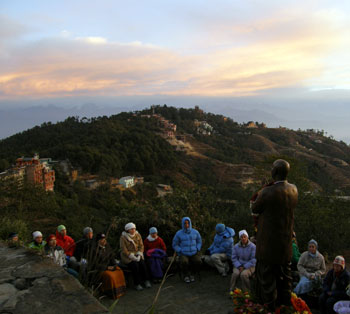
The most recent statue dedication I attended took place while on a two week trip to Nepal in January 2011 with several hundred members of the Sri Chinmoy Centre. During the Nepal statue dedication ceremony, officials (including two former Prime Ministers of Nepal) eloquently shared their own memories of their friendship with Sri Chinmoy and Sri Chinmoy’s contributions to make the world a better place. The setting where the statue is located offers extraordinary vistas of the Himalayas and is located on the grounds of an area where tourists come to view the sunsets and sunrises of the Himalayan Langtan mountain range in the distance.
A few days after the statue was unveiled and dedicated some of us who attended the ceremony decided to return to the hilltop and stay overnight in order to experience the statue during sunrise and sunset. The return to the statue also gave me the opportunity to bring a photograph to the Nepalese woman who lived and worked nearby who had spontaneously had her picture taken alongside me during the day of the statue ceremony.
Perhaps because I was still jet lagged from the 11 hour time difference between Nepal and my home in the U.S., I woke up shortly before 4:00 am the morning we anticipated we would gather at the statue to share a 6:00 am meditation followed by the sunrise at 6:50 am. Immediately thinking that I might never return to Nepal ever again, I seized the opportunity to bring my wakefulness outside to the foot of the statue instead of inside the hotel room of the grounds where the statue was near.
Bundled up in many layers for warmth, I found my way out of the hotel and to the foot of the statue which was underneath a canopy of a brilliant starlit sky. With electricity somewhat of a luxury in Nepal, the vista afforded a magnificent view of the night sky unmarred by the light pollution so prevalent in many industrialised locations.
As I sat on the ground across from the statue, my inner experiences were many-layered. I kept feeling that although I was alone at the statue in those wee hours of the morning it seemed that I was not at all alone. I imagined that the spirit of Buddha could be nearby with the statue’s location in the country where Buddha was born. My ruminations turned to Shiva as well after I spontaneously imagined that I was smeared with ashes and dust to try to set aside the ego and human personality and let divine essence fill me. The Himalayas are the legendary dwelling place of Shiva, Mt. Kailash in particular, so I was not surprised when thoughts of Shiva entered my inner awareness.
Eventually, the presence of others became a fact and not my imagining as other students of Sri Chinmoy arrived for an early morning meditation at the statue. Tourists arrived as well shortly before sunrise.
Even though my solo meditation at the foot of the statue was unforgettable and truly special, I felt as if I reached my inner spiritual summit when I was seated on the ground alongside the statue with about forty of Sri Chinmoy’s students. Together we sang some songs composed by Sri Chinmoy that are especially significant to us, starting with The Invocation. After singing for about five or ten minutes, I felt an inner prompting to start singing a Bengali song about forgiveness written by Sri Chinmoy called Jiban Debata. Sri Chinmoy’s English translation of the song states,
“O my life’s Lord Supreme,
Sleeplessly I invoke You
To forgive me today.
O great One, O world’s Reality-Salvation,
May I be fully awakened
In purity’s auspicious dawn.”
I poured my heart and soul into singing this song that I had often heard Sri Chinmoy sing in public concerts with great intensity and soulful power. I looked straight up towards the statue while singing this song about forgiveness since I was sitting to its right facing in the same direction as the statue. I had moved over there after people started arriving, figuring that I had already had ample opportunity to sit directly across from it earlier that morning.
While singing Jiban Debata and looking straight up at the statue with eyes wide open, to my utter astonishment the face of the statue came to life and I saw the lips move and the nostrils and eyes of the statue come to life as well. By coming to life, I do not mean that the face of the statue transformed into an image of Sri Chinmoy’s actual face. Rather the visage started to move as if the bronze nostrils were breathing, the bronze lips were moving and the bronze eyes were blinking.
Almost as quickly as it happened, the moment was over. What it left with me with was a renewed appreciation for the importance of forgiveness in the lexicon of Sri Chinmoy’s message to the world. Out of the varied inner experiences I tasted during an overnight stay to visit the Nepal statue of Sri Chinmoy, the one that towered over all the others was cloaked in the invocation of forgiveness.
One can find this centrality of forgiveness in Sri Chinmoy’s philosophy throughout his writings and composed songs. In his book What I Need from God written in 1982, Sri Chinmoy describes the significance of God’s forgiveness in the life of a seeker with the following words,
If someone asks you your name, you will say, “My name is my Lord’s Forgiveness.” If someone asks who you are, you will say, “I am my Lord’s Forgiveness.”
This will be your only credential. In the ordinary life people have many credentials. They have this university degree, that degree and so on. But a spiritual seeker will say that he has only one credential. He will say either “I am my Lord’s Forgiveness,” or “I am my Lord’s Compassion,” or “I am my Lord’s Love.”
-Sri Chinmoy, What I Need from God.
Now whenever I sing or hear the song Jiban Debata, I will remember the morning in Nepal that a statue came to life before my very eyes while singing that song. And I now carry inside a deeper feeling of awe and respect for the significance of forgiveness as a ladder to bridge my own life with that of the highest Himalayan spiritual heights. How fitting that I was blessed with this miraculous experience while surrounded by the Himalayas themselves.
Forgiveness
Some of the dictionary definitions of the word ‘forgiveness’ are:
“To pardon an offense, to cease to feel resentment towards someone, to cancel an indebtedness or liability”.
In Sri Chinmoy’s own words, from one of his many poems and comments on forgiveness, he writes:
On earth, forgiveness is a sweet experience, a necessary realisation. Forgiveness is the expansion of one's reality-light and divinity-height.
In Heaven, forgiveness is a supreme necessity. The cosmic forces at times unnecessarily lord it over us. They exercise their power on earth beyond necessity.
In God, forgiveness is the living Breath that transcends itself each time it is used.
Sri Chinmoy, Silver Thought-Waves, Part 1
Here we see many levels of forgiveness. Sweetness, necessity and transcendence are three key elements embodied in the experience of forgiveness.
For me, the most important element in ‘forgiveness’ is the word ‘give’. This word in and of itself holds the true essence of forgiveness. ‘Giving’ is an offering of part oneself, a yielding to the will of others. With a sense of oneness, sympathy or empathy we allow our own personal ego to give up some of its sense of separativity in order to bring more peace and light into a situation. This is indeed an important step into what Sri Chinmoy refers to as ‘God-becoming.’
Forgiveness is the seeker's immeasurable accomplishment in both the world of self-giving and the world of God-becoming.
Sri Chinmoy, Four Hundred Gratitude Flower-Hearts.
This can be a very difficult thing to do for most human beings, especially when we are not in a spiritual consciousness or in a mood to give. This is when we need to take the help of what Sri Chinmoy refers to above as ‘the expansion of one’s reality-light and divinity-height’.
In our normal day-to-day human consciousness without a higher light or a divine aspect of our lives it is difficult to forgive. But when we learn how to expand our consciousness beyond the limited confines of the mundane human consciousness, then forgiveness comes much more easily for us.
This experience becomes a sweet experience which was transformed from what could have been a very bitter experience. If the power of forgiveness can change something from bitter to sweet, then why not try to exercise this power as much as possible? To make it more possible to do so, we have to learn how to expand our consciousness to bring in more light and divinity into our lives. Meditation will certainly expedite this process and allow forgiveness to grow inside us.
A true Spiritual Master of the highest order is an embodiment of this Divinity and Light, therefore they exercise the highest forgiveness most of the time, at least when it is most helpful in allowing their spiritual children to make spiritual progress. Other times justice-light may prevail in order to teach us lessons in transforming our old habits and our limited human understanding.
When humans exert their justice power over others there may be no forgiveness present. When we are in a human justice consciousness we tend to forget all about forgiveness. But in God’s Justice there is still forgiveness. According to Sri Chinmoy:
Another name
For God's Justice
Is constant Forgiveness-light.
Another name
For man's justice
Is continuous forgetfulness-night.Sri Chinmoy, My Promise To God
In God’s justice we also see compassion and illumination, which can be an aspect of forgiveness as well.
“God’s Justice-Light
Does not punish us—
God’s Justice-Light
Compassionately illumines us.”Sri Chinmoy, Seventy-Seven Thousand Service-Trees, Part 45
So in learning about the very important quality of forgiveness, we also learn about compassion and illumination. Even in justice there can be forgiveness, for in the end the goal is to transform our nature and allow us to become illumined in our human consciousness as we make progress towards our divine consciousness.
Finally, in learning the important quality of forgiveness and the act of forgiving others, we also need to learn how to forgive ourselves. This will bring us true happiness as we try to understand ourselves and understand God in our lives.
According to Sri Chinmoy, if we can forgive ourselves we will be able to feel God dancing inside our own meditation-heart. This is truly a goal worth striving for in our spiritual life here on earth.
Forgive the world. The world will sit at your compassion-feet. Forgive yourself. God will be dancing inside your meditation-heart.
Sri Chinmoy, Four Hundred Gratitude-Flower-Hearts
That Final Quality of Greatness
He is, quite possibly, Australia’s favourite war hero.
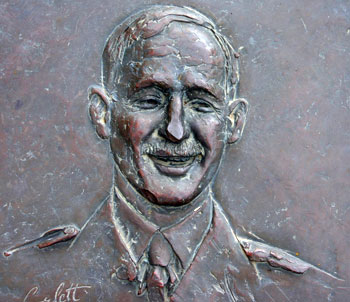 Like most nations, Australia takes pride in its military victories (and more than most, its military defeats). Still, Edward Dunlop was not a fighter. He was not a dashing pilot, or a magnificent combatant. He never became known for the feats of derring-do that other glorious war heroes might exhibit. His most famous, courageous moments were as an inmate in a prisoner-of-war camp (and no, he didn’t make any dashing escape, using a wooden horse or anything else). He is even known to Australians by his nickname: “Weary”. Not the most inspiring epithet. As he worked tirelessly, it didn’t really suit him. Indeed, it was given to him by university friends. It was a pun on his surname. Dunlop equals tires… which sounds like “tired”… which equals “weary”. Perhaps you had to be there. Strangely, the name stuck.
Much of his story is more typical of war heroes. As a child during World War I, he had been inspired by the Australian soldiers and wished that he could serve his country in the field of war. Sadly, his wish would eventually be granted. In 1939, when World War II broke out, he was a 32-year-old surgeon. He joined the Medical Corps of the Australian Army, and for two years, set up hospitals and medical resources in the Middle East.
Along with many Australian troops, Weary was moved out of the Middle East to protect Australian territory from the approaching Japanese Army. In Java, just north of Australia, he was made a colonel, taking command of Bandoeng Hospital.
Not the safest place to be. As the Japanese troops advanced, the situation seemed more and more hopeless. Weary ensured that patients and non-essential staff had the chance to escape, but as more patients arrived, the hospital itself had to keep functioning. On 27 February 1942, it was captured. Weary did not desert his post. That was his position: not a fighter, but a healer.
Over the next three years, he would be a prisoner-of-war at nine different prison camps. His leadership qualities were recognised by the British and Australian officers, also living behind the barbed wire, and he was appointed camp commander, in charge of the health, discipline and morale of 800 troops.
In war, of course, the rules of humanity can be discarded. Hence, Weary’s humanity faced its greatest challenge in the prison camps. Interned in the camps, the men were fed only rice. Most lost a third of their body weight and suffered from chronic illness. After some time, Weary suffered an emotion he vary rarely knew: hatred. Hatred to the Japanese soldiers, as they allowed their fellow human beings—including Weary himself—to slowly wither away.
Though starvation could not be prevented, his allegiance the Hippocratic Oath meant that Weary had to do all he could. Under his direction, education and entertainment programs were set up, and inventive ways were found to improve the camp diet.
By the end of the year, he was placed in charge of a group of prisoners who had been sent to Thailand to build the Burma Railway, a 420-kilometre railway line through thick jungle. The prisoners—despite sickness, starvation and squalor—were forced to work 10-hour days in intense heat. Every day, Weary would argue with his captors to give light duties to the ill soldiers. He forced himself to remain strong and disciplined—an inspiration to the prisoners—and was often tortured or beaten for speaking out on their behalf. He hated the guards. It was not something that he could control.
The surviving servicemen were finally released with the end of the war in 1945, but many of them would never regain their health. For many decades, the physical and psychological bruising would define these men. However strong, however, heroic they were, it was something they could not control. But once again, Weary remained strong. His secret? It was something else that he was somehow able to muster.
Forgiveness
Despite the beatings, the torture, the starvation, he could bring himself to forgive. Not just the Japanese people (most of whom, of course, were entirely innocent), not just the Japanese forces, but every architect of the conflict, ever leader who brought the world to war. How he could find this forgiveness was astounding to most people who had lived through the war, either on the field or at home, waiting for the their world to end.
Weary had hated the Japanese as much as anyone during his imprisonment. But inside himself, he was able to forgive them after the war. This forgiveness meant that the war left him deciding not to seek revenge, but to devote his life to helping others. He continued his medical practice, and was involved at one time with 40 different social aid organisations, improving the lives of civilians just as he had done for servicemen.
Many times during the war, he had revealed a penchant for greatness. His leadership qualities, his strength, his courage, his compassion, his devotion to duty… all would define him as one of Australia’s great military heroes. But his unexplainable capacity for forgiveness, revealed after the war, proved he was something even greater.
Here, he went from the incredible to the nigh impossible. Men and women can be no greater than that.
Forgiveness Heartbeat
 I have learned not to call my brother ‘Your Excellency’. He does not appreciate it.
But, on those rare occasions when I get an email from … His Excellency, it says at the bottom, amidst a long tirade of small print, ‘this email message is not necessarily the official view or communication of the Ministry’.
Since the email message is generally shorter than the disclaimer and reads ‘Hello dear brother. Next week I will be in your city attending a meeting on the human rights of indigenous peoples. Wondered if you would be free to meet for dinner and a chat on Thursday night? Cheers meanwhile, MJ,’ I have never actually been in any great doubt as to whether or not the message were the official view of the Ministry.
However, all that small print has its use, and I intend to borrow it to begin my thoughts on forgiveness.
The ideas on forgiveness expounded below are not necessarily the official view of … anybody. They are perhaps not even my own official views. I hope that you will forgive any inadequacies in the formation or expression of these ideas.
*
Perhaps it was the day that I got His Excellency’s email at work that I was later sitting in traffic on the South Western Motorway on the way home looking out at the gloom, the stalled traffic, the grey rain knitting sky to tarmac. It was then that I decided I would definitely take up the opportunity of another trip to southern Africa.
And so it was that I found myself approaching Nata.
*
Mile after burnt mile brings one to Nata. The land—shall we call it savannah, shall we call it pan, shall we call it desolate wasteland? Dry, dead, thin trees reach up from the dust—to the horizon and beyond. And beyond that, even such meagre life fades away into parched desert.
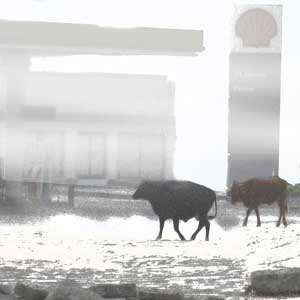
When one finally gets there, Nata is hot and dusty. The sky is grey with heat. The air presses in around one with enervating force. Dust. Dust lies everywhere. Dust coats the desiccated palms. The dust moves only in little spurts beneath the hoofs of somnambulant cattle beasts. The cattle wander, heads down, lost in ancient, surrealist dreams of dusty, sunbaked wastes, flanks dull with thirst.
These dead trees, this dust, these cattle—they have a timeless permanence, a solidity, a veracity. The one thing that seems ephemeral in this lost place beyond time is the petrol station. One feels that the great, black bull might walk right through its walls as if they were merely a mirage; that, if one looked hard enough, one could see the horizon through the building as if industrialisation, the exploitation of hydrocarbons, wars for oil, had never existed. It has a lack of substance in this timeless realm.
Much more substantial than the ephemeral petrol station are the baking, canvas rows of the refugee camp outside the town.
It was by the shimmering, illusory walls of the Nata petrol station that we met the refugee. I do not remember his name. No one wants to remember the name of a refugee. No one wants to remember that he exists at all. I do remember the small, wooden giraffes which he tried to sell us, but who wants a wooden giraffe?
We talked for a long time.
When the goons arrived at his home and threatened to kill his family he had left his home and walked through the dusty wastes. He had crossed the border deep on the bush and arrived at Nata. Home now a tent, he could walk each day the 5 km to the petrol station with his three wooden giraffes and hope someone would stop.
The world is an imperfect place. I may pass through Nata: the man with no name and no family must stay there with only three jaunty, but ultimately tragic, wooden giraffes.
*
I saw God once. Perhaps that would be a more impressive claim if I had been awake at the time, but dreams may whisper of realities we miss in our wide-eyed daytimes.
And God was a heartbeat—a pulsing heartbeat suffusing everything.
And is it not the case that the beat of the heart is found deep down behind existence? The systole and diastole the green-clad, scrubbed physicians call it—the inflowing, the outflowing; the drawing in, the flowing out; the contraction, the expansion. Deep down, behind the atoms, behind the galaxies, behind the people and the animals and the rocks—that setting out, that return, plays out its endless rhythm.
Love, the saints and savants tell us—that is what it is. It flows out, it flows back. It flows out as a love that creates the cosmos, it flows back as a love tinted with gratitude and aspiration for union. The perfect rhythm of divinity.
And imperfection does not destroy that rhythm.
As we stand sweating beside the petrol pumps at Nata with a nameless and lost man, the imperfection of the world seems too great. But here too that play of life continues. Where that great outflow meets imperfection it does not cease, it simply changes its colour—it flows as that shade of love we call forgiveness. How could mankind survive if the life of divinity did not flow ever outward as forgiveness?
Sri Chinmoy spoke of meditation as an exchange. God gives us what He is—Bliss, Perfection, Light. We give God what we have—our own ignorance.
Thus we can live. Thus all the victims and the perpetrators of political madness in the lost and desiccated, forgotten lands of Africa can live.
Where outflowing love finds no imperfection it need not be forgiveness.
When Nata is a walled garden, a Persian paradise under which water flows, bedight with an efflorescence of pomegranate and walnut, the scent of orange blossom sweet on the air and the play of watery fountains delighting the ear and eye; when men do not hound others from their homes; when men do not flee their homes in fear, but live rather in perfect amity, perfect oneness, perfect peace; when that day comes—as come it must—even God will forget about forgiveness. Love will flow as love alone in a perfect heartbeat.
I Forgive You
by Tom McGuire
“I forgive you”. These three little words hold magic power.
Christmas Day. A crazed relative entered the house of my father, furious at some perceived wrongdoing. Leaping over a fence and smashing open the glass door with a white plastic table, she started pulling shards of glass from the doorframe and throwing each one like a knife into the house. Children bolted upstairs, while my father and I restrained the assailant until the police arrived.
Before the judge. Sharp-eyed lawyers lay clever traps for the unwary witness, weaving webs of doubt to obscure the truth. Not enough evidence, they say. A get out of jail free card is issued. There is whispered talk of interference and foul play behind the scenes. The wheel of justice has turned.
A dream. The protagonist in this violent drama lies frozen in a block of ice, trapped deep in its cold, cold clutches. I suddenly realise that the choice is mine—do I leave her there? A wave of sympathy overtakes me and I release the ill will, the desire for retribution. It is right then that the ice melts away, freeing its inhabitant. It is forgiveness that melted away the ice.
We have all committed wrongdoing at some point in our lives, and so we are all in need of forgiveness. To forgive is to hasten the healing process when damage has been done. To forgive is divine, as the great teachers remind us. Sri Chinmoy tells us, with his trademark wisdom, that if we pray to God with the feeling that He is all Forgiveness, then “All the mistakes that you have made over the years, all the ignorant things that you have done, will be annihilated.” If God is so ready to forgive us, then can we not extend this same attitude to others? We can and should, because forgiveness paves the way for happiness.
Forgiveness

I don’t ‘get’ a lot of Paul Simon’s lyrics. Even in his Simon and Garfunkel days he used a lot of private language. In his more recent songs, he uses nothing but personal references and quotations from books I’ve never even heard of. Surprisingly, that’s one of the things I like about his work—I like the fact that I can enjoy the songs without knowing exactly what they mean.
I like the opening ballad of The Rhythm of the Saints a lot—it is so simple, so lyrical and touching. Take the lines:
Some people say a lie is just a lie is just a lie
But I say the cross is in the ballpark
Why deny the obvious child?
That reminds me of a poem by Sri Chinmoy from Transcendence-Perfection:
Down the road of hope
I sported with you today—
I shall not deprive
The divine child within me
Of anything, any day.
The spiritual life is a long, arduous journey, as the Vedic seers have said (sharper than the point of a knife, difficult to tread).
When I think of the line: “the cross is in the ballpark” I realise that the cross is a symbol of suffering, but also of spiritual attainment. The ballpark implies risk—we play games precisely because we do not know the outcome. So, taken as a whole “the cross is in the ballpark” may mean that to accept the spiritual life means to take a big risk, to take a brave plunge into the unknown. The spiritual life always demands tremendous courage. To exercise forgiveness and generosity takes great inner strength. No risk, no reward.
Shakespeare’s King Lear proposes a similar moral ideal. At the end, all the main characters die—both the good and the bad. A cynical interpreter might say that indicates nothing really matters. But I think Shakespeare shows how egotism brutalises just as love humanises. Take one of King Lear’s last great speeches, after he and his faithful daughter, Cordelia, have been apprehended by the enemy and are about to be sent to jail and, unbeknownst to them, execution:
King Lear
No, no, no, no! Come, let's away to prison:
We two alone will sing like birds i’ the cage:
When thou dost ask me blessing, I'll kneel down,
And ask of thee forgiveness: so we’ll live,
And pray, and sing, and tell old tales, and laugh
At gilded butterflies, and hear poor rogues
Talk of court news; and we'll talk with them too,
Who loses and who wins; who's in, who's out;
And take upon's the mystery of things,
As if we were God's spies: and we'll wear out,
In a walled prison, packs and sects of great ones,
That ebb and flow by the moon.
I don’t know if Shakespeare believed in God or in an afterlife. But he did believe in virtue, and that honesty and humility were fundamental to real happiness. I think this speech shows Shakespeare’s personal values in a very sweet way.
Johann Sebastian Bach was a pious Lutheran believer. His music is full of spirituality. There’s a moment in the St. Matthew Passion of Bach when time absolutely stands still. It’s when Jesus holds up his wine cup and says that, from this moment on, he will never take unto his lips the fruit of the vine, until “I will be able to drink it new with you in my Father’s Kingdom”. Bach sets these words to a dance melody, maybe a quick sarabande. What strikes me is not only the beauty and majesty of Bach’s articulation of these words, but also his capacity to express Christ’s unconditional love and forgiveness for his spiritual children.
I like the spare, heartfelt aria that immediately follows this speech. It’s uttered from the perspective of a devotee:
Soprano
In truth my heart in tears doth swim,
That Jesus doth from me depart,
But I am by his Testament consoled:
His Flesh and Blood, O precious gift,
Bequetheth he to mine own hands now.
Just as he in the world unto his people
Could never offer malice,
He loveth them until the finish.
To cross genre boundaries, let me say that I am extremely fond of the last scene of Moby Dick. In that final section of the novel, the White Whale, fatally wounded, has dragged Ahab off the boat into the ocean, and has also destroyed the Pequod. As the boat sinks, with all its crew, one of the “pagan harpooners,” Tashtego, a “red” Indian, nails the ship’s flag to the highest mast, and continues doing so, even as only his arm is left sticking out of the water, still furiously hammering at it. I like that image of the red arm and hammer. The colour red here symbolises blood, or the giving of oneself in the absolute fullest measure. The hammering of the flag may mean that the crew forgives Ahab for leading them into death. They are grateful for the great adventure, and the chance to give their all to a great cause, however bizarre and quixotic.
In one of Guru’s earliest books, My Yogi-Friends, My Avatar-Friends, he depicts the sometimes light-hearted fun that he enjoys with God, and with other spiritual Masters. The last sentence of each chapter, however, features Guru conversing with God as a fervent, prayerful devotee. At the end of the first chapter, after he and God have exchanged cute jokes about how they each have different versions of their first meeting, he says to God, ”You are my Lord of immediate Forgiveness, You are my Lord of eternal Concern, You are my Lord of constant Compassion.”
The sweetness and the intimacy of those words are simply breathtaking, and show how deeply and profoundly Sri Chinmoy embodied the qualities of love, compassion and forgiveness.
Quotes of Sri Chinmoy
A new collection of Sri Chinmoy's quotes at Sri Chinmoy Centre.
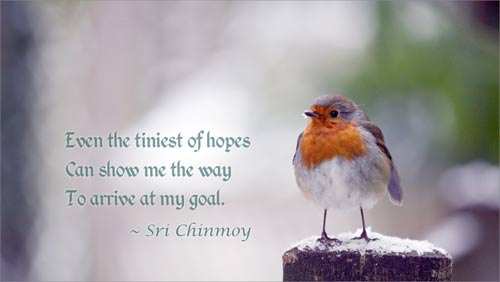
Even the tiniest of hopes
Can show me the way
To arrive at my goal.
- Sri Chinmoy [1. Sri Chinmoy, Twenty-Seven Thousand Aspiration-Plants, Part 243, Agni Press, 1998. ]
Related- When the power of love replaces the love of power
- Aphorisms at Sri Chinmoy Poetry
- Seventy-Seven Thousand Service-Trees
photo and artwork - Pavirata Taylor
quotes 2
Quotes on Peace
A moment's truth
Can and shall make the world beautiful.
A moment's peace
Can and shall save the world.
A moment's love
Can and shall make the world perfect.
Sri Chinmoy 1
World-peace
Can be achieved
When the power of love
Replaces
The love of power.
- Sri Chinmoy 2
"No price is too great to pay for inner peace."
- Sri Chinmoy 3
"If you have inner peace, nobody can force you to be a slave to the outer reality."
- Sri Chinmoy 4
If we can invoke Peace and then offer it to somebody else, we will see how Peace expands from one to two persons, and gradually to the world at large.
- Sri Chinmoy 5
- more: Quotes on peace
Quotes on Life
"To be true to oneself is the hardest test of life."
- Sri Chinmoy 6
"Life is effort." So says the body. "Life is blessing." So says the soul.
- Sri Chinmoy 7
Life is given to each human being
For a very special purpose.
This secret each human being
Must discover for himself.
- Sri Chinmoy 8
I did not come into the world
To prove anything.
I came into the world
To love everyone
And everything.
Sri Chinmoy 9
Quotes on Love
"Hatred is a disguised form of love. You can only hate someone whom you really wish to love, because if you were totally indifferent to that person, you could not even get up enough energy to hate him."
- Sri Chinmoy 10
"If you really want to love humanity, then you have to love humanity as it is now."
- Sri Chinmoy 11
"Life is nothing but the expansion of love. We can cultivate divine love by entering into the Source. The Source is God, who is all Love."
- Sri Chinmoy 12
"Man is by nature a lover. Only he has yet to discover the real thing to love. This quest awakens him to the fulfillment of his real Self."
- Sri Chinmoy 13
"When your love is pure or spiritual, there is no demand, no expectation. There is only the sweetest feeling of spontaneous oneness with the human being or beings concerned."
- Sri Chinmoy 14
Love is not a thing to understand.
Love is not a thing to feel.
Love is not a thing to give and receive.
Love is a thing only to become
And eternally be.
- Sri Chinmoy 15
"Love
Is never afraid
Of fear.Fear
Is always afraid
Of love"
- Sri Chinmoy 16
True, this world of ours is full of hatred and disbelief, but that is no reason why we should not love and why we should not believe. We must love and believe in order to empty the hatred-sea.
- Sri Chinmoy 17
Quotes on Hope

Hope is Eternity's slow, steady,
Illumining and fulfilling height.
- Sri Chinmoy 18
- Related: Short poems on Hope
Quotes on God
God is beyond definition. But according to one's own vision or receptivity, one will define God in one's own way. Some will say that God is all Love. Others will say that God is all Power. Each one will see God according to his own necessity, his own receptivity and, finally, according to the way God wants him to see the ultimate Truth.
- Sri Chinmoy 19
There is no yawning gulf between man and God. Through his aspiration and meditation, Man can become conscious of his oneness with God.
- Sri Chinmoy 20
Everybody has God inside, but not everybody is able to see God within. One can see God only when one cries for Him. Those who cry for God and pray to God can realise God.
- Sri Chinmoy 21
Quotes on Religion
"There is no fundamental difference between one religion and another, because each religion embodies the ultimate Truth. Each religion is right, absolutely right, because each religion conveys the message of Truth in its own way."
- Sri Chinmoy 22
Man-made religions find fault with one another, whereas God-made religion is eternally a oneness-song — God-manifestation through human aspiration on earth.
- Sri Chinmoy 23
"If we live in our oneness-heart, we will feel the essence of all religions which is the love of God. Forgiveness, compassion, tolerance, brotherhood and the feeling of oneness are the signs of a true religion."
- Sri Chinmoy 24
Quotes on Gratitude
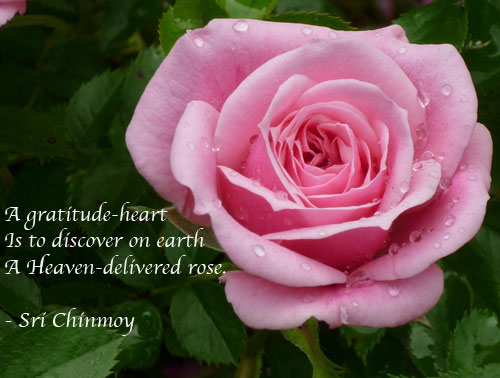
A gratitude-heart
Is to discover on earth
A Heaven-delivered rose.
- Sri Chinmoy 25
"Gratitude is not a mere word; it is not a mere concept. It is the living breath of your real existence on earth."
Sri Chinmoy, Sri Chinmoy Answers, Part 1, Agni Press, 1995.
- Sri Chinmoy 25
Quotes on Compassion
"Be kind, be all sympathy, for each and every human being is forced to fight against himself."
- Sri Chinmoy 26
Quotes on Meditation
What is meditation? Meditation is our conscious awareness of something vast and infinite within us. Meditation grants us Peace, Light and Bliss.
- Sri Chinmoy 27
" Meditation speaks. It speaks in silence. It reveals. It reveals to the aspirant that matter and spirit are one, quantity and quality are one, the immanent and the transcendent are one. It reveals that life can never be the mere existence of seventy or eighty years between birth and death, but is, rather, Eternity itself."
- Sri Chinmoy 28
More Quotes on meditation by Sri Chinmoy
Quotes on Music
“Music knows no frontiers.
It is free all-where.
Its contribution to emotional integration,
Human and divine,
Can never be fathomed.”
- Sri Chinmoy 29
Music is the language of God. God's language, music, is not like mathematics or geometry. It is a language of love. If we love music, that is enough.
- Sri Chinmoy 30
Quotes on Spirituality
Spirituality is man's conscious longing for God. Spirituality tells us that God, who is unknowable today, will tomorrow become knowable and, the day after, will become totally known.
- Sri Chinmoy 31
Spirituality tells the seeker not to live in the hoary past, not to live in the remote future, but to live in the immediacy of today, in the eternal Now.
- Sri Chinmoy 31
Spirituality means
A seeker's attempt to be better
Then he was yesterday.
- Sri Chinmoy 32
Science has the capacity to show mankind the full development of the mental life. Spirituality has the capacity to show mankind the possibility and inevitability of the life beyond the mind, the supramental life.
- Sri Chinmoy 33
Spirituality is the science that teaches us how to achieve peace of mind and supreme satisfaction. Right now we are hankering after many, many things, but nothing we get satisfies us. Spirituality tells us that satisfaction can be found only if we lead a good and divine life-a life of simplicity, purity and humility.
- Sri Chinmoy 34
Inspirational Quotes
The very nature of kindness
Is to spread.
If you are kind to others,
Today they will be kind to you,
And tomorrow to somebody else.
- Sri Chinmoy 35
We must every day try
To love the essential
And not the superficial.
- Sri Chinmoy 36
I do not pray for a safe road.
I pray for infinitely more courage
Than I now have.
- Sri Chinmoy 37
Always it is a great encouragement
To feel and realise
That the ultimate Truth
Can never, never tolerate
Human deception-night.
Sri Chinmoy 38
Quotes on the World
"Is the world so unbearable? No! What we need is only a little more love for the world."
- Sri Chinmoy 39
You and I create the world by the vibrations that we offer to the world.
- Sri Chinmoy 5
“Only by our positive thinking,
By our bringing the positive qualities
Of others to the fore,
Will this world be able
To make progress.”
- Sri Chinmoy 40
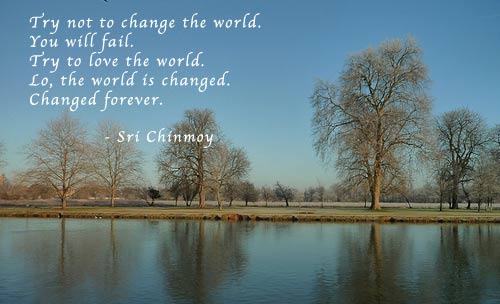
"Do you want to change the world?
Then change yourself first.
Do you want to change yourself?
If so, remain completely silent
Inside the silence-sea."
- Sri Chinmoy 41
Quotes on Joy / Happiness
"If I have just one aim,
And if that aim is to be myself,
Then I am bound to discover joy,
True joy, eternal joy."
- Sri Chinmoy 42
Be happy
You will get
What you like most.
You will be
What you like best.
- Sri Chinmoy 43
Do you want to be always happy?
Then give up fighting
For negativity
And learn the beautiful art
Of self-encouragement.
Sri Chinmoy 44
Happiness means
The simplicity
Of life.
Sri Chinmoy 45
Smile, my friends, my soulful friends, smile. Let us smile. True, this world of ours is full of suffering and excruciating pangs, but that is no reason why we should not smile.
Sri Chinmoy 17
Quotes on Self-Giving
"My life is only half full
When I receive.
My heart is completely full
Only when I give."
- Sri Chinmoy 46
"Every self-giving effort
Of every human being
Is needed to change
The fate of the world."
- Sri Chinmoy 47
And in self-giving we become really happy. Real humility is the expansion of our consciousness and our service.
- Sri Chinmoy 48
Quotes on Self-Transcendence
“I compete only with myself, and I try to become a better human being. This is my goal.”
- Sri Chinmoy 49
"I do not give up,
I never give up,
For there is nothing
In this entire world
That is irrevocably unchangeable."
- Sri Chinmoy 50
“What gives life its value if not its constant cry for self-transcendence?”
- Sri Chinmoy 51
The soul teaches the body
Never to accept
Any limitation.
- Sri Chinmoy 52
"Who is the winner? Not he who wins but he who has established his cheerful oneness with the result, which is an experience in the form of failure or success, a journey forward or a journey backward."
- Sri Chinmoy 53
Quotes on Death
Whatever dies really does not die.
We see it not;
Therefore
We feel that it has died.
Death is only another shore
Of the Reality-sea.
Death is only another way
To God-Reality's Shore.
- Sri Chinmoy 54
We fear death, the unknown.
Death fears us, the unknowable.
We fear death's necessity.
Death fears our Divinity.
- Sri Chinmoy 55
Death is not the end. Death can never be the end. Death is the road. Life is the traveller. The soul is the guide.
- Sri Chinmoy 56
Quotes on Progress
"What comes to me unmistakably is what I carefully 0r carelessly invite."
- Sri Chinmoy 57
I do not compete
With the rest of the world.
I compete only with myself,
For my progress is my true victory.
- Sri Chinmoy 58
Do not cherish suffering. Don't act like a fool. Don't think that your suffering is going to accelerate your spiritual progress.
- Sri Chinmoy 59
What is realisation? Realisation is my conscious and constant sailing with my Inner Pilot in His Golden Boat towards the uncharted land, where sooner than at once beauty, divinity and Immortality seeds grow into the richest harvest.
- Sri Chinmoy 60
Arise, awake! This path is arduous. So we learn from the wise, and we have to follow in the footsteps of the wise. The path of spirituality is not a bed of roses. But neither is it a chimerical mist. The Golden Shores of the Beyond are not a mere promise. The crown of human aspiration is bound to be fulfilled on the Golden Shores of the Beyond.
- Sri Chinmoy 61
Quotes on Consciousness
Paradise is not a place; it is a state of consciousness.
- Sri Chinmoy 62
Consciousness is the inner spark or inner link in us, the golden link within us that connects our highest and most illumined part with our lowest and most unillumined part. Consciousness is the connecting link between Heaven and earth.
- Sri Chinmoy 63
Each individual has to know himself. He has to know himself as the infinite, eternal and immortal Consciousness.
- Sri Chinmoy 7
This divine Compassion is spontaneous Delight. In it there is no feeling of separativity, no feeling that one is superior and the other is inferior. No! It is a feeling of oneness.
- Sri Chinmoy 64
Quotes on Criticism
How to overcome destructive criticism? Just love a little more. That's all.
- Sri Chinmoy 65
Self-investigation
Is a necessary light.
Self-criticism
Is an unnecessary burden.
- Sri Chinmoy 66
Negativity and criticism
Will eventually be losers
In the battlefield of life.
- Sri Chinmoy 67
O my mind,
Do you really want peace?
Then shun competition-comparison,
World-criticism and self-criticism.
- Sri Chinmoy 68
Quotes on Spiritual Qualities
When we seek appreciation from others, we get not appreciation, but flattery.
- Sri Chinmoy 48
One who has an inferiority complex can never be really humble, but can only have false modesty or false humility.
- Sri Chinmoy 48
Sacrifice does not mean that, by giving, we lose something. We sacrifice our limited self to our highest and largest Self, and at that time we immediately become the largest and the highest Self.
- Sri Chinmoy 69
One has to all the time feel others' sufferings as one's very own. Sympathy has to be the first and foremost thing in one's life, sympathy and the feeling of oneness.
- Sri Chinmoy 70
Notes:
Photo Artwork, Pavitrata and Tejvan
- 1. Sri Chinmoy, Europe-Blossoms, Agni Press, 1974.
- 2. Sri Chinmoy, 1997, Peace-Lovers, AUM publications
- 3. Sri Chinmoy, Yoga And The Spiritual Life. The Journey of India's Soul, Agni Press, 1971.
- 4. Sri Chinmoy, Peace Agni Press, 1995.
- 5. a. b. Sri Chinmoy, Illumination-Fruits, Agni Press, 1974.
- 6. Sri Chinmoy, Seventy-Seven Thousand Service-Trees, Part 27, #26570, Agni Press, 2002.
- 7. a. b. Sri Chinmoy, Eastern Light For The Western Mind, Agni Press, 1973.
- 8. Sri Chinmoy, Twenty-Seven Thousand Aspiration-Plants, Part 227
- 9. Sri Chinmoy, My Christmas-New Year-Vacation-Aspiration-Prayers Part 33 Agni Press, 2005.
- 10. Sri Chinmoy, Earth's Cry Meets Heaven's Smile, Part 3, Agni Press, 1978.
- 11. Sri Chinmoy, Earth's Cry Meets Heaven's Smile, Part 1, Agni Press, 1974.
- 12. Sri Chinmoy, Words of Wisdom (2010)
- 13. Sri Chinmoy, Eternity's Breath, Agni Press, 1972.
- 14. Sri Chinmoy, Earth's Cry Meets Heaven's Smile, Part 1, Agni Press, 1974.
- 15. Sri Chinmoy, When God-Love Descends, Agni Press, 1975.
- 16. Sri Chinmoy, My Christmas-New Year-Vacation Aspiration-Prayers, Part 26, Agni Press, 2003.
- 17. a. b. Sri Chinmoy, Everest Aspiration Part 1, Agni Press, 1977.
- 18. Sri Chinmoy, Ten Thousand Flower-Flames, Part 99
- 19. Sri Chinmoy, God And The Cosmic Game, Agni Press, 1977.
- 20. Sri Chinmoy, Earth's Cry Meets Heaven's Smile, Part 3, Agni Press, 1978.
- 21. Sri Chinmoy, Earth's Cry Meets Heaven's Smile, Part 3, Agni Press, 1978.
- 22. Sri Chinmoy, God-Journey's Perfection-Return, Agni Press, 1975.
- 23. Sri Chinmoy, President Premadasa: Nectar-Bliss-Heart, Lion-Roar-Soul, Agni Press, 1990.
- 24. Sri Chinmoy, World-Destruction: Never, Impossible! Part 1, Agni Press, 1994.
- 25. a. b. Sri Chinmoy, My Sunrise-Heart, Part 1
- 26. Sri Chinmoy, Twenty-Seven Thousand Aspiration-Plants, Part 129, Agni Press, 1990.
- 27. Sri Chinmoy, My Rose Petals, Part 7, Agni Press, 1976.
- 28. Sri Chinmoy, Yoga And The Spiritual Life. The Journey of India's Soul, Agni Press, 1971.
- 29. Sri Chinmoy, Ten Thousand Flower-Flames, Part 5, Agni Press, 1979.
- 30. Sri Chinmoy, Sri Chinmoy Answers, Part 27, Agni Press, 2000.
- 31. a. b. Sri Chinmoy, Sri Chinmoy, Everest Aspiration Part 1, Agni Press, 1977. Agni Press, 1979.
- 32. Sri Chinmoy, Seventy-Seven Thousand Service-Trees, Part 20, Agni Press, 2001.
- 33. Sri Chinmoy, Eastern Light For The Western Mind, Agni Press, 1973.
- 34. Sri Chinmoy, My Meditation-Service At The United Nations For 25 Years, Agni Press, 1995.
- 35. Sri Chinmoy, Ten Thousand Flower-Flames, Part 93, Agni Press, 1983.
- 36. Sri Chinmoy, Seventy-Seven Thousand Service-Trees, Part 20, Agni Press, 2001.
- 37. Sri Chinmoy, Seventy-Seven Thousand Service-Trees, Part 34, Agni Press, 2003.
- 38. Sri Chinmoy, Ten Thousand Flower-Flames, Part 10, Agni Press, 1981.
- 39. Sri Chinmoy, Seventy-Seven Thousand Service-Trees, Part 5, Agni Press, 1998.
- 40. Sri Chinmoy, Seventy-Seven Thousand Service-Trees, Part 15, Agni Press, 1999.
- 41. Sri Chinmoy, Ten Thousand Flower-Flames, Part 40 Agni Press, 1982.
- 42. unsourced
- 43. Sri Chinmoy, Songs Of The Soul, Agni Press, 1971.
- 44. Sri Chinmoy, Ten Thousand Flower-Flames, Part 12, Agni Press, 1981.
- 45. Sri Chinmoy, Seventy-Seven Thousand Service-Trees, Part 20, Agni Press, 2003.
- 46. Sri Chinmoy, Twenty-Seven Thousand Aspiration-Plants, Part 78, Agni Press, 1984.
- 47. Sri Chinmoy, Seventy-Seven Thousand Service-Trees, Part 8, Agni Press, 1998.
- 48. a. b. c. Sri Chinmoy, Illumination-Fruits, Agni Press, 1974.
- 49. Sri Chinmoy, Aspiration-Body, Illumination-Soul Part 2, Agni Press, 1993.
- 50. Sri Chinmoy, Twenty-Seven Thousand Aspiration-Plants, Part 3, Agni Press, 1983.
- 51. Sri Chinmoy, unsourced
- 52. Sri Chinmoy, Twenty-Seven Thousand Aspiration-Plants, Part 224, Agni Press, 1995.
- 53. Sri Chinmoy, The Outer Running And The Inner Running, Agni Press, 1974.
- 54. Sri Chinmoy, Transcendence-Perfection, Agni Press, 1975
- 55. Sri Chinmoy, God's Hour, Agni Press, 1973.
- 56. Sri Chinmoy, excerpts from My Rose Petals, Part 1
- 57. Sri Chinmoy, Twenty-Seven Thousand Aspiration-Plants, Part 187, Agni Press, 1993.
- 58. Sri Chinmoy, Twenty-Seven Thousand Aspiration-Plants, Part 194, Agni Press, 1993.
- 59. Sri Chinmoy, Everest Aspiration Part 2, Agni Press, 1977.
- 60. Sri Chinmoy, Everest Aspiration Part 1, Agni Press, 1977.
- 61. Sri Chinmoy, Eastern Light For The Western Mind, Agni Press, 1973.
- 62. Sri Chinmoy, Fifty Freedom-Boats To One Golden Shore, Part 3, Agni Press, 1974.
- 63. Sri Chinmoy, The Summits Of God-Life: Samadhi And Siddhi, Agni Press, 1974.
- 64. Sri Chinmoy, Illumination-Fruits, Agni Press, 1974.
- 65. Sri Chinmoy, To-Morrow's Dawn, Agni Press, 1982.
- 66. Sri Chinmoy, Ten Thousand Flower-Flames, Part 37, Agni Press, 1982.
- 67. Sri Chinmoy, Seventy-Seven Thousand Service-Trees, Part 8, Agni Press, 1998.
- 68. Sri Chinmoy, Seventy-Seven Thousand Service-Trees, Part 4, Agni Press, 1998.
- 69. Sri Chinmoy, Illumination-Fruits, Agni Press, 1974.
- 70. Sri Chinmoy, Illumination-Fruits, Agni Press, 1974.
Sri Chinmoy's Marathon Running
Sri Chinmoy felt running made an excellent complement to a spiritual life of prayer and meditation.
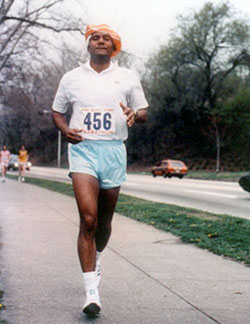
Sri Chinmoy running
During the 1970s and 1980s, Sri Chinmoy ran 22 marathons. His first marathon was on 3 March 1979 in a time of 4:31:34. His fastest marathon time was 3.55.07 in the Toledo marathon [1. Sri Chinmoy, Run and Become part 7]
Speaking on the spiritual significance of marathons, Sri Chinmoy writes:
"The marathon is a long journey. Of course, there is also the ultramarathon, but the marathon is unique and it will always remain unparalleled among long-distance runs. Just as the marathon is a long journey on the outer plane, so is spirituality a long, longer, longest journey on the inner plane. Your own spiritual run is birthless and deathless; it is endless."
- Sri Chinmoy [2. Sri Chinmoy, The Outer Running And The Inner Running, Agni Press, 1974.]
A prolonged knee injury later forced Sri Chinmoy to give up running; instead he took up weightlifting.
The Sri Chinmoy Marathon Team continue to promote marathons and other running races world-wide.
Related- Love of Running - video by Utpal Marshall
President Gorbachev
March 2nd is the 80th birthday of President Gorbachev, a good friend of Sri Chinmoy. Mallikarjun Rakala writes a short piece on the contribution of President Gorbachev.
At his first meeting with President Gorbachev, Sri Chinmoy said:
"You are the master-key of the global heart. You have liberated the world from bondage-night, and you have brought to the fore the inner freedom which we need so desperately. Before, people were in darkness, and now you have brought light to them."
Sri Chinmoy, [1. Sri Chinmoy, Gorbachev: The Master-Key Of The Universal Heart, Agni Press, 1990.]
- ‹ previous
- 142 of 337
- next ›

Except where explicitly stated otherwise, the contents of this site are licensed under a Creative Commons Attribution-NonCommercial-NoDerivs 3.0 Unported License. read more »
SriChinmoyCentre.org is a Vasudeva Server project.