
World Harmony Run Spain
Recently, the World Harmony Run passed through Spain as part of the European year long relay run.

World harmony
Carries the message
Of world peace
- Sri Chinmoy (1)
The run has visited the beautiful Spanish countryside and has also visited many local schoolchildren and others who have come to support the ideals of the run.
Read More: Spain World Harmony Run
(1) Seventy-Seven Thousand Service Trees no. 48,445
Everyday Poem
Sri Chinmoy composed many thousands of inspiring short poems and aphorisms.
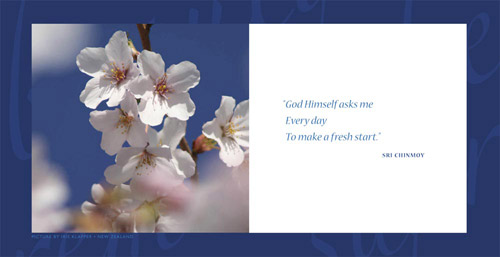
God himself asks me Every day To make a fresh start
- Sri Chinmoy
From: Daily Poem of Day (German and English)
RelatedTime
I sometimes wish I could pull inspiration out of a hat, like some of my friends, and write beautifully and elegantly all the time.
Writing, alas, does not come easy to me. I have to work at it.
Pushkin, the great Russian writer, took Mozart as his model, and endeavored to hide how hard he worked, claiming that for him, as for Mozart, writing was like play. But the truth is, he worked very, very hard on his poetry.
Mozart died at thirty-five. I think it’s ludicrous to think that overwork did not contribute to his collapse. He worked at a feverish pace for years and years.
Artists try to compress reality, squeezing out from it everything but what’s most precious, its real essence and truth. This reminds me of a poem by Sri Chinmoy, from his book, Transcendence-Perfection:
The Mother Of Time
Time itself has fallen asleep
With you.
Who will wake you up?
Nobody knows.
No, not even the Mother of Time:
Truth Reality's satisfaction-dawn.—Poem 412 from Transcendence-Perfection
(http://www.srichinmoylibrary.com/books/0241/1/412)
Time is an instrument, or maybe a field through which karma and the other big cosmic forces work out their aims and resolve their pressures. But according to this poem, the very source of time, its ‘Mother’, is “Truth Reality’s satisfaction-dawn.”
I do not know what ‘Truth Reality’s satisfaction-dawn means. But if I can break this phrase down, maybe it will be easier.
The first half of the phrase reads: ‘Truth Reality’s’. I feel that the phrase ‘Truth Reality’ is singular for a reason. A Chinese expression states that you should always tell the truth, so that you will never have to remember anything. Truth is always simple, single, and irrefutable. It just is. So, there may perhaps be many illusory false cosmic realities, but there is only one Truth Reality.
‘Satisfaction dawn’ is also an interesting phrase. Dawn implies the very beginning of some process. Therefore, perhaps this phrase has some inner link with the ancient Vedic chant:
Asato ma sade gamaya
Tamaso ma jyotir gamaya
Mrityur ma amritam gamayaOr
Lead me from the unreal to the Real!
Lead me from darkness to Light!
Lead me from death to Immortality!
In other words, satisfaction existed from the very dawn of creation, but God created the universe to enjoy and to manifest ever-transcending, ever-heightening and ever-deepening satisfaction. What we call ‘sin’ or ‘evil’ or ‘darkness’ is only light and goodness and perfection in their incipient forms. Maybe that’s why great spiritual Masters like Sri Chinmoy come down to this humble earth-planet in the first place. According to Indian spiritual teachings, only this planet is in evolution. It is only here that we can embody a conscious, constant hunger to go beyond ourselves in every possible way, and also, at the end of our teeming battles and struggles, to shake hands with God Himself on His own terms, but also as equals.
To combine the phrase: “Truth Reality’s satisfaction-dawn”, implies that Truth is the only reality, that we are moving from lesser to greater and greater satisfaction, and that in time we shall discover that satisfaction and truth are one. In other words, the supreme Satisfaction will one day be found at the Feet and in the Heart of the ultimate, incontrovertible and unique Truth, God.
I am not an old man, but I am thirty-four, and I am slowly stumbling into middle age and I do not like that. But, that’s the way it goes. I don’t fear getting older, as I once did because I have become a conscious seeker. That means that I feel each second of my life is precious; my life has a goal, and that goal is to achieve infinite Light. I may not achieve that goal in this life, and that’s ok. Goals give meaning to our lives. Why not choose the absolutely highest goal if you want the richest and most meaningful life?
For some reason I’ve had a lovely poem of Andrew Marvell on the brain. I can excerpt some lines here:
“But at my back I always hear/ Time's winged chariot hurrying near;/ And yonder all before us lie/ Deserts of vast eternity…
“Thou by the Indian Ganges' side /Shouldst rubies find: I by the tide/ Of Humber would complain. I would /Love you ten years before the Flood, /And you should, if you please, refuse /Till the conversion of the Jews.”
(The only ‘meat’ dish I occasionally pine for is gelfite fish. I wonder how Mr. Marvell would have put that into verse!)
I feel a similar sense of urgency in some of Sri Chinmoy’s late poetry. Take for example this poem from one of his last Seventy-Seven Thousand Service-Tree volumes:
You must complete your journey
To God’s Heaven Kingdom
In this life.
(unofficial quote)
I have a little more poise than in earlier stages of my life. I worry less, and enjoy myself more.
Somehow I feel that the greatest gift that Sri Chinmoy gave me are my memories of him. Whenever I feel frustrated or confused, I will think of my Guru, and I get the sense that things will be fine.
Sri Chinmoy wrote the following comments on the power of his smile:
“But for my disciples, my smile has tremendous power. When I smile, it comes from the soles of my feet to the crown of my head. Believe it or not, my smile has even cured the fatal diseases of some disciples. Only by remembering my smiles- at which place I smiled at them, on what occasion and so forth- they have had miraculous results. They knew it was not the medical world, but my smile, that cured them” (Sri Chinmoy Answers, volume 37, page 5).
Recently, I’ve been living in a Centre that has few members, and we do not live very close to each other so I have been spending more time alone that I would absolutely like. Sometimes when I get the blues, I just go to the lip of the Gulf of Mexico, look at the slow tides, and I think of the many times that Sri Chinmoy smiled at me, or just the times that I saw him smile at other people. I remember in the autumn of 2006, when an old lady presented Sri Chinmoy with a very high award. She shed tears of joy when she gave the award to him, and Sri Chinmoy gave her such a sweet smile that I will never be able to formulate it into words.
I think many of my personal experiences with Sri Chinmoy do not belong to me alone; they are stored in the universal consciousness. Anyone who loves divinity and light can get compassion and joy from a Master like Sri Chinmoy.
This reminds me of another poem by Sri Chinmoy, from his Seventy-Seven Thousand Service-Tree collection. I am quoting it unofficially as I don’t have the source book in front of me:
God-Smiles blossom not only
In the Heart of time,
But also in the Heart
Of the ever-transcending Beyond.
With gratitude to my ever-expanding world-family,
Mahiruha
Buddha Play in New York
As part of a meditation and spirituality festival, the New York Centre produced a play about the life of the Buddha - 'Siddhartha Becomes The Buddha'
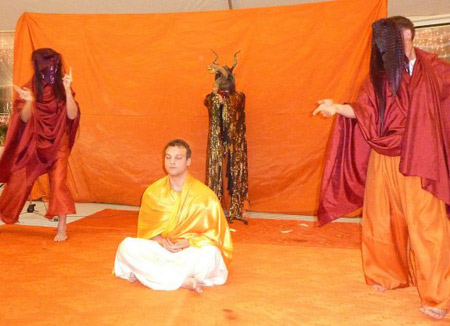
Siddhartha becomes The Buddha is a play written by Sri Chinmoy and depicts the key moments in the life of Lord Buddha. The play was directed by Ketan Goldman and performed at The Bleecker Street Theatre in Manhattan. The cast were drawn from members of the Sri Chinmoy Centre.
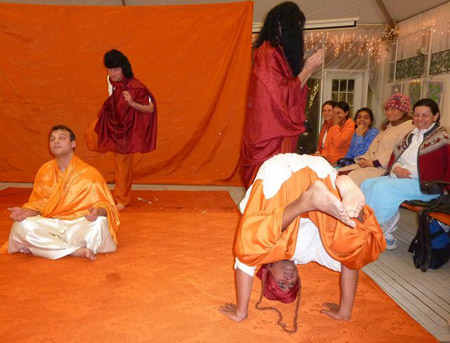
RelatedBUDDHA: O Ananda, most loving child, if we move from one place to another with the idea of finding a better place for manifesting the Truth, we shall never be successful. Truth has to be manifested here where we are, and not elsewhere. Once the Truth is established here, in the twinkling of an eye the Truth will be founded everywhere. Either here or nowhere the Truth must be established. Again and again I must tell you, Ananda, the Truth has to be seen, felt and realised within, and then manifested here on earth, wherever we are, and nowhere else.
Excerpt from Siddhartha Becomes the Buddha
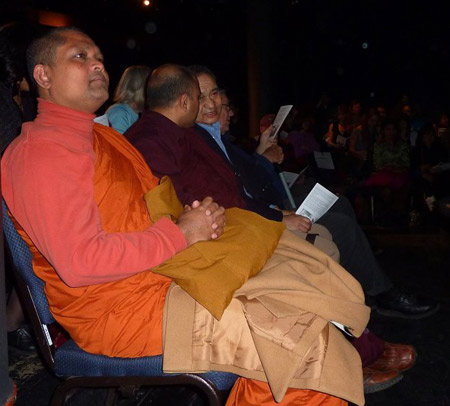
- Spirituality Festival - report by Arpan DeAngelo
- Buddha Play at NYC Meditation.org
New York Interludes
 It is interesting how, as a disciple one’s sense of time changes. Reincarnation and a growing comprehension of the soul’s long journeying; the quest of God discovery and it’s great canvas of aeons; impositions of karma; the growing urgency of the soul to manifest and serve; the intensity and velocity of a spiritual path; these and other things confer a different perception of time and how to best use it. In the ‘only-one-lifetime’ culture of Western thought, time can seem like an enemy—youth’s springtime giving way to the sickness and infirmity of age; the race to gather, nest build and succeed before frailty descends; time dominated by ambition, outer goals; achievement measured by materiality and gain—but in the spiritual life time is more about process than productivity, a God-given gift, something eternal and something to wisely use than be used by. And its empty spaces, times of purposelessness or non-clarity, conceal other realities, prepare us for what lies before us and other processes of growth and change.
Time can be poetic—rhythmic or cyclic—and there is creative time, dream time, down time, joy time, meditation time (non-productive timelessness!), the soul’s non-temporal time, eternal time—‘wasted time’ too, though what constitutes this will also differ according to one’s capacity for insight. And perhaps too the great illusion of time itself, for as Ramana Maharshi observed—and Guru seemed to share this view—time is only a construct of human consciousness and has no independent reality. Extraordinary!
Regarding ‘wasted time’, Guru corrected my erroneous perceptions of this early on in my disciple life when on two occasions he requested my wife and I to stay in New York through to the following celebrations, a 4 month and later a 6 month layover requiring a total abdication of all ‘normal’ responsibilities, a discarding of EVERYTHING (along with my ‘productivity’ notions of time). So we were to discover another dimension of time, a reality that only values time for the soul’s unfoldment. We protested of course: “But Guru, we have new jobs in New Zealand, we’ve just found and paid for a newly rented Centre, there are six new disciples to take care of, classes are organized for the next three months, a relative is undergoing surgery.” Guru waves his arm airily, dismissively, no need to even reply, and you know even then with your neophyte’s tiny comprehension that he has seen deeply into something measureless and universal, taken you into another chapter of your God discovery. We all have these stories.
In hindsight and all those months later you would be overcome with gratitude, since this long time spent around a great master has been a golden time, days and weeks bathed in light, immersed in processes of great change that, though unknowing, you were deemed ready for, catapulted from that rung in your evolutionary ladder way up to THIS rung! How memorable, this love and overreaching concern of our teacher who prized our God-realization so far above all other worldly considerations.
In the great spiritual and religious traditions in all of time, time itself is most sacrosanct when given over to the search for God, this ultimate and highest purpose. “You shall seek me and you shall find me” says God in one of the old Christian texts. “Because you seek me with all your heart, I will let myself be found... I will put a new spirit in you, I will remove from you your heart of stone.”
For The Times They Are A-Changin'
 I am 18 years old, walking through the streets of Amsterdam where I have just started university. An old man passes who is whistling happily. In passing he looks over to me. “You better stay cheerful, son,” he says. “Life is over before you know it. I still remember the time I was your age like it was yesterday. And now I’m sixty-five years old!” It’s more than 13 years ago, but I still remember the incident so clearly. Indeed, like it was yesterday. The old man’s wise words prove themselves as I recollect the memory.
He was right of course. Time is a funny thing. So is memory. Scientific research among elderly people has shown that we remember the years around our twentieth year best, because that is the time when we usually experience the most change. We move away from home, start a new life and leave the last lingering remains of childhood behind to face our new role as adults. Those changes leave the deepest imprints on our memory. And unless we become ardent world travelers or adventurers, the wheels of our life again find the grooves of habit and the rest of our life passes by in a rushed blur—or so it seems to our memory, as it did to the old man I passed in the street.
Time is always intertwined with change. Although time itself is invisible, change is its visible footprint. We notice time’s passing by the changing positions of the hands of the clock. Time makes itself known as day changes into night and night into day. As winter’s cold abates and trees grow back their leaves. But time itself is ever elusive. It works secretly, a noiseless force shaping fate. We only notice it when it has completed its task.
Can we ever catch time red-handed? Right in the middle of its life-changing work, when its agile hand pulls the levers of the universe? I have concentrated on the minute hand of a church clock to see if I could catch it moving, ever so subtly. I couldn’t, although I stared for minutes. But when I looked away for five minutes and then looked back the hand had suddenly moved. Such conspiracy!
Just as I could not catch the hands of the clock moving, I also cannot catch my life changing. Still it does change continuously, as one firm look into the past proves. The years tell what the days withhold, as an old German saying goes. In matters of our human life time also proves itself a humble worker, never to be seen or heard. Does it really exist then? According to spiritual philosophy only the present is real. Sri Chinmoy speaks of the ‘eternal Now’. The past and the future are mere railroad tracks; the present moment is where the train really is. But because it is so difficult to be in that present moment we have created the past and the future and put solid labels on them, almost as excuses for the restless nature of our mind so helplessly attached to anything but the here and now. But really we are talking about illusions. Only the here and now is real.
What a blessing is meditation then, for teaching our mind to sit still and enjoy the fullness of that eternal Now. In my best moments seated on my meditation cushion I feel like a child again, safely anchored in the heart where the Now abides. Not a care or worry in the world—they belong to the past and future. I am a child again, rowing my boat on the gentle stream of life. With next to me my mother, showing me how to steer the boat. This is how life should be. A safe and happy journey on the ever-changing river of time.
Time
 I had a cool friend at art school. His name was Stefan and he played guitar and sang: 60s and 70s rock only. He was tall and thin and moved with feline grace. Was he a hippy in an age of grunge rockers? You bet. One night his band played at the James Cook Tavern, a local blues rock haunt. Somehow they were a little off, not quite as groovy as they sounded at the parties they liked to play at. The first song of their set was Time, by Pink Floyd. After a few intro bars, Stefan stepped up to the microphone to sing the first ragged, desperate lines: “Tickin’ away / The moments that make up a dull day”... Suddenly he was motioning the band to stop. “No, no, I can’t do this one tonight. Sorry.” Was the band not getting it right? Were they playing out of time? Or was it just the wrong time? Were those lyrics simply too heavy for Stefan’s delicate artistic temperament that night?
“You are young and life is long and there is time to kill today. And then one day you find ten years have got behind you.” These lyrics come a little later in that same song. I remember hearing them when I was eighteen, at a friend's place. Life was long, and there was time to kill that day. But suddenly I felt shockingly aware of my own mortality. The lyrics struck to the core of my being, and I felt alone and afraid. The reality, the inevitability of the passing of time pressed in on me, and with it the sure knowledge that one day my life would come to an end. The passing minutes and hours that the clock marks never come back, and we only get so many of them in a lifetime. I don't know if I had ever really thought much about my own death before. When you are eighteen, death is usually something that happens to other people, older people—people not clever enough to be teenagers.
Now, some years later, I look back at the decade just gone, and wonder where it all went. Ten years have got behind me. Just when I was getting into it.
It seems that, on the whole, most people resent time, if not fear it. We’d like to remain in our prime forever, enjoying ourselves, and our friends, and life in general. Time often brings with it a gradual deterioration of our condition, until we are in no state to enjoy anything. What kind of a friend is time?
But where would we be without time? If we enjoyed immortality here on earth, would we ever get around to doing anything? What would be the point? It is our very mortality that compels us to try and knit the universe into some kind of garment we can wear. What is the meaning of this candle flame of existence we have been given? Have been given, along with the knowledge that the flame will be extinguished? And who is the giver and taker of the flame? How do we make sense of the Everything all around us—and the Nothing we fear may follow it, at the end of our “time”?
Here is the root of all humanity’s philosophy and faiths, and most of its -isms. We are mortal, and don’t really care for this inescapable fact. We struggle, and have always struggled, with the apparent monumental injustice of it all.
“Let us not waste time.
If we waste time,
Time will not only waste us
But also destroy us.”
—Sri Chinmoy
And the terrible thing is, time-wasting is all many of us do. How does one truly “seize the day”, as the Roman poet Horace exhorted us to?
“As a spiritual seeker, you should always regard time as a great friend of yours and always try to be worthy of your friendship with time. If you appreciate, admire and adore the illumining and perfecting capacity that time has to inspire you constantly, to increase your aspiration-flames and brighten your surrender-light, then you will run the fastest toward the ultimate Goal.”
—Sri Chinmoy
So time can be our friend after all. Just so long as we don't waste it! Too often we are just “passing the time”, instead of using it properly.
“To the unaspiring man time is a plaything; to the seeker it is something that he counts upon; to the advanced seeker it is something that he longs to transcend; and to a God-realised man time is something he uses to manifest God in God’s own way.”
—Sri Chinmoy
I haven’t seen Stefan for many years now. I wonder if he is still in love with the same music, and wearing paisley print shirts. I guess I'll never know why he stopped playing that song that night. But I fancy it was because the words filled him with the same unwelcome awareness of mortality as they did me. I hope he has learned to appreciate time as a friend, and not something to fear, or merely squander. I hope we all can.
- ‹ previous
- 151 of 337
- next ›

Except where explicitly stated otherwise, the contents of this site are licensed under a Creative Commons Attribution-NonCommercial-NoDerivs 3.0 Unported License. read more »
SriChinmoyCentre.org is a Vasudeva Server project.