
Two New Records For Catching Grapes and Maltesers
Ashrita Furman set two new Guinness World Records in Edinburgh taking his number of current world records to 88.
The 54-year-old - managed to catch 51 malteasers in one minute – smashing the previous entry of 41 To make the record more fun, Ashrita decided to strap a Maltese dog to his back. The idea was to attempt the record by the statue of Bobby at Greyfriars. But, the lcey condition meant Ashrita's helper was too cold throwing the maltesers, so the record was set inside a sports hall. Ashrita said, the key to breaking this record and the grape record was the power of concentration.
A couple of years ago, Ashrita set record for the most pogo stick jumps by Bobbys Greyfriar in Edinburgh. - Honouring Bobby Greyfriar at Ashrita.com
Inspiration-Letters 1
An introduction to Inspiration-Letters

Dear Reader,
We are very happy to introduce Inspiration-Letters to you, a collective effort that tries to serve the literary thirst that so many of you have expressed to us. Inspiration-Letters is a forum for inspired writers with a multitude of backgrounds and interests.
We have sent this first issue of Inspiration-Letters in the hopes that you will find it interesting, entertaining, or, at least, amusing. Unless you subscribe for future editions, you will be spared additional pain.
We would be most grateful if we are able to offer even a little inspiration.
Yours,
Mahiruha Klein, editor
Priyadarshan Bontempi, technical coordinator
P.S. For the word game lover, word 81 has been intentionally misused.


In the middle of June the World Harmony Run brought me to Sedona, Arizona, a unique place for many seekers. A generous couple had learned that we were coming and offered to put us up for the night in their home. Situated on several acres of desert, and a few miles from any main road, the house had big windows, indoor and outdoor gardens and (God bless them!) a hot tub which we tired runners could use.
The wife was a great reader, and kept a big personal library. As she had prepared beds for some of us in that room, I got the chance to look at her wonderful collection. I love old and unusual books, and her tastes were eclectic.
I saw one book that I remembered well from college. It was J.W.N. Sullivan’s: “Beethoven: His Spiritual Development”. Published in 1927, it has never gone out of print. In the book, Sullivan presents his own philosophy of music, and then talks about how Beethoven’s music is special because of the consciousness it reveals. Well-reasoned and powerfully written, Sullivan’s book confirmed my own feelings towards Beethoven, especially his late string quartets.
In the last three years of his life, Beethoven wrote these famous five string quartets. I think of them fondly because they gave me some clues as to what the spiritual life is all about. By listening to soulful, spiritual music like Beethoven’s we grow as people, and we begin to think and feel out of the box.
My former political science Professor, Barry, loved these quartets and played them every day at home. We would take long walks together and talk about…everything, but especially our shared love of Beethoven. I did not go to a “Brand Name” college, but I had wonderful Professors like Barry who introduced me to their own intellectual and spiritual interests.
As I put the book back, I remembered something my philosophy Professor, Dominick, told me, that certain works of art go beyond beauty. They take us to a place or a state of consciousness which words cannot properly describe. He placed Beethoven’s late music in this category.
Dominick’s very presence was special. A monk in his youth, in a contemplative order, he maintained a four-year vow of silence while cloistered. When he would lecture or just stand in front of his students, we could feel his silence and profundity. He embodied, in my view, a lot of what Beethoven expressed in his last works.


One scripture that Dominick sometimes quoted in class, the ancient Isa Upanishad, summons the experience of the late quartets better than any critic ever has: “That moves, and that moves not; that which is near and yet that which is far; that which is immanent, and yet that which is transcendent.”
That night, I dreamt I was back at my old University. I was sitting in a classroom with my dear philosophy Professor, Dominick, and there was complete silence. The lights were dimmed, but sunlight poured in through the windows and I could hear strange, but beautiful bird calls. The calls reminded me of the slow movement of Beethoven’s greatest and most unearthly string quartet- the opus 131 in C – sharp minor.
When I woke up, I noticed I could still hear the birds. I unzipped my tent and looked around at the vast desert landscape with its sage and Joshua trees and brush. The sun had turned one edge of the sky a slight pink and the air was so wonderfully crisp and cool. I offered a short prayer of gratitude to the wonderful teachers I have had in my life, who have taught me to think deeply, live bravely and go forward continuously.
Mahiruha Klein
Philadelphia - USA
This question concerning my latest climbing expedition was asked by my spiritual teacher, Sri Chinmoy. I appreciated his sincere concern for my safety and well-being; and I also appreciated the fact that he listened carefully and sympathetically to my reply. He cares enough about me to take the time to understand my motives for climbing. But to all the other people, including my parents and some of my colleagues, who look at my mountaineering ambitions as if they were a completely useless and hardly understandable – not to speak of justifiable – extravaganza, I wish to tell this story.
Sri Chinmoy made it clear to me that I was free to decide. I wasn’t told not to climb this mountain, nor was I in any way “ordered” to test my capacities and fate there. Everything was up to me. This moral dilemma was a several tonnes heavy boulder in my heart. I called a dear friend, another silly girl “who does things in the mountains”, (actually quite brave things far beyond my skills and abilities) and I told her about my plan and The Question. She asked back: ‘Yes, why do we take a risk?’ And we both laughed – even if it was a serious kind of laughter. We both knew that we take risks, because there is simply no mountain without danger, there is hardly any summit without risks... And then why do want to get Up There? The question persists.
I remembered the first day I saw the picture of the summit I was aiming at. I liked it immediately. I loved the number of its height in meters: 4027. (That is approximately 13 289 feet.) And I knew it was meant for me, just as well as I knew that I was too weak, too heavy, too slow and too inexperienced. Thus I decided to give myself time to train, and to gradually progress until I would be able to try it. And each time I saw the picture of this mountain, I would burst out in tears and mumble a prayer. I thought that in a year or two, I would pull myself together and try it.
But life and time had a word on it. Only one extremely busy month later, an opportunity turned up to join a small group that would venture climbing this “horn”. And suddenly the clouds I could see from my balcony after the big summer storms took the unusual shape of a cone (clearly imitating the summit) with other types of clouds lightly floating near the upper edge of the triangle: so much reminding me of the picture some brave climbers made of Mt Everest with those almost transparent veil-like clouds touching its topmost parts, somewhere above the Hillary step or South Col. At the sight of this I asked loudly, ‘Are you playing with me God? You want to send me up to this mountain? Please, give me another sign, a clear one.’
Have you ever heard of clouds that take exactly the same peculiar shape in two consecutive days? I hadn’t. The next day, however, this is what happened. I refused to let God to pull my leg like that. I wanted another sign, and I made it clear to God: no way of using clouds, He has to use some better means of letting me know whether He wants me to try to climb this mountain or not.
And no third sign came. I only got a call from a Swiss mountain guide association asking me whether I wanted to participate in this trek as the implementation of it would depend on my answer: if I said ‘yes’, it would take place, if I said ‘no’, they would cancel the trip, for there weren’t enough participants. This was a long distance call, the program of four other people depended on my decision and I had only one second to answer. Quite unfair, I thought, and quickly said ‘yes’.
On the way home from my office, I cursed myself, knowing that I no longer could recline; I felt nothing but uncertainty. How could I accept the challenge without the third, the real sign from God?
The same evening I glanced at a new climbing magazine nd the first thing I saw was a picture of my compatriot unfolding the Hungarian flag at the summit of Chomolungma. I immediately started sobbing and couldn’t stop until it slowly dawned on me that the third sign had been carved in my heart long ago: I so badly wanted to do that mountain! I cried a little more and went outside to run downhill and then uphill and then I trained on stairways... after all, in a week I had to be able to do this for four consecutive days at the maximum of my strength. Thank God, I had already been doing that all spring and all summer, so it wasn’t that I was starting training a week before the probe. However, in spite of my yearning to get up to that summit, all I could feel was fear and worry.
A month ago I had some unpleasant falls in the treacherous crevasses of a glacier and now the prospect of repeating this wasn’t to my liking at all. There was just too much fear in me that I needed to overcome. Not only the fear of falling, but also, and above all, the fear of failure. I was trembling at the thought of not being able to keep pace with the others, of having to give up, especially if I gave up after reaching the “no return” point, for instance the first glacier or any place where one cannot just walk or climb down alone. I was scared to imagine myself being totally exhausted on the second day while others lightly went on. I was really terrified at the thought of this humiliating retreat. So, when I was put to it, I felt compelled to choose the harder thing: packing and going to try, instead of enjoying a calm and peaceful week at home.
Day One
A whole evening spent in train, a whole night spent at a noisy railway station, and here comes the morning of the first day I won’t be able to take a shower as usual. Who cares now? I am just too nervous to meet my future companions. To climb with strangers is always a lottery game. Then we set off. We test each other’s normal pace. I warn the others that I am utterly slow. They say, it’s OK, and that they don’t mind it. They all are much more fit than I am, one of them had climbed Kilimanjaro, the other two, a couple, spend every week-end at high altitude... the fourth is the mountain guide. He spends almost every day of his life in the mountains. I am just a little self-taught mountaineer-seedling, with not much time spent above 3000 meters, not much experience in running downhill with crampons on (this will be regrettable), and quite concerned about glacier crevasses. How will the five of us spend the next four days together?
We go up to a hut at 2600 m altitude to stay there overnight. By the time we arrive, we are a little bit wet. After two more hours of rain, the sky is again clear albeit colourless and the sacred object of all mountain fans, the Matterhorn condescends to reveal its particular shape. We stare at it like devotees at a murti (idol). I remember a colleague of mine complaining that during the two weeks he had spent in the region he hadn’t managed a single time to get a glimpse of it. So, I feel chosen.
Day Two
I AM chosen. We leave for our next, somewhat higher destination early in the morning. Continuously moving eastward and upward I feel very tempted to look back all the time at the twisted horn-shaped stone god, the awesome and exhilarating Matterhorn which occupies the horizon and boldly watches our tiny bodies becoming smaller and smaller with the increasing distance. We crawl higher and higher. We struggle up from huge stone to another huge stone amidst a debris of rocks of every size from a lion’s head to a mammoth’s head, or a house even. Stones that almost all move below one’s feet.
Remembering the experience of my first big marathon, the 1996 NYC Marathon, I offer gratitude at regular intervals, when I feel that we gained again 50 or 100 meters altitude. It makes me happy. I use all I learned from my spiritual Master on yogic breathing. It does help. However it doesn’t reduce the risk of twisting one’s ankles while moving upwards on, in between and amidst all these small and big boulders. I start repeating a mantra in English, some simple sentences about a Master’s love for his students and vice versa.

The boulder-chaos becomes milder and we find ourselves in a col, a mountain saddle or ridge section at 3150 m altitude. I am glad that my sunglasses hide my tears. I am bathing in love. Again I offer my gratitude and keep offering it as I climb on. For long minutes all I can feel is but gratitude, unalloyed gratefulness. .
Far in the horizon the challenging alpine tasks of Dufourspitze, Castor and Pollux, the Matterhorn, la Dent Blanche, Fluhalp, Breithorn stand immobile, invariable in the sun. And according to the guide, our goal, Allalinhorn is there, just before Taeschhorn and behind Alphubel, if I just look more to the right. I don’t want to look, I just don’t dare. I need two more days to bear its majestic aspect in its shining white overcoat.
Half an hour later comes the first fall. As we descended a particularly icy slope, we see the remnant of a glacier that has almost disappeared. Quite steep, at places we cross huge stone blocks, at places we cross streams of grey glacier water running down, at places we make our way through half-vertical fields of ice. The place where I fall is the bed of a fast running river current. I fall in ice-cold water, right on my back. I spring up, shake my body and go on. Something is weird though. I touch my back, my clothes, my rucksack and everything is dry!!! It was very clear that I had fallen in icy water. After all I slipped on a wet stone while crossing a stream. Yet, I am dry. My elbow bleeds a bit. I wash it with the dirty snow I find everywhere, where it hasn’t yet become either ice or water. I keep on descending, lowering the altitude, and wonder: ‘if it is bleeding why does it not hurt’? A day later I check the wound, it is smaller than a gentle scratch... I feel love all around me.
A little lower, at the milder section of this slope, the stones transported there by this bygone glacier are simply fabulous. Each of them carries a whole history of our mother earth. For a geologist this place would be heaven itself, there are so many samplings of various minerals. But the majority of stones have some silicate in their composition and also metals, in all likelihood Iron. There are hundreds of silver-coated shining flat stones. I cannot stop wondering at these little marvels. Then suddenly I notice one that looks not alike any of the others. Its shape is common, it is a flat, several layered stone, shining in the sun. But its colour is something I haven’t yet seen today: it is golden! I don’t have much time to ponder, I quickly pick it up and walk on, following the leader. A gold coloured stone warms my palm. With eyes fixed on the uneven, rocky ground, I keep searching, scanning to find more of these fairy tale type of golden stones. Not a single one! By the evening I understand that the one in my pocket was the only golden one; all the others are silver or just some other plain colour. My heart gives a special significance to this and it dances with rapture, solemnly and excitedly at once: I found the only golden stone of this mountain! The Golden Stone. The mountain gave it to me! Not to the person who stepped there before me, not to the one who came after me... I guess this is one of the things we take a risk for. The task or mission of finding the Golden Stone. No other mountaineer would take a gram of extra weight on his back, especially if he has to carry that for several days. But I am bound to do this, for I have to carry the stone down after having taken it everywhere up here with me. I have proof, a justification that saying YES to that long distance call a week ago wasn’t a bad choice. I have at least and at last an answer to the question about taking risks.
Day Two continued: Silent Night
When dusk starts to descend with its long legs slowly slipping down the cliffs and valleys all around, when the temperature cools down to make our backs shiver, we all retire in the hut to enjoy a warm drink, a soup and each other's company
At quarter to three, before the first flock of climbers, the ones aiming at the more distant summits get up to leave the hut. I quickly go out to silently pray and to do some spiritual exercises. I walk out into the chilly night only to realize that I have spent my evening and the first part of the night in a five million star hotel. Or five billion stars… or more even. Hush-gap silence envelops every single object of this undisturbed nature, no human eyes can perceive anything on earth but the sky where glittering diamond powder has been scattered by a noble and generous hand.
The Milky Way freely flows from one end to the other of two horizons incrusted among chains of black mountains. In the mythology of my ancestors, the high cheek-boned Szeklers who used to be the Kshatriyas of the Hungarian nation once upon a time, the Milky Way is not milky at all. We call it "Hadak Utja", which means "The Road of the Warriors". For the collective consciousness of my forefathers, this myriad of stars is nothing but the dust triggered by the galloping divine army of our Greatest Ancestor, Prince Csaba, when once he descended and lead down a massive celestial army from the eternal skies in order to rescue his trapped great-grand sons fighting against an enemy that largely outnumbered them. The memory of this miraculous battle is enshrined in the heart of every Szekler and I am no exception to that. And each time one of us looks up into the night above us at remote places non-affected by light-pollution, the sight of the "Warriors' Road" reminds us of what we are: warriors, the Kshatriyas of a nation that tends to forget us, yet warriors to the very core, people who once upon a time received help of a divine army dashing down from the stars. In these moments I feel so proud of my star- and horse-worshipper forefathers who had the capacity of drawing divine grace while obstinately resisting the oversize adversaries storming on them from every direction.
A falling star puts a halt to my thoughts. I know that in a second I have to wish something and it will be fulfilled. I quickly wish "let nothing wrong happen to us, let us accomplish the journey safely." Another star falls, and I wish the same thing. I realize that it is the 13th of August today, one of those days when a specific group of asteroids approaches our globe on their perpetual journey around the Sun.
I repeat my silent request five more times, as I see more falling meteors.
I still have some time at my disposal, in silence. I stay in front of the hut's door, with my headlamp switched off and I inwardly sing the Invocation, a sung of supplication to the Highest of All Beings, the Supreme One whom I so much wish to be near me at this and at every moment. In no time I feel His Cosmic Aspect penetrating into my heart, my eyes, my smallest cells. I let him occupy my psyche and body as well. After I finish singing and bow to the glittering night of hundred thousands of years of space, I feel that God is looking through my eyes, God is moving through my movements. It is He, well, in my case: She that looks into the first headlamp coming closer from inside. It is She that hears the familiar sound of metals clinging and singing when bounced against each other the moment climbers clip karabiners, ice-screws onto their harness… I will soon be doing that too, in the deep night somewhere above 2700 meters on top of a slope, below the drooping feet of a hanging glacier.
Kamalika Gyorgyjakab
Hungary
(Next issue - part two “A Game of Risk”)
If you came here in August, if you have an interest in things of the spirit, you might have walked down this driveway in the New York City Borough of Queens and through a gate as I did, and entered into a world of great beauty and surprise.
Today, August 16, they are celebrating the birthday of Chitta Ranjan Ghose, a devout soul born into a family of great Indian souls. 800 students of Chitta’s brother, the living spiritual Master Sri Chinmoy, are here to commemorate this sacred occasion.
Inside the gate two majestic stone lions greet you, regal guardians immaculately carved in white marble. They are immense, alive, full of power – the fierce gatekeepers inspire in you humility, reverence, respect. You find yourself standing in an outdoor garden of sorts, a temple grounds rich with bright colours and flanked above by steep terraced benches. People are milling about, the women in brightly coloured saris, a garment honouring the spiritual and sacred, the men in white, the colour for ceremony and meditation.
In the background, set into a grove of shading oaks, stands an elegant low temple, Zen-like with its flowing lines and graceful simplicity. Everywhere nature’s riotous beauty, bursts forth in the multifarious greens of summer – evident in the tendrils and creepers of the wisteria vine, engulfing the western roof of the temple in a blaze of invading green; in the dappled shadow-greens of the oaks and sycamores, their boughs merging with the temple’s elegance in a symmetry of man’s artifice and nature; and amid all this, the indescribable abundance of flowers. Yes, flowers are everywhere, the jubilant yellows of marigolds and sunflowers; peonies and violets tumbling from dozens of hanging baskets; the huge, tall moon globes of orange blossoms, heavy with fragrance.
Inside the temple, beneath its burnished copper-tiled roof, Sri Chinmoy is a calm, solitary figure. Like the leonine gatekeepers, the Master sits motionless, and you watch and marvel at his stillness – in his simple white cotton dhoti he, too, is a statue, majestic in the repose of meditation, eyes half closed, conscious of this world yet clearly roaming in other, inner realms that lie beyond the horizons of our comprehension.
Gathered behind him, life-size images of his family stand together, each garlanded with flowers – Shashi Kumar Ghose, the pious father; Mantu, the renunciate; Hriday, eldest brother; Chitta, once a disciple of Sri Ramakrishna and so close to Sri Chinmoy.
Down on the garden courtyard a stage has been set for a concert of songs that will honour Chitta-da’s life, Chitta-da’s soul. Behind the assembling performers, cosmic gods and goddesses have been installed in panels of bright colours - Mother Kali, dark-hued transformer of human ignorance, depicted with her necklace of human skulls; Saraswati, imparter of knowledge: Ganesha, protector of homes and temples. Everywhere bouquets of bright flowers, statues, a rich feast of colours and details enchanting to the eyes. Overhead long streamers of white paper flowers sway silently in the breeze, prayer-flags moving slowly in unison like underwater plants swaying to the rhythm of silent seas.
Invisible in their overhead kingdom of trees, cicadas sing their harsh summer song. Their voices rise in unison then fade into silence – rise again together as though attentive to some unseen conductor.

Now for several minutes a ritual bell is rung, single-noted, vibrant in the silence, summoning the soul of Chitta-da from its own abode to this earth world. “Come, come” it seems to say. “We have decorated our garden-temple for you today, beloved Chitta-da. Come, come, we invoke you, it is you we celebrate.” Tumblers of incense are lit, activity fades into stillness, everything falls silent in anticipation.
Now the singers begin their mantric song chants, beautiful repeating melodies accompanied by harmonium, hammer dulcimer, flute, tabla and the haunting sounds of the two stringed Chinese erhu, eerily resembling the human voice in supplicating song.
And how beautiful the human voice is when harnessed to the force of spirit – listening our very souls seem bathed in sunlight. Immersed in the Master’s songs, you are surprised how deeply moved you feel, your hands fold together over your heart in spontaneous devotion. Sri Chinmoy the composer-alchemist is transforming the base stuff of mind, body into a golden rapture of pure consciousness, an effortless euphoria of spirit. Each tribute song distills some essence of Chitta-da’s earth-life, some aspect of his soul – the words are garbed in Sri Chinmoy’s wonderful melodies that so energise, awaken our spirits. They are pure brush strokes of music that somehow capture and convey a sense of something very lovely – what is it ? – something already familiar to the soul and waiting just beyond reach for its rediscovery. So that spirituality is less an act of learning and knowing, but simply of remembering.
What was it that summoned Chitta-da’s soul – the ritual bell, the songs filled with such a pure devotion, the force of brother Chinmoy’s encompassing love, spanning other realms, other times not of our knowing? Later Sri Chinmoy would recount to us many of his inner experiences during the concert – experiences that would seem remarkable and wonderful to us. What might have been only a belief in the endless life of the soul becomes a compelling portrait of its reality as you hear Sri Chinmoy talk of these visitations by his family. Clearly, an illumined Master is a bridge between co-existing worlds, a meeting place between the seen and the unseen, the material and the ethereal, body and spirit, a truth vividly revealed this day.
In his book My Brother Chitta, Sri Chinmoy writes: “My brother was not an ordinary human being. He was a really great soul… His love for me was unparalleled… When I was meditating, or studying, or writing poems, he would come and stand in front of me and look into my eyes. I am his youngest brother and his only wish was to look into my eyes.”
“I wish to say that no elder brother has been so indulgent to his younger brother in God’s entire creation… Unconditional love and unconditional service my brother showed me all his life. He only desired one thing: my happiness.”
From My Brother Chitta, by Sri Chinmoy
(Pgs. 3, 50, 51)
Jogyata Dallas
Auckland - New Zealand
A child greets the world alone, primary breath exclaiming life itself through sound. Voice is born as the ambassador of feeling; words attend in retinue. Sound is the boundless assembly of any mortal relevance.
Anthem tends the patriot, canticle tends the pilgrim, sonnet tends the lover, march tends the warrior or bride, requiem the mourner. Crying or extolling, stooping to entreat; music, poetry, or two combined in songs, string hyphens between human hearts: now and ever, and in every realm.
Creation’s adoration listens for a higher Realm, where the Song Elemental shines from earthly hearts and eyes, thrills in sun’s resonance, lilts in colour’s harmony, leaps in chorus from the lawn-bound blades.
God harkens to an endless Song of Love, Self-born; Self-absorbed surveys Estates of sky through Ocean’s mighty lens, set to compose a verse of dawn or tempest, and to weave it in the Melody.
Through one who intuits any nuance of that Realm, one song of many songs, one instrumental tone, one phrase of one verse of many poems, is a voice and vessel of the Source.
“…Thou art the ring
Of the lowest chasm and spanless height….”
- Sri Chinmoy, excerpt from “Master,” My Flute
Sumangali Morhall
Cardiff - Wales


In the movie Forrest Gump, the main character on an impulse starts running throughout the entire United States and along the way he alters the course of history. For four months through all 48 contiguous U.S. states and for eight months along the highways and byways of Europe, groups of runners, all running under the banner of the World Harmony Run, cross entire continents for the cause of friendship and mutual understanding. - always accompanied by a flaming torch. For two weeks I had the good fortune of being a member of the European team on the Run, the world’s longest relay race, as it made its way through Switzerland and Italy.
‘How far still?’ my Austrian teammate asks in broken Italian to the 79 year old man who runs with us during the last part of today’s stage to Florence. ‘Solo uno kilometro,’ he replies sullenly. One more kilometre. That kilometre seems never to end as ten minutes later we receive the same answer, ‘Solo uno kilometro.’
I’ve joined the European team of the World Harmony Run as the representative for The Netherlands. The World Harmony Run is the longest relay run in the world, which takes place simultaneously on different continents. The purpose of this Run, which was founded in 1987 and takes place every two years, is to foster friendship and understanding among people and nations. On the way the team visits many schools, but also mayors and athletic clubs to pass on the torch of harmony and friendship. Today’s stage runs from Bologna to Florence, a distance of 110 kilometres or 70 miles.
After having already run about 20 kilometres or 12 miles today, my knee suddenly starts hurting. The team vans have already driven to the finish so I’m forced to continue running. The pace dictated by our guest runner isn’t really the problem; I can keep up while speedwalking. However, we have a meeting planned with a group of children and a number of dignitaries from the city council and we’re already more than an hour behind schedule.
We continue at a jog-trot. The old man now functions as our guide, since he is the only one who knows, or at least “should” know the area. He leads us away from the highway on a deserted gravel road. On the left looms a large factory, on the right an overgrown grassy field. The view doesn’t look very promising. After about another kilometre the gravel road suddenly ends before a large iron gate and we come to a full stop. The old man throws his arms heavenward in desperation and rages in Italian. His friend was supposed to meet him here, he maintains. Meanwhile, our torch has run out of fuel and gone out.
The European part of the relay started on March 2nd in Lisbon, Portugal. In Europe alone 24,000 kilometres will be covered altogether in 45 different countries. The European coordinator and team captain Dipavajan Renner (what’s in a name?) is the only one to complete the entire eight months on the road. The rest of the team consists of runners joining for a few weeks or perhaps for a few months. You can decide for yourself how much you would like to run every day, for there are two vans driving to and fro which the tired runner can use to jump into at any time to take rest.
The front runner carries the ever burning torch, a symbol of friendship and harmony, which passes from hand to hand during the Run and in a greater sense, from nation to nation as the Run progresses. Quite a heavy piece of equipment to be carrying along for all those miles, but according to Dipavajan the torch gives energy. ‘Whoever holds it inevitably runs about ten per cent faster. We usually have to slow him down.’
We’re now following the old Italian into the grassy field on our right. Thistles are pricking at our legs and bushes are lashing against our arms. Running is out of the question here, so we proceed walking in single file like a family of ducks. Suddenly the old man falls down head first into the grass. My heart skips a beat as for a terrible second I think of a cardiac arrest. At 79 years of age anything can happen. Fortunately he gets up quickly and marches on grumbling crankily. After what seems like an eternity we finally reach a gravel road alongside a highway leading towards civilization. At a local restaurant we borrow somebody’s cell phone to call the team captain. It turns out we’re pretty close, so sprightly we resume running.
It still takes longer than expected, however, and my knee is also hurting more than I dare to admit. I decide to keep the ambling old man company instead, while the rest continue running to the finish. Finally the two of us also reach the small school building, where, much to my amazement (we’re two hours late), a group of children is still waiting for us with banners and slogans for peace, harmony and friendship. ‘Viva la fiaccola!’ they chant, ‘Long live the torch!’ The big shots from the city council have already left (understandably of course!).
One has to have a reasonable level of fitness to participate in this relay. Although it’s up to you to decide your daily mileage, it is silently assumed that you’ll be able to do an average of about ten to twenty kilometres (six to twelve miles) a day. My Austrian friend Pratul runs about a marathon a day - an exceptional feat. His secret: Italian olive oil, about half a glass a day and undiluted. ‘Olive oil is my discovery of this run. I recover extremely well because of it,’ he explains. I surreptitiously try out a spoonful which leaves an unpleasant burning sensation in my throat. I decide to apply some to my knee instead. Two days later the results speak for themselves: the pain in my knee has vanished.
We usually spend the night in pensions or small hotels. Once we stayed in an abandoned gym hall; occasionally we will lodge at friends’ houses. Food and lodgings are often sponsored by the communities where we end the day’s stage. It proves very helpful, since we do not have a big budget. The World Harmony Run is financed by the runners themselves, who are all members of the Sri Chinmoy Marathon Team (SCMT), a worldwide organization of ultra runners coordinating the event. The Sri Chinmoy Marathon Team sponsors over 500 athletic events each year, including a number of multi-triathlons in Australia, a swimming marathon in Lake Zurich, Switzerland, and the longest certified road race in the world, the 3100 mile race (4988 kilometres) in New York. Founder of the World Harmony Run and the related marathon team is Sri Chinmoy, a spiritual teacher, author and artist living in New York. To Sri Chinmoy sports form a significant instrument to develop international friendship and global harmony.
After a refreshing night’s sleep in Florence we lace on our running shoes again for our next stage through the Tuscan hills towards the medium sized town of Arezzo. Early in the morning we start by visiting two local schools to share the inspiration of our run with the children. Here in Italy the enthusiasm of the hordes of bambini we meet is unbounded. We are greeted as if we were movie stars and more than once are asked for our autographs. The southern European temperament shines forth as the children run a few laps with us around the schoolyard. Madly sprinting would be a better term for it.
When Dipavajan is asked about the highlight of the relay he doesn’t have to think long. ‘For me the kids are the highlight. Today’s children are tomorrow’s adults, so I think it’s important to give them the right example. Children are always enthusiastic and really feel what the Run is all about. They get a kind of magic twinkle in their eyes as soon as they hold our torch.’ Having had many first-hand experiences of children running with us, I cannot but wholeheartedly agree with him.
After the school visit we immerse ourselves again in the ocassionally rough, but always inspiring Italian landscape. Here in Tuscany we enjoy and marvel at nature’s beauty and the breathtaking, picturesque villages built on the undulating hills surrounded by the ever present olive groves. It would be a completely different experience if one would cover the same distance by bicycle or car. As a runner one can completely merge with the surrounding scenery. This feeling of oneness with nature which the runner experiences is surely one of running’s most beguiling charms. In this I am most generously accommodated during this relay.
We are often joined by local athletic clubs who run with us for a few kilometres by way of training. To meet that many different people and to run together for an initiative that unites people, nations and continents is truly uplifting. It is an idea that speaks to many people directly. During the Run drivers honk their horns at us or give us a “thumbs up” in appreciation.
A runner makes friends easily. Already in these two small weeks I’ve met hundreds of wonderful people, both old and young, from all walks of life. Kindred spirits sharing the same longing, the same ideal, the same aspiration for a world of peace and a world of oneness. True friends. I feel that through everyone we meet, through every smile we put on a face, through every heart that opens to our message, we are sowing a seed. A fertile seed. One day these seeds will germinate and little plants of peace will start growing all over the world. Over time these plants will become trees and a day is bound to dawn when this beautiful forest will give shelter to the entire human race. This is the vision that is behind our Run. This is why we lace on our shoes every day. This is why we are here.
Running through the city centre of Arezzo we see a robust Italian man, a real macho, coming out of his local pub. Arms crossed in front of his chest he observes us from behind his cool, dark sunglasses. As we pass him, however, we are surprised to hear a sincere and enthusiastic 'Va ragazzi!' Go kids! I smile in silence. Can there be any greater reward?
Abhinabha Tangerman
The Hague, The Netherlands

At the turn of the last century, the development of the modern bicycle gave a new freedom to working people across the UK. The bicycle enabled workers to escape the dour grime of factories and race into the countryside. At that time motor cars were the sole preserve of the wealthy and were a rare sight on the roads. Since by nature people like competition, it wasn’t long before cycle races were being organised on British roads. In fact, they were so successful that wealthy motorists began complaining about the roads being filled with fast and dangerous cyclists. (This was in the days when cars were limited to speeds of 20 mph.)
Unfortunately the wealthy motorists had the right connections with powerful people and a law was passed in the UK banning cycle races, because they were too fast.
This could have been the death of British cycling but resourceful cyclists found a loophole. It was only mass start cycle races that were banned. There was nothing to stop cyclists setting off at one-minute intervals and seeing who was the fastest over a certain distance. Thus the sport of cycling time trials was born. In essence it is a simple race: Each competitor rides unpaced and completes the distance as quickly as possible. For this reason they are often known as “The Race of Truth” as the strongest rider should win. Road races, on the other hand, with a peloton (group of up to 150 cyclists) can often be won by weaker cyclists who have good tactics or are just good at sprinting at the end of a race.
In contrast to Britain, European cycle races were nearly always bunched road races, which are much more exciting for spectators to watch. Therefore on the continent famous races like Paris - Roubaix, Milan - San Remo and The Tour De France developed. Britain on the other hand was stuck with time trials, great to participate in, but lousy for spectators.
The heyday of British time trialling was in the post-war period. During this time cars were scarce and many thousands took the opportunity to cycle in the country. Long distance time trials of 100 miles, 12 hour races and 24 hour time trials were also particularly popular. In recent years the sport has struggled with the ever-increasing level of cars on the road making it difficult to find safe courses. Because of this, many races now have to start very early in the morning. Early morning starts are one of many eccentricities to the sport. - In the early days riders had to wear all black to make them look less conspicuous. Thankfully this is no more, instead riders are now more concerned with aerodynamics. To save a few seconds, riders will use disc wheels, shave their legs, wear lycra skinsuits and pointy aero hats. This sometimes leads to mirth amongst the British public who are not noted for their appreciation of cycling. (Several times a year a passing pedestrian will shout out to me “France is the other way mate!”)
Although outside the mainstream of professional cycling, the sport has produced some outstanding cyclists. Both Graham Obree and Chris Boardman were initially UK time triallists who went on to break the prestigious world hour record in the 1990s. Also Beryl Burton, one of the greatest female athletes of all time, won the Best British All Rounder competition for 25 consecutive years. In 1967 she broke not only the women’s 12 hour record but also the men’s, covering 277 miles. (the women’s record still stands today)
One of the main attractions of time trialling is the fact that a rider can always try to beat his personal best or season best. Most riders in this sport are more interested in their times than their placing in a race. Also very popular is the veteran standard, which gives veterans a time to aim for depending upon their age.
Thus time trials fit very well with Sri Chinmoy’s philosophy of self-transcendence. Self-Transcendence is the attempt to go beyond our preconceived limitations and set new goals in both a sporting and a spiritual sense.
I started racing in time trials over 2 years ago, competing for the Sri Chinmoy Cycling Team. It is very satisfying to go faster and set new personal bests.
So far this year I have won 16 races and finished 4th in the National 100 Mile Championship. My favourite discipline, however, takes place in October and November. These are special hill climb time trials: Racing up a hill of 1 – 3 miles. It is more like a sprint and very painful but I tend to do well because I am light.
Tejvan Pettinger
Oxford, UK
Links:
The Rainbow
My heart leaps up when I behold
A rainbow in the sky:
So was it when my life began;
So is it now I am a man;
So be it when I shall grow old,
Or let me die!
The Child is father of the Man;
I could wish my days to be
Bound each to each by natural piety.
- William Wordsworth (1803)
Perhaps you’ve heard of the appellation “storm-chaser” or “tornado-chaser” but have you ever considered that someone might chase rainbows with a similar zeal? If the weather conditions are favorable for rainbows, don’t stand in my way because I make haste to grab an umbrella and rush outside to look for rainbows in the sky. Sun and rain together are fairly uncommon in my region so their appearance elicits full alert! When indoors, I walk around looking out the windows in all directions. If I’m at work, I cross my fingers that my boss will tolerate a little break from my desk to step outside and walk around the perimeter of the building as I look in every corner of the sky for a rainbow. If I’m at home, I put my camera around my neck and pop open my umbrella to walk up and down the street peering intently skyward for some telltale colour. If behind the wheel of an automobile, don’t be surprised if I crane my neck this way and that or just decide to pull off the road for a better look.
Scientifically speaking, a rainbow is simply the reflection of sunlight on drops of water. Sunlight is composed of many colours, which appear as white to our eyes. If the light refracts through water droplets, the myriad colours then appear. The sun will always be behind you when you view a rainbow in the sky and the rain will be in the direction of the rainbow. This play of colour can occur in the mist of waterfalls, the spray of a garden hose or even at night if a full or nearly full moon casts bright enough moonlight while still low on the horizon (Lunar rainbows, or moonbows as they are sometimes called, usually appear as a rainbow of white light or, if the moonlight is bright enough, as muted colours).
The magic of a rainbow can hardly be contained in the scientific equations that explain its creation. The Scottish author and novelist Sir Walter Scott asks:
What skilful limner e'er would choose
To paint the rainbow's varying hues,
Unless to mortal it were given
To dip his brush in dyes of heaven?
- Marmion: The Tale of Flodden Field (1806)
Indeed rainbows herald nature’s glory at her finest. As Sir Walter Scott describes, they whisper to us of heavenly realities as we journey on terra firma. For a rainbow beckons to us to hope and dream of visionary vistas with its ethereal beauty in the midst of dark storm clouds.

Another type of rainbow visionary vista dawned one day for me on an inner horizon. While in Xiamen, China, in December of 2004, I took part in a silent meditation session amidst the landscape of China’s ageless wisdom. The Indian spiritual teacher Sri Chinmoy led us, his students from all over the world, in the meditation. As he shared his own spiritual wisdom with us through the vehicle of silence, we prayerfully walked across the room, returning one-by-one to our seats with a hush in our hearts.
As I quietly sat during this shared sacred moment, years of spiritual inquiry under his guidance led me to contemplate on God’s vision of perfection for humanity. Spontaneously, my love of rainbows came forward and I suddenly was lost in the profundity of all the individuals surrounding me as beings of light that together shone with a beauty far surpassing that of a rainbow. As each seeker received Sri Chinmoy’s blessingful darshan (vision), the experience anchored itself more and more deeply inside me. Immersed in the conviction that God views each human being as a radiant expression of the divine source, I imagined that from God’s vantage point the prayerful group passing before us were the individual rays of a rainbow creating infinite colours and beauty. As this vision of a spiritual rainbow felt increasingly real, the room filled up with white light and this light emanated brilliantly from each and every person present.
I felt humbled by this vision and marveled to imagine that perhaps one defining quality of God is seeing the promise of perfection that is invisible to the naked eye. I tried to consider how different my life might be if I could see the world around me at every moment through this visionary lens. If a gathering of individuals could reflect light in a unity more beautiful than a rainbow, what other inner vistas might await to be discovered replete with similar grandeur? I do still resonate to Wordsworth’s declaration that my heart will leap up at the sight of a rainbow throughout the passage of my life. However after this gift of rainbow vision during a China meditation with Sri Chinmoy, an earthly rainbow will now inspire me to reflect on an inner divine beauty – namely the spiritual rainbow called mankind.
Sharani Robins
Rhode Island - USA
Learning to Meditate in New York
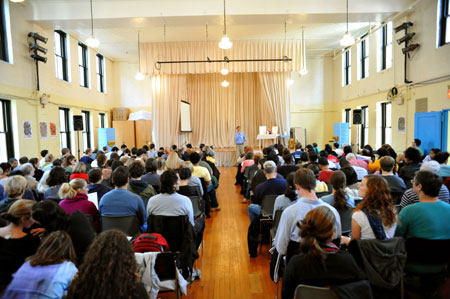
Throughout the year, the Sri Chinmoy Centre in New York offer free introductory meditation classes for people wishing to learn how to meditate. Recent classes have been well attended with over 400 people attending different sessions.
The meditation classes are based on the teachings of meditation teacher, Sri Chinmoy. Sri Chinmoy, born in India, lived in Queens, New York from April 1964 to his mahasamadhi in October 2007. As well as establishing a thriving meditation centre in New York, there are now Sri Chinmoy centres in over 60 different countries.
The essence of meditation is to experience the peace buried deep within. As Sri Chinmoy says:
" I meditate So that I can inundate My entire being With the omnipotent Power of peace."
For more information about New York Meditation, kindly visit: NYC meditation.org
Also pages at Sri Chinmoy Centre - New York Meditation
Sri Chinmoy in New York Times
Photo by Jowan
Inspiration-Letters 15
In the Silence Edition, 7 writers recall places and times of quietude, and reflect on their influence...
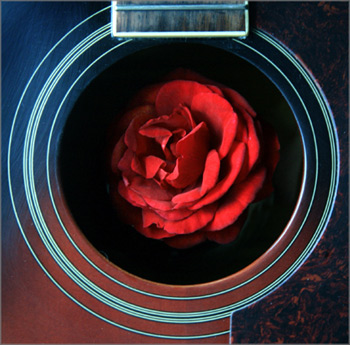 Shortly before Guru left this world, I dreamt that I was driving, with my mom, down a road that was over shadowed by big trees. She was in the passenger seat and we were listening to Simon and Garfunkel’s rendition of Scarborough Fair, on the radio.
On the day I learned of Sri Chinmoy’s departure, I went home and went to sleep, unable to react. In my dream, I saw that Guru was walking through a deep, dark wood in Wales, surrounded by elves, faeries and forest spirits. They were singing to him in some ancient, forgotten language and he was smiling and smiling.
My spiritual name, Mahiruha, literally means “tree”. I like Celtic mythology and symbolism because of their reverence for trees and nature. Sri Chinmoy himself said many times that he loved trees, their deep aspiration for humanity and their intense cry for God.
Maybe a week after our Master’s Mahasamadhi, I walked over to Kissena Park, about a three-mile jaunt from my house. When I was sure nobody was around me, I allowed the tears to roll down my face. I passed a big tree in a field. Somehow I got the sense that the tree “wanted” me to sit at its base. I don’t know why, but I complied, sitting down on the thick bed of crabgrass that grows around the roots of old trees. It was a chilly late afternoon in Fall, and some of the branches that hung near my face had yellow and brown leaves clinging to them. The sight of those leaves made me feel better.
At this time, I will still letting myself cry silently. The tree “told” me that I could cry but it also wanted me to sing two of Guru’s songs: “He who loves never grows old, God is a shining example”; and “No entrance fee is needed to enter into God’s Heart-Home”. I sang those songs over and over again through my tears. Some young Chinese and Indian girls were playing softball nearby, to the vigorous encouragement of their coach, Mr. Carter. Somehow the sight of their game comforted me, as if life will always go on, in all of its spontaneity, innocence and joy. After half an hour of crying, singing my Master’s songs on hope and new life, and watching softball practice, I left the base of the tree. I knew I would be OK. Definitely, I will always adore that tree.
Here is something I wrote recently, in my attempt to frame Sri Chinmoy’s first full year of silence:
Dear Guru,
Your silence is as rich and as profound as your words were. In the depths of your silence we feel your Universal Heart loves us, cherishes us, and needs us. Beloved Guru, we are swimming, running, diving and rejoicing on the waves and cadences of your silence. Your silence is our true and eternal friend.
With love and gratitude,
Mahiruha

P.S. Here’s a link to a story by Sri Chinmoy, which hauntingly illustrates the power of silence:
Mahiruha KleinEditor
Title photograph: Pavitrata Taylor at Sri Chinmoy Centre Gallery


Remembering October
 To begin with, you can’t help noticing how vivid and beautiful our Aspiration Ground is. Physical spaces seem to interact so much with human consciousness, take on energy and light and livingness — here the devotion and caring of so many of the local disciples ahead of our arrival have created a sanctuary both tranquil and sheltering to the spirit. Within the grounds themselves — flanked by the great mass of vines and trees yellowing with fall — no-one is talking, not for the three days of these observances.
For three days and nights Aspiration Ground will be open continuously, just as it was one year ago, and many will stay throughout these long hours, enchanted with the solitude and brimming silence.
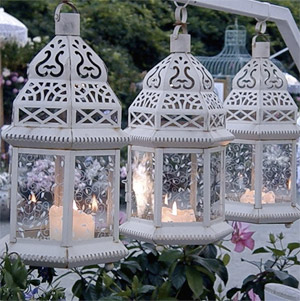
Seated on a garden balustrade and majestic with his purple dhoti and meditative smile, Guru presides over everything in a centrepiece, four metre high portrait. In a complicity of imagery, the garden theme of the photo flows out onto the stage — real flowers, great banks of pink roses, sections of identical garden wall, a profusion of plants, statues of Ganesha. Threaded strings and necklaces of flowers hang from the Temple entrance. On our first night a three-quarter moon shines perfectly above the amphitheatre of dark trees. And everywhere, candles and candlelit lanterns.
There is a hush in the air, a sense of possibility, as though at any moment something revelatory might come.... We are at the conjunction of a sacred occasion, hallowed ground, the energy generated by these hundreds of seeking souls. Cocooned in this haven of beauty and devotion, we strive for a deeper stillness, a renewal of aspiration. In the middle of the night the veil that separates us from those things we long for, those distant but remembered realities of spirit, seems almost translucent — a little effort more and some special dispensation of grace might come to bring a long hoped for epiphany. This is the place.
Each day repeats the same ceremonial themes. A gong, heraldic, strikes thirteen times and conches sound, triumphal as befits this salute to one of the greatest of great lives. And scores of tinkling simultaneous bells, all sweetness, sweetness. The sounds thrill the soul, proclamatory, seem to reach out to other co-existing worlds in invocation. Each day, too, we will sing together, trailing a little behind the Master’s own recorded Invocation — I smile a little as He lingers on those long devotional notes, wringing out every little drop of God-love and still teaching us about soulfulness.
And each day, as well, our candle offering. In a long line we shuffle slowly forward, holding in our palms the votive candle that is at once the renewal of our discipleship and the offering of our soul’s love. At night, down where Guru’s physical lies, the 500 devotional candles flicker and shimmer, a pool of light like a far off city, poignant and touching. Each tiny flame dances and sways, alive with our hopes or whispered prayers. At night a projection of our Guru’s Transcendental photo towers on a giant screen and there are these wonderful long meditations. Remembering Guru’s comment regarding meditation and the great secret of grace — “when the father is a multi-billionaire, why should the children have to work...?”
Each night Mridanga offers videos of Guru’s life — his meditations, his activities and talks. By chance one has been filmed from almost exactly where I am sitting and in a bizarre juxtaposition of time past and time present I am sitting in Aspiration Ground and watching a video from years ago that almost perfectly captures everything of here and now — same masses of flowers, candles, a stage of white trellises, statues and the Master’s own portraits. Only Guru himself is missing from what we call the present — which might itself be an illusion — and I feel a thrill of surreal and vicarious anticipation ( my time past self) as though at any moment He might again appear, sweeping around the court on his chariot.
How generous and thoughtful our New York family hosts — hot chai, assorted teas, trays of food appear around the clock. And they have built a stage against the back wall of the court beneath the steps — at intervals each day our songsters and poets and musicians perform. In the evenings the main Temple and court lights are turned off and candlelight and lanterns — fifty of these hang from walkway railings — create a haven’s shadowed secrecy. We are each only dim figures, released by this soft half light to our own deeper sincerity and private spaces. The candlelight mutes our setting, confers a curious timelessness — we are shuffling across a landscape that is history itself, impelled by our tribal memory of a lost enlightment. Aspiration Ground is returning us to the essence of life — we are seekers drawn together on the Great Quest to sing and pray and dream, released from all other banalities towards this single consummation.
Looking back at these wonderful October days, two impressions linger. One is of the after-midnight silence at Aspiration Ground, it’s solemnity, portentousness, the unmistakable sense of being close to something. As though here, more than anywhere else in this vast world, a beckoning other realm is waiting for you — tonight, if you can summon your deepest meditation, you might pass through that portal to some lovely Beyond.
The second impression is of another silence, which has been telling us to listen more, to be patient, to not intervene or decide, and like a reed in the wind only to move and act and speak at the very last, responsive only to the currents of spirit. Letting everything in our lives work itself out without us, being intent instead on absorbing the Master’s consciousness to best know and prepare for our tasks.
And Guru aptly says:
“Sometimes I must be silent
For that is the only way
To know a little better,
To think a little wiser,
To become a little more perfect,
To claim God a little sooner.”
~ Sri Chinmoy
(unofficial)
Jogyata Dallas
Auckland, New Zealand
Photograph by Sharani Robins
Defining Silence (a feeble effort)
SILENCE SPEAKS, SILENCE LEADS
“Silence is not silent. Silence speaks.
It speaks most eloquently.
Silence is not still.
Silence leads.
It leads most perfectly.”
— Sri Chinmoy
(unofficial)
To begin to understand silence is to begin to understand the essence of being on earth. Without silence there could be no sound for earthly existence is arguably, nothing but duality, a world of opposites.
Silence is the medium, the means, and the bridge to our souls. To sit in meditation is to listen for unspoken messages not easily heard. To focus and find that sweet spot deep inside our heart, the only trustworthy place any human can know, requires silence.
It is a paradox that chanting, drumming, doing japa, meditative music, all elements of sound, aid in attaining silence by deadening thought and enabling us to go deep within. It is part of the conundrum of duality as a means to oneness.
But, does silence help us in attaining sound in our lives? No, in that sound is inherent and almost impossible to get entirely away from unless sleeping. Yes, in the sense that being silent in this noise infested world is a means of dynamically changing how we deal with the trials of everyday life, the sound life.
Unfortunately, it is as if we fear life without sound. A prolonged silence during a conversation or an interruption is oh, so, awkward. Noise and activity become convenient excuses keeping us from diving deep within into our true selves.
Because meditation or entering into silence may be new, unknown and difficult initially, the concept of silence is uncomfortable. There are distractions. Laziness rears its ugly head, even for those who meditate regularly. “My life is so busy. It takes how long? Fifteen minutes, too much time, I have to shop, work, clean, exercise, read, take the kids to school, watch TV, go to a movie” or whatever.
But, for those who take the time to sit in silence, the rewards are precious gems, more than the simple discovery that silence is like a safe cocoon and at the same time, a dynamic raceway. It is an ever changing state that adapts to your own needs, many times unconsciously if you trust your soul to take the lead. It is much more than sitting still and not speaking. It is the agent for tangible changes.
Silence is now. It has a time element known as the present moment. Books have been written to explain this concept and how it can dramatically change perceptions in an instant.
Silence is here. It has space. Once silence is achieved in meditation, our being opens to the vastness of the inner worlds. There is sacredness and a freedom where the possibilities are endless. It is unconditionally accepting. Love lives here.
Silence is movement and action. Transformation is conceived in silence as well as a reason to enter into silence and transformation is movement toward self discovery. Finding silence through meditation results in action either actively or passively. We may decide not to act in an unfulfilling way and consciously change or a change in behavior happens over time only to be subtly discovered by noticing our reactions to situations are, indeed, different.
Silence is you. It is each and every one of us. It is our link to God’s consciousness which is our soul. We are one with God for each of us has a soul. In order to hear the Supreme’s words, we have to listen with spiritual ears to the language unknown to our conscious mind. It is with this language of silence that we receive messages that are revealed to us in a myriad of ways. It might not be hearing words directly, however, it may be found by observing another’s actions or overhearing a word or two from a conversation or seeing a phrase in a book that makes us take pause and contemplate the meaning. It may be loud and obvious or gentle and subtle. We never know. It may not even be conscious. The message may permeate our being until slow changes occur.
Silence is divinity. It is the Oneness from which the aspiration for God-Realization is born and eventually will be manifested. It is the Alpha and the Omega.
Silence not only leads, in another poem, Sri Chinmoy tells us that silence is life’s discovery. How cool is that?
SILENCE
“Silence is God's Vision.
My heart knows it
Unmistakably.
Silence is Heaven's illumination.
My mind sees it
Proudly.
Silence is earth's perfection.
My life discovers it
Unconditionally.”
~SriChinmoy
(unofficial)
It is only if we listen with spiritual ears in silence that the soundless sound is achievable. Sri Chinmoy says in his book A Life of Blossoming Love:
“AUM is called the soundless sound because we do not strike any object with any other object in order to produce it. Because it is unstruck, it is known as the soundless sound. In Sanskrit, this phenomenon is called Anahata, which means literally 'unstruck'. We can hear the sound in the inmost recesses of our heart, but we ourselves do not do anything to create it; it is created spontaneously. We only receive AUM or hear it.
On the physical plane AUM is a physical sound like any other sound. But permeating the physical sound is a higher divine vibration. This spiritual vibration comes from its connection with the inner reality of the universal AUM, which is the life-breath of the whole creation.
We call AUM the soundless sound although with our ordinary ears we may hear this sound produced in the ordinary way in the outer world. But we can also hear it in the inner world if we have a special kind of hearing. We can hear the unstruck AUM with our spiritual ears. It is not the same sound that we hear with our physical ears. The inner AUM comes from an inner world and its sound is altogether different. With our human ears we cannot hear it. We must have a different type of hearing if we want to hear the true soundless sound.”
— Sri Chinmoy
(unofficial)
Palyati Fouse
Alaska, USA
My First Dance with Silence
 What is the most precious moment in a musical concert? To me, it is not the rapture of a particularly uplifting piece in the composition, neither the grace or virtuoso of a skilfully performed solo, nor the glory of the human voice, crowning the music on the apex of expression and emotion. What is it then? To me it is the hush directly following the performance. For within that silence the essence of the entire piece is captured. I’ve never understood why that silence is not universally recognized and valued. Often it is breached by thunderous applause, arising in an almost panicked fashion after the very last note is played, as if withholding it for the briefest of moments would show ingratitude or lack of appreciation. But in that well-meaning yet ill-timed applause, the subtle musical essence waiting to nourish the soul is often crushed.
Silence is not just empty space. It is not merely an absence of sound. Real silence, in a spiritual sense, is a rich and full presence, a state of being full of peace, life and energy. Yet there are many different sorts of silences. The stuffed and heavy silence of a crowded elevator is different from the silence of the mountains, lakes and forests. One is filled with unspoken thought and the discomfort of impinged personal space, the other with wonder, grace and natural calm.
Yet beyond these exists an absolute silence, the silence of the soul. This silence can be found in deep and profound meditation. It is the very foundation of our being, the fruitful soil in which our spiritual life can grow and blossom.
The first time I experienced this inner silence was somewhat of a shock to me. I remember starting my meditation, as I did every evening, sitting cross-legged in front of my bed. I had taken up the practice only a few months before, reading about it in a book called “Shambhala, the path of the warrior” written by Chögyam Trungpa, a Buddhist monk. The simple instruction was to breathe in and out and to concentrate on your breathing. Thoughts that arose were passing clouds to be ignored.
I had done the meditation quite a few times already with varied success. Sometimes I felt something that resembled inner peace, but I could never really be sure. Yet this evening it was different.
For some reason I had switched off the light and was sitting in the darkness inside the tiny room that made up my living quarters in those days. I was studying at the university and was of an age where having your own room in Amsterdam, no matter how small, was luxury itself.
I started breathing in and out as usual, trying to stay focused. And suddenly there it was: an overwhelming silence, so real and tangible it shook the foundations of my being. It lasted only for a couple of seconds and then it was gone, chased away by a mad inrush of self-congratulatory thoughts: ‘I am meditating!’
Yet those precious seconds were my first acquaintance with the great silence. I learned quickly that no matter how hard I tried, the great silence was not to be summoned at my sweet will. It seemed to come of its own accord, often when least expected. Expectation and the great silence didn’t really get along well, I learned that pretty quickly as well.
As time wore on and silence started taking up more space in my life, sound seemed to lose much of its attraction. So much more could be felt, learned and gained from life just by being quiet, I discovered. Sometimes classmates were puzzled, even irritated. “You never say anything!” I thought that was a great compliment, really.
I was studying at the acting school at the time and it involved long periods of just sitting and watching your fellow students practice or perform. To me it was perfect. I had some of me best meditations just sitting there and letting my mind become quiet. Naturally I tried to keep it a secret, but in that ever-buzzing environment I wasn’t always successful. I was quickly and quite affectionately known as the crazy spiritual guy. Despite of having very different views on life in general and some of its aspects in particular, I was accepted and loved. It was a wonderful time.
During those beginning years of my meditation practice I also noticed my attention and concentration improving. Books that I read opened up entire vistas of imagination previously unattained. I developed a keen revival of interest in the books I read during my childhood and greedily devoured most of them again. It was like walking through a land of dreams. There is so much sweetness in some of these books.
And sometimes, in the best of moments, thoughts came in their lucid, pristine beauty, unafraid of the barking dogs of speech and gave way to a deeper and richer understanding of life and the universe.
I guess these are all things meditation does. It teaches you to be quiet inside. “Meditation means communication with silence,” my teacher Sri Chinmoy once wrote. An illuming paradox. I couldn’t word it any better.
Abhinabha Tangerman
Amsterdam, The Netherlands
Photograph by Kedar Misani
Silence Please!
“Silence, please!
God is coming.
I hear His Voice.
Silence, please!
God is come.
I see His Face.
Silence, please!
God needs you,
You alone,
Desperately.”
— Sri Chinmoy
(Excerpt from Sound Becomes, Silence Is)
We have heard time and again that ‘silence is golden’. Why is silence so valuable when it seems that music and speeches and ambient noises are the order of the day? If silence is really ‘nothing’ then what makes it more valuable than anything?
Let us approach silence from the inside out instead of the other way around. The source of silence seems to come from the source of creation, a fullness stemming from a nothingness. Only when the cup is emptied can it be filled with something valuable, meaningful and fruitful. Silence seems to be the backdrop of all the beauty that can fill the void and entertain our souls. Silence may seem boring to the mind at times, but that same silence offers a deep and nourishing peace to the soul. This is where we find the value of meditation, where the mind is calm and quiet, allowing the depth of silence to fill us with peace and light.
“When you meditate and go deep within, you enter into the realm of silence, real silence. In this silence Reality is growing. But when you are in deep silence, real silence, spiritual silence, there you will also see truth is growing, love is growing, beauty is growing; everything is growing and flowing. In real silence, Reality is constantly growing in different forms and shapes.”
— Sri Chinmoy
(Excerpt from Life-Tree-Leaves)
Again, in the words of Sri Chinmoy:
“Silence, silence, silence. Silence awakens the sleeping seeker in me. Silence enlightens the aspiring seeker in me. Silence fulfils the self-giving seeker in me. Silence, silence, silence.”
— Sri Chinmoy
(Unofficial, from Compassion-Sea and Satisfaction-Waves)
Here we see the value of silence as threefold: awakening, enlightening, and fulfilling. What can be more valuable than that?
Even though we may seem to understand the value of silence it still may be difficult at times to attain it. Because we live in the mind most of the time in our daily practical life, the experience of an inner silence or inner peace, can evade us during most of our days, and for some people perhaps their whole lives. Therefore we have to learn the secrets of silence and how to make it practical as well. It is only then when we understand and experience the full spectrum of silence that we can utilize for our own growth and progress.
The following poem by Sri Chinmoy tells us that silence is more than the absence of sound:
“Silence is not silent.
Silence speaks.
It speaks most eloquently.
Silence is not still.
Silence leads.
It leads most perfectly.”
— Sri Chinmoy (Excerpt from Sound Becomes, Silence Is)
We can also discover that silence has more than one quality. It is not just a quiet, soft feeling, but can also be loving, daring, breathless, soothing, striving, searching and illumining. In the following poems we can appreciate the various aspects of silence that different parts of our own being may long for or need:
“My body longs for
Loving silence.
My vital longs for
Daring silence.
My mind longs for
Thoughtless silence.
My heart longs for
Soundless silence.
My soul longs for
Worldless silence.
My God longs for
Breathless Silence.”
— Sri Chinmoy
(Excerpt from The Golden Boat, Part 12)
“Soothing silence
My body needs.
Striving silence
My vital needs.
Searching silence
My mind needs.
Illumining silence
My heart needs.
Fulfilling silence
My soul needs.”
— Sri Chinmoy
(Excerpt from The Golden Boat, Part 13)
Finally, we have to realize that silence is not just an earthly quality which by many accounts can lead us towards perfection. Sri Chinmoy shares with us another very important secret about the value of silence. In its deepest essence it is both God’s Vision and Heaven’s illumination as expressed in the next poem:
“Silence is God's Vision.
My heart knows it
Unmistakably.
Silence is Heaven's illumination.
My mind sees it
Proudly.
Silence is earth's perfection.
My life discovers it
Unconditionally.”
— Sri Chinmoy
(Excerpt from The Golden Boat, Part 15
Having covered the full spectrum of the characteristics and the value of silence, I feel that my only goal at this point is to write no more but rather to be silent. In order to assimilate the very meaningful and fruitful qualities of silence that we have been so kindly offered in the writings of Sri Chinmoy, we must go to the source of silence and experience these qualities in the silence of our own deep meditations. Only then can we understand the true meaning of silence and the invaluable role it plays in the perfection of our lives and of the earth itself.
Silently,
Arpan DeAngelo
New York, USA
Seven Drops of Silence
 1
1
I once had the misfortune to live in a large and dilapidated house with a large and disreputable collection of inhabitants. One of my fellow-denizens of that miserable, old abode was a young Armenian. His grasp of English was, while quite impressive given the limited time he had been using the language, none-the-less delightfully individual and eccentric. Many of his quirky expressions passed into common usage amongst those who knew him, such the appeal of them. But, in that bedlam of a habitation in which we lived, our Armenian friend had one more commonplace phrase for which he also became famous. In a drawn-out cry — loud and strangled — sounding like nothing so much as an enraged parrot he would screech — ‘Shuuuut Uuuuup!’
It is good advice.
2
My brother and I once drew up lists of our five favourite places in the world. It is an interesting exercise. On my list was Lake Rotopounamu.
There is a track which runs through the dense, wet rainforest. If you follow that track it will take you to the far end of Lake Rotopounamu where you will find a small, sandy beach. You can sit on that beach and all that you can see is the lake, the sky, the hills that encircle the lake clad in the dark green of New Zealand native bush, and, peeking over the ridge of those surrounding hills, the snow-capped summit of Mount Ruapehu.
I have sat there on that beach — the tranquility, the peace, the utter silence carrying me to some profound tranquil point within, the silence such that I was startled from my trance by what seemed a sudden, strange and clangorous sound resounding in my ears. I took some bewildered moments to place what that sound was — a duck walking at the far end of the beach, its tiny webbed feet crunching on the sand.
3
Silence we can discover deep within ourselves. Or it can fall upon us from outside. And art — that expression in many forms of all the insights of the human soul — can bring us to that silence.
Once I rounded a corner in the Metropolitan Museum of Art and saw Gustav Klimt’s ‘Portrait of Serena Lederer’. I halted in my tracks and then literally tip-toed towards the great upwards sweep of its white brush strokes, the hum of the gallery subsumed into a profound silence.
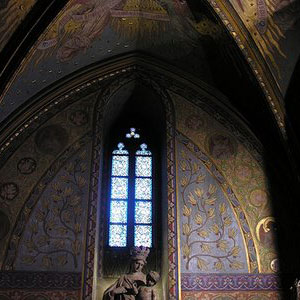
In the Matyas Templom in Budapest I hardly dared to breathe as I explored its treasured depths, shocked into silence by its beauties and splendours.
On an evening in 1986 my brother and I went to the movies. We saw ‘The Mission’ — the film featuring Robert De Niro and Jeremy Irons about the so-called ‘Reducciones’ of Paraguay. My brother and I got up from our seats in the theatre, walked to his car, drove home, had a cup of tea and went to bed never having uttered a word. Only the next morning could we break the silence which was the only possible initial response to this powerful piece of the film maker’s art. Twenty years later — a lifetime gone by — I still remember that silence.
4
A cafe kitchen is a noisy place, and this kitchen seemingly particularly so — the roof is high and seems to amplify the clatter and the babble of instructions and requests and idle chatter. The volume rises, and excited altercations and conversations take on the air of shouting matches.
We resolved once that we would not speak at all while working in that kitchen except for that which was strictly necessary — which is very little.
Bliss!
No more the babble of voices, no more inane and pointless words, no more listening to the waiter’s latest absurd theories trawled up dripping from the dark depths on his last expedition wading through the corrosive swamps of cyberspace, no more the dish-washer’s kick by kick recount of some long-forgotten world cup football final, no more grizzling, no more gossip, no more profound discussion . . . silence.
At the end of our work period when we would sit down to eat dinner together we found that the silence of our working time spilled over. We would eat quietly: we had learned that there is little that needs to be said, and much to be gained from silence.
5
We had a tiny, tin caravan, and, come Christmas and those long, dry, endlessly sunny, blue-skied days of holiday time, Dad would hitch it up to the car and we would grind down some distant, dusty road to a remote spot beside a leafy river, and the blissful days of rest and adventure would begin.
There were exhausting hikes to undertake; there was swimming in some mysterious swimming hole in the river; there were adventures in the bush; battles with pinecones; there was washing in the cold, early morning in the river; there was scraping potatoes in a bucket for Christmas dinner; there were wild birds to gaze upon; there were games of badminton — a dusty track the court: all the joys of childhood.
The caravan was far too small to house all of us. Mum and Dad and my two eldest sisters slept there; my two brothers slept in the tent — a weighty canvas affair — my youngest sister and I slept in the car. But each evening with the day’s adventures done, when that delightful lassitude falls upon one after a day of sun and fresh air and exertion and experience, we would all crowd into the caravan and we would kneel down on the hard, grey floor and we would pray the rosary.
The kerosene lamp — the only light — would cast a dim, golden glow as the great silence of the surrounding night shaped itself about the ancient words, hallowed by centuries, worn smooth by ceaseless use. ‘Concentrated meditation upon the prototypes of magnanimity’ an Islamic scholar once called it. And at the end of that recitation — that call and response of mantric phrase — when the great silent world of heaven seemed to hover with bright wings just beyond our sight — then vast silence would fall upon us and a stillness wherein the tiny tremor of the lamp’s flame was the only sound.
6
How may one who has returned from the silent depths of divinity convey to man in his chaotic, quotidian realm something of the beauty of the silence of God? Music, such a one might employ.
I was privileged once to hear Sri Chinmoy — just such a friend of God’s silent depths — play music: a music that flowered forth from his understanding of the great silence beyond.
The Riverside Church — a name redolent of all that it is which flowing water means in the spirit of man — was his venue, and from the initial, soft, husky, dove-like notes we were in the presence of sound as it is rarely heard.
After teasing meaning from a variety of different instruments, Sri Chinmoy played upon the pipe organ in that great stone church beside the river. He later named the piece he had played ‘Love versus Power: Equal Winners’ — and a great wall of sound it was, a roaring of the very universe that seemed to shake the very substance of the stones. And at the end — silence. A silence more vast than even that great sound.
7
The seventh drop?
Listen!
Barney McBryde
Rhode Island, USA
Solo Style Silence
 My mornings began with the same ritual. I finished meditating, laced up my shoes, and brushed the last vestiges of sleep from my eyes before heading out the door for a morning jog. I had to go running early if I wanted to avoid the sun’s heat and humidity – an otherwise midday partner to the manicured hotel lawns, palm trees and adjacent rice paddies while vacationing in Solo, Indonesia. It was a far cry from the fast-approaching winter I left behind at the end of November back home on the East Coast.
I found myself in such tropical environs in 2003 while on a spiritual retreat with my meditation teacher Sri Chinmoy and several hundred of his students from around the world. Hoping to deepen my inner communion with God, for three weeks I found myself immersed in meditation, devotional singing and the learning of prayers under the tutelage of Sri Chinmoy’s spiritual and artistic mastery. All told over the course of the trip, he would offer hundreds of prayers, spiritual poems and devotional songs during functions held in conference rooms at the hotel.
A day brimming with this meditation, singing and the learning of these literary kernels of wisdom typically started for me with a run. Even though it was just 6:30 am, the idyllic landscaped grounds of this beautiful hotel were invitation enough to overcome my usual obstacles to taking exercise in the dawn of the day. The hotel complex itself spread out over a large area and I typically followed a short road lined with palm trees contained within the grounds and also some paths that snaked around hotel buildings, small ponds, over little bridges and alongside the rice fields.
Those quiet solo runs amidst nature’s tropical beauty offered an invitation to a world of stillness. I savored the time alone hearing just the rhythm of my feet and the calls of morning birds. Because this part of my day was itself steeped in quietude, my thoughts as I ran were repeatedly drawn to some of Sri Chinmoy’s compelling prayers on silence offered the prior week in Singapore. Singapore had been our week-long location prior to arriving in Solo. One such prayer from that first week of the retreat declares,
“No mind-emptiness,
No heart-oneness,
No God-fulness.”
– Sri Chinmoy
(Unofficial, from My Christmas-New Year-Vacation-Aspiration-Prayers, Part 22)
I found an ocean of spiritual wisdom in these three lines. According to this aphoristic prayer, quieting the thought process is a necessary first step in spiritual awakening. While I contemplated the importance of silence for inner growth, I lamented just how frequently silence was actually missing from my daily life.
As I ran on a different day, the beautiful flora surrounding the hotel reminded me of another prayer he offered in Singapore on the preciousness of silence portrayed as a favorite flower.
“I have millions of flowers
In my heart-garden,
But I love the silence-flower
Infinitely more than any other flower.”
– Sri Chinmoy
(Unofficial, from My Christmas-New Year-Vacation-Aspiration-Prayers, Part 22)
I bore witness to the intervals of internal chatter and thoughts as I jogged along and yearned to mirror the early morning stillness around me more completely. I prayed while running to truly befriend and learn silence – to know the beauty of silence as a personal reality.
Thinking the attempt would support this desired inner silence, I also tried to let go of dwelling on the past or future and imagined that while I ran nothing else existed except the Eternal Now. I wasn’t sure I exactly knew what the Eternal Now precisely meant but just even imagining it left me feeling as if heavy mental and emotional burdens were being instantly lifted from my shoulders. I felt happy in the core of my being.
These morning contemplations quickly took on a new layer of special thrill when signs appeared to indicate my whispered longings were heard in the inner realms. Along with the practice of writing down the prayers and poems Sri Chinmoy offered during the retreat, I used to try to guess and write down the words to the songs he composed in his native Bengali right as he was teaching them to us.
One afternoon Sri Chinmoy sang a newly-composed song in Bengali in the function room. I delightedly wrote down a song with the Bengali words for learning, silence and initiation. The song from the Ashar Duar, Pt. 1 Songbook by Sri Chinmoy states:
“Shikkha dite chaho tumi nirabatar shikkha
Taito tumi dile amai amaratar dikkha.”
I knew that “shikkha” had to do with the English word for teach or learn, “dikkha” for initiation and that “nirabata” meant silence. As was often the case in Sri Chinmoy’s songs, the last word of each line of the song rhymed.
With a Sri Chinmoy Centre Bengali Dictionary in hand, the song seemed to indicate a kind of conversation between the seeker and the Guru with the Guru speaking to the seeker in the first line - You want to learn and be given silence. Then in the second line the seeker seems to be answering - Therefore, You gave me initiation into Immortality.
I am unable to verify my rough sense of the song’s meaning because Sri Chinmoy never translated this particular song from his native Bengali into English. Regardless, my own interpretation was that my prayers were undoubtedly heard.
My feeling that I was now engaged in one-on-one tutoring about silence without a single outward conversation between Sri Chinmoy and myself received reinforcement in another prayer taught to us during this trip,
“Where is God?
God is just behind me,
Watching me very carefully.”
– Sri Chinmoy
(Unofficial, from My Christmas-New Year-Vacation-Aspiration-Prayers, Part 24)
Convinced that Sri Chinmoy was tuned in to my inner psyche, his composed prayers and songs spoke frequently and eloquently on the subject of silence during this trip. The books published afterwards containing prayers given in Singapore and Solo, Indonesia include profound wisdom on this important concept in Sri Chinmoy’s spiritual philosophy. Some were a whimsical depiction of the battle to silence the mind,
“Do not think unnecessarily,
Do not think!
Your mind will completely be covered
With ink.”
– Sri Chinmoy
(Unofficial, from My Christmas-New Year-Vacation-Aspiration-Prayers, Part 23)
Others articulated my fervent prayers,
“O my mind,
I am begging you
To come with me only once
Into the silence-world.”
– Sri Chinmoy
(Unofficial, from My Christmas-New Year-Vacation-Aspiration-Prayers, Part 24)
My concentration on living in the present and the subject of the Eternal Now was even reflected in the prayers Sri Chinmoy offered subsequent to my experiments with invoking that concept,
“Since my Lord
Does not think of my future,
Why do I have to think
Of my future?
Do I not know
That my future is eternally safe
In my Lord’s Hands?”
– Sri Chinmoy
(Unofficial, from My Christmas-New Year-Vacation-Aspiration-Prayers, Part 24)
“To have purity,
The seeker has to feel
That he is a child
Of the Eternal Now.”
– Sri Chinmoy
(Unofficial, from My Christmas-New Year-Vacation-Aspiration-Prayers, Part 25)
One prayer in particular crystallized my experiences during those daily runs.
Sri Chinmoy offered it at the conclusion of a formal running race held one morning on the road inside the hotel grounds,
“My morning running prayer
Is my heart’s
Silence-bliss.”
- Sri Chinmoy
(Unofficial, from My Race-Prayers, Part 1)
Ever since that spiritual retreat in Solo, I associate Sri Chinmoy’s philosophy on the subject of silence with the hush of my footfalls in the early morning light framed by palm trees, rice fields and a song melding the teaching of inner silence with the doorway to immortality.
Sharani Robins
Rhode Island, USA
Silence
 The first time I heard a late Beethoven string quartet, I was dog sitting a giant black poodle while its owners, my longtime friends, were away on vacation.
I had recently become interested in classical music. After my friends left me alone with the dog in the big house, I put the disc in their stereo system in the living room and sat down in the easy chair. The dog took a break from its pacing and sat at my feet as the music began.
It sounded restless and strange- like the music they play on Mars or some far away galaxy. I didn’t enjoy it, but for some reason I felt compelled to play the CD again. I scratched the dog’s big, curly head, behind his ears, and sailed with the music to distant ports.
Maybe going deaf was somehow a boon for Beethoven because it enabled him to forget the pressures of the outside world and just focus on composing music, on listening to his musical conscience.
It intrigues me that Beethoven, after years of physical ailments, financial hardship and absolute consecration to his art, at the end of his life found the means to listen to his musical conscience without any conditions or compromises. He surrendered to the Voice of Silence, to use a favorite expression of Sri Chinmoy’s.
Sri Chinmoy himself has a special and unique silence that attracted me from the first time I saw him. I admire the way he can stand in front of an audience of thousands, and through the mere simplicity and goodness of his presence, make everyone gathered there vividly and fluently conscious of his own inner divinity.
I remember when I took a dear friend and spiritual seeker from Philadelphia to see Sri Chinmoy in Queens for a public meditation program. It began around eight o’clock in the evening and finished shortly before eleven. When we boarded the subway for our long return trip, I noticed that my friend was literally shining with light. All he could do was smile and smile, and I noticed that that was all I could do, too.
“Were you people meditating with Sri Chinmoy?” an old woman on the subway asked us.
“Yes,” I told her; and then asked her how she knew.
“Oh, I could see the haloes!” she replied.
A few months after our New York adventure, I saw my friend in a spiritual bookstore in Philadelphia. He was with a friend or a co-worker. I asked him if he still remembered the experience he had with Sri Chinmoy.
“It was like my mind was truncated,” he said, hurriedly and breathlessly, “I felt a peace and a light that night that I have never felt before or since.”
His buddy raised his eyebrows and said, “So, merely being in the presence of a great soul was enough to raise you into another plane?”
“Absolutely,” he said emphatically.
Sri Chinmoy once wrote that all true spiritual Masters teach meditation in silence. A careful and a meticulous writer, Sri Chinmoy tends to avoid absolutes. He recognizes how many different forces and possibilities are working at the same time. So, I was struck by that statement, that all real spiritual Masters teach meditation in silence. All. It reminds me of a Daoist proverb, that if a seeker asks a question about the Way, and if the Master answers it, then neither of them knows anything about the Way.
To digress a little, I remember so well many of Sri Chinmoy’s beautiful smiles. One of Sri Chinmoy’s most powerful spiritual tools was his smile. I recall that once he was reading the prasad (sanctified food) list after a function and he came across an item that he read out as “M plus M” with a somewhat puzzled quality in his voice. Everyone in the room immediately shouted “M and Ms!” and he gave us the biggest, sweetest smile I can remember. Whatever could help to station us in the child-like consciousness he loved. Maybe that’s why he was always handing out ice cream after functions. Hmmm… meditation and ice cream. Add some crème brulee, Swiss chocolate syrup, some maraschino cherries and… well, I seem to be getting off track!
Long before I ever met Guru, a friend of mine handed me a copy of Beyond Within, Sri Chinmoy’s treasure house of spiritual wisdom and knowledge. Here’s a striking poem from that book:
“Your thoughts divine are in my heart;
In Your Heart, my pangs and my sufferings.
In my life is Your Dream;
In Your Life I am the constant torture.
I am the tiniest drop of Your Compassion.
O Nectar-Ocean of Infinity, come, come into my dark room
And bind me with Your cord of Liberation.”
— Sri Chinmoy
(Unofficial)
This was one of the first poems of Sri Chinmoy’s that I ever came across. I like how well this poem works read aloud. It has a wonderful richness in its movement, that recalls the psalms or some of Shakespeare’s great soliloquies. There are only four concrete images in the poem, and they occur in the last four lines: drop, Nectar-Ocean, dark room, cord of Liberation. Drop, ocean, room, cord. The drop is isolated in a dark room, and it cries for the Nectar-Ocean to appear and to bind it with its cord of Liberation. It is crying to come out from the prison of self-chosen isolation, into a divine captivity- which is no captivity but really the drop’s or the individual’s awakening to his own cosmic identity. The intensity of the imagery may be compared with that of John Donne’s masterpiece “Batter my heart, three-person’d God” (Source).
Sri Chinmoy’s written words will stand for him, manifesting his unique Light for future generations. How lucky I am to have known the author of so many heart-awakening books!
I will remain eternally grateful to Sri Chinmoy for his soulfully dynamic life, and for shining his light down to guide us towards the infinite Beyond.
With love and gratitude always,
Mahiruha Klein
Chicago, USA
Oslo Statue at Eternal Peace Flame
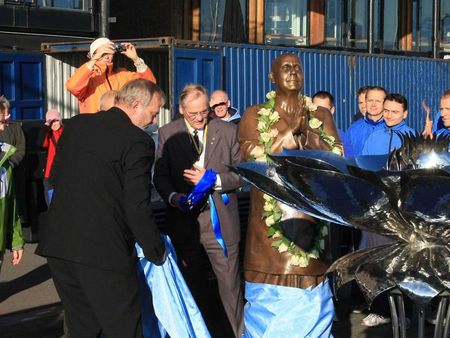
Report by Manatita
It is undoubtedly true to say that Oslo city in the last couple of days was quite cold. Today, however, October 27th, 2008, at about 1230 hrs, the breeze was quite fresh and the sun was shining intermittently in and through the heavens. Here at Honnorbryggen, Aker Brygge Port, Oslo, Norway, a small but expectant group of about one hundred and fifty people, were gathered together, eagerly and enthusiastically awaiting a very special Ceremony. It was about 12.30 p.m; the second World Harmony Interfaith Walk, and the unveiling of the Sri Chinmoy Statue at the Eternal Peace Flame, was about to begin.
The Walk commenced about 12.45 p.m. Present were Interfaith guests, dignitaries, ambassadors, friends, well-wishers and spectators alike. Two Interfaith delegates carried the lighted World Harmony Run (WHR) Torch, which served as a symbol of friendship, harmony and mutual understanding of the need for universal peace.
The World Harmony Interfaith Walk arrived at the Eternal Peace Flame and the Statue at about 1300 hrs. There Husiar - one of the main organisers of the programme - acted as Master of Ceremonies and conducted the proceedings. To welcome the runners, a Norwegian Children’s Choir, known as Aspirant Kortet, and their lovely conductress, gave an enchanting performance of the World Harmony Run song, the Norwegian National Anthem and a sweet, childlike and traditional song called Fola, Fola, Blakken. As the WHR runners were introduced, they ran into the Ceremony, and were heartily received by all present. The Interfaith leaders were asked to lead the group in a minute of silence for peace. They all offered a prayer, and Husiar concluded with another minutes’ silence.
Present were the Deputy Bishop of Oslo, Olav Dag Haughe, Imam Hafiz Mehboob Ur-Rehman, Spiritual Leader of the Islamic Cultural Centre of Norway, Venerable Minh Tanh, Head of the Vietnamese Buddhist Society in Norway, Mr. Gopal Sharma, past President of the Sanatan Hindu Temple, Alia Kirsten Arnesan, Head of the Sufi group in Oslo and Rabbi….
The former Mayor of Oslo, Mr. Svenn Kristiansen’s speech preceded him, as it was uncertain as to whether he would arrive on time. However, he turned up immediately afterwards, and was honoured with the Torch Bearer Award of the World Harmony Run, for being an open-hearted champion of world peace. In his speech the former Mayor recognized the importance of the World Harmony Interfaith Walk, and expressed his pride in seeing people from so many countries working together to promote peace in their day to day lives and in their communities. Former Mayor Kristiansen also mentioned Sri Chinmoy and his gift of the Eternal Peace Flame, to the people of Oslo, his dedication to fostering religious harmony and oneness amongst peoples and nations. He also pledged his support for these noble ideals. He finally thanked the children and youth, recognizing them as the hope and promise of the world.
The next speaker was Dr Vidor Vambleim of the Centre of Peace Studies at the University of Tromso. He spoke of Sri Chinmoy as a man of dialogue. He also said that dialogue and searching for a common ground for peace was much easier in the presence of children, and praised the organisers for including children in the programme. He thanked Sri Chinmoy in Heaven, and wished that his message of peace and oneness, continue to inspire and uplift the world.
The last speech was by Mr. Paul Moen, Director of Aker Brugge Port. Mr. Moen was very instrumental in the installation and inauguration of both the Eternal Peace Flame and the Statue of Sri Chinmoy. He mentioned Oslo harbour as a focal point for Tourism, talked about his pride in having the Eternal Peace Flame in Oslo, and said that the flame represented the spirit of Oslo and the dedication of Norwegians to world peace. He also praised Sri Chinmoy, saying that although Sri Chinmoy was not tall physically, he stood as a giant of love, kindness and peace, and a champion of Interfaith Harmony. He touched on Sri Chinmoy’s good standing with other world bodies such as the United Nations, Parliament of World Religions, and leaders such as Nelson Mandela and Mother Theresa. Mr. Paul Moen concluded by mentioning Kaivalya Torpy, the sculptor of the Statue, and afterwards invited Mr. Svenn Kristiansen, Dr Vidor Vamblaim and Kaivalya Torpy for its unveiling. This took place at about 1345 hrs.
About the Statue, it stood 2 metres tall (6ft 6 ins), majestically and powerfully overlooking the Eternal Flame. Arms folded in front in prayerful obeisance and seemingly in deep contemplation, Sri Chinmoy‘s Statue appeared to be radiating light in abundant measure.
The evening had a cute conclusion with Mr. Paul Moen playing and singing a ballad-type song on his guitar, to the delight of all present.
See also: WHR Report
24 Hour Self-Transcendence Race: an eyewitness report
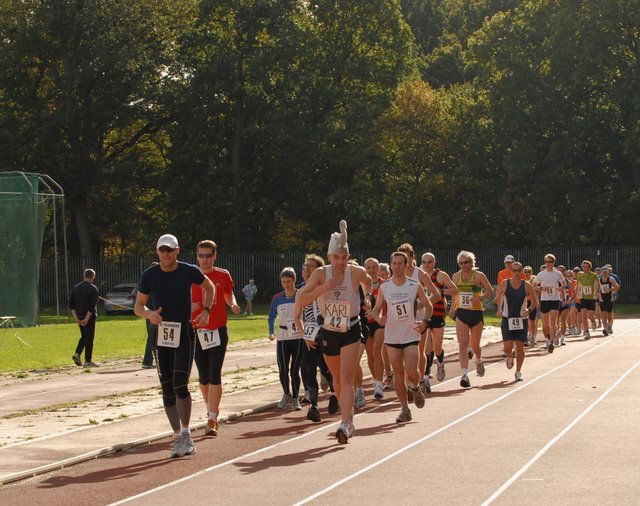 Sri Chinmoy always saw sports - and running in particular - as tremendously beneficial to the spiritual life, both in terms of keeping the body healthy and for the opportunities it afforded for people to reach their highest potential. In 1977, he founded the Sri Chinmoy Marathon Team to serve the worldwide running community, and it has since grown to be the largest organiser of endurance sports events in the world. One very popular race it organises is the 24 Hour Self Transcendence Race in London every October. Sri Chinmoy Marathon Team member Matthias Eckerle went over to help, and he has kindly provided us with this eyewitness report:
The race started at 12pm Saturday, continuing around a 400m track right through the night till 12pm the next day. The field of runners came from many different countries. As well as organising the race, there were also two members of the Sri Chinmoy Marathon Team participating. One of the, Asprihanal Aalto from Finland, has the distinction of being a four-time winner of the world's longest race, the 3100 Mile Self-Transcendence race. Alongside the faster runners, it was especially aspiring to see many older people also participating - the oldest was 77 years!
For me, it was a nice experience to take care of the runners and to meet their requests for coffee, tea and soup - even after hours of running most of them were still able to smile! With in a couple of hours, we knew the names of all the runners, and they really appreciated this personal treatment.
Some of them (including the winner) ran very fast in the beginning before slowing down towards the end of the race. Others were mre constant, including Asprihanal, who in the last hour put on a surprising burst of speed to run 7 kilometers in 40 minutes to end up in 7th place. One of our jobs as helpers is to run along with the runners forthe last 2 or 3 minutes to mark thir finishing spot - I was running with Asprihanal, and it was a very nice feeling - he really is a very humble guy who doesnt think of boasting about his considerable achievements.
The race was won by Chris Finhill covering a distance of 243km followed in 2nd place by Ireland's Eoin Keith who ran 235km, breaking the Irish national record along the way. However, a race like this is really all about competing, and at the end everybody was honoured with a race medal and photo commemorating their achievement. It was very inspiring for me, and I think I will definitely work towards entering this race myself at some point in the future.
Race photos: Alan Young
October 2008 - latest news
Tatyana Lebedeva, winner of the triple jump in the Athens Olympics and two time silver medalist in Beijing, first met Sri Chinmoy in 2004. Recently, upon returning from the Beijing Olympics she gave a very nice interview with the International Athletics Federation where she talks about how Sri Chinmoy has encouraged her. “His philosophy of constant Self-Transcendence left a deep trace in my life, and I always try to improve myself, no matter how tired I may feel.” she reflected in the interview. “It is impossible to live only in sport. I need to learn a lot, so that when I finish my sports career, I would have a chance to bring real benefits to the sport of athletics. This is my internal task and I formulated it thanks to the philosophy of Sri Chinmoy.” Tatyana has no intention of ending her athletics career just yet, and already has her sights fixed on Olympic gold in London in 2012. Read interview here...
Karteek swims channel for 9th timeKarteek Clarke from the Sri Chinmoy Centre in Edinburgh cmpleted the gruelling swim from Dover to Calais, making it his 9th time! Quite a few of Sri Chinmoy’s students have swum the channel, and in fact the Sri Chinmoy Marathon Team (the sporting organisation founded by Sri Chinmoy as a service to the sporting community) holds the record for the team with the most Channel crossings.
Gandharva Loka OrchestraIn April 2008 and again in August 2008, two beautiful concerts were performed in tribute to Sri Chinmoy and his music. These concerts, called ‘Songs of the Soul’ featured well known musicians such as Philip Glass, Roberta Flack, Boris Purushottama Grebenshikov and Kristin Hoffman. One highlight of both concerts was the Gandharva Loka Orchestra, a 75 member instrumental and choral ensemble of Sri Chinmoy’s students, performing dazzling orchestral arrangements of Sri Chinmoy’s songs which brought the audience to their feet. The orchestra are now scheduled for a European tour in November, taking in the cities of Berlin, Prague, Munich, Milan, Zurich and Heidelberg and a North American and Canadian tour next spring.
- ‹ previous
- 174 of 337
- next ›

Except where explicitly stated otherwise, the contents of this site are licensed under a Creative Commons Attribution-NonCommercial-NoDerivs 3.0 Unported License. read more »
SriChinmoyCentre.org is a Vasudeva Server project.