Before sending a message, check if there are local contact details for a Sri Chinmoy Centre in your country (see the list below). If you don't see your country, then please use this form and we'll make sure it gets to the right person.
For copyright and media requests, you can also use this form.
My God-Hunger-Cry – August 28, 2006
To keep God busy I cry and cry;
To keep God smiling I try and try.
- Sri Chinmoy.
In October of 2005, Sri Chinmoy began a series of prayer-poems entitled My God-Hunger-Cry. We are delighted to feature them here and hope they bring you joy and inspiration.
My God-Hunger-Cry – by Sri Chinmoy
My God-Hunger-Cry – August 27, 2006
I came into the world
To clasp the Feet of my Lord Supreme.
Every day in a special way
He fulfils my treasure-dream.
- Sri Chinmoy.
In October of 2005, Sri Chinmoy began a series of prayer-poems entitled My God-Hunger-Cry. We are delighted to feature them here and hope they bring you joy and inspiration.
My God-Hunger-Cry – by Sri Chinmoy
My God-Hunger-Cry – August 26, 2006
I came into the world to burst my ego-balloon
To become power's sun and beauty's moon.
- Sri Chinmoy.
In October of 2005, Sri Chinmoy began a series of prayer-poems entitled My God-Hunger-Cry. We are delighted to feature them here and hope they bring you joy and inspiration.
Step 4: Living a Meditative Life
Goals
In this fourth and final step you will:
Learn how the power of mantra can help your meditation.
Learn how the power of words can improve the quality of your life.
The Power of Words
You’ve come a long way in the last three weeks. We hope by now you are feeling more comfortable with meditation. This week you will be continuing all of your exercises from Week 3, plus you’ll be adding one more important technique: mantra.
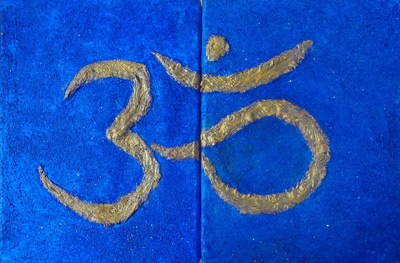
The word AUM - the oldest known mantra - written in Sanskrit.
Simply put, mantra is the repetition of a word or a phrase. Traditionally, mantras are specific words or phrases that invoke or embody some spiritual power. In a broader sense, any word or phrase that you use on a habitual basis is a kind of mantra. In either case, the power of mantra comes from repetition and from the qualities of the words themselves. Therefore the effect of the mantra on your consciousness depends on how often you repeat the mantra and the words you use. If you use positive, spiritual, uplifting words, your life will be positively affected. If you use negative words, your life will be negatively affected.
This week you’ll be trying a few traditional mantras and mantric songs during your meditation, using spiritual words that contain tremendous power. But you need not limit your use of mantra to meditation. Mantras can be used any time you need them. For example, if you are feeling stressed out and you are in a situation where you can’t meditate, you can always silently chant a mantra.
Tips for a Meditative Life
Does this mean you need to drastically change your life within the next ten minutes? No. Your own meditation will naturally, gradually, and gently make the necessary changes in your life. In fact, you may have noticed some of these changes already.
However, you can encourage and accelerate the process by consciously engaging your body, mind, heart, and soul in sup-port of your meditation. There are countless things you can do; here are a few suggestions:
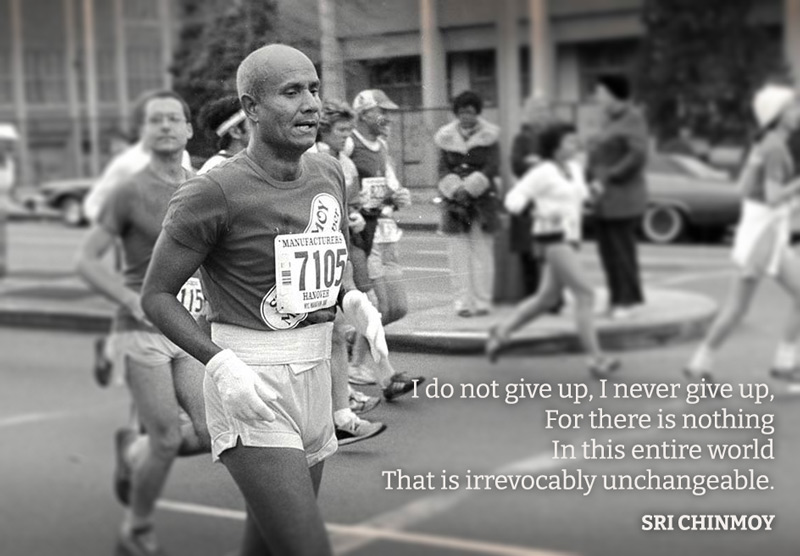
Sri Chinmoy felt that sports and meditation could go together; his students practice sports and put on events for the public.Exercise: By cleansing and strengthening your body and mind, exercise can have a tremendous impact on the quality of your meditation.
Diet: Many people who meditate find a vegetarian diet to be especially beneficial, from both a physical and a spiritual point of view.
Inspirational Reading: Many other spiritual seekers have passed this way before us, and their writings are a valuable source of inspiration, consolation, and direction. Try to make inspirational readings a regular part of your mental diet.
Music: Music is a universal language that speaks directly to our heart and soul. Try to surround yourself with meditative music—in your car, at work, at home, even while going to sleep. Singing and playing meditative music can have a mantric effect.
Spiritual Friendship: Friends provide strength in our moments of need and affirmation in our moments of joy. That’s why it is so important to have friends who live a meditative lifestyle, and can share in your experiences as you progress in your own meditation. Whenever possible, take the opportunity to enjoy group meditation—if the group is practicing a form of meditation harmonious with your own. The collective energy and inspiration of the group will be an invaluable aid to your own meditation practice.
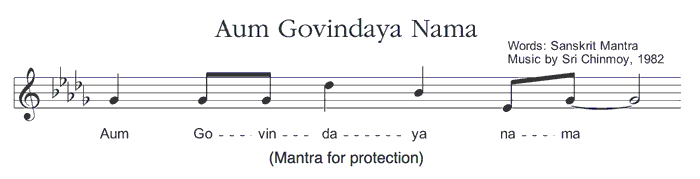
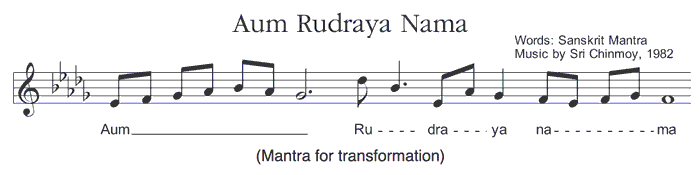
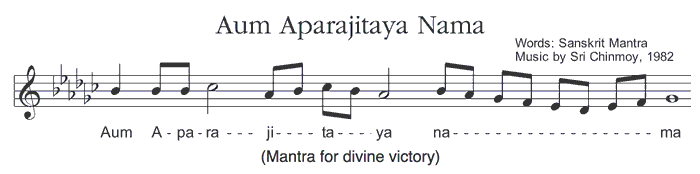
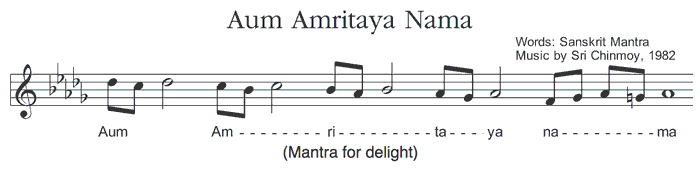
These are some simple songs that we often play in our meditation classes. They are Sanskrit mantras that are thousands of years old, that have been set to music by Sri Chinmoy. Play the mantra, and try to sing along with it, either silently or (preferably) audibly. Using the folded-hands posture is especially powerful when it comes to singing mantras; it make it much easier to get in contact with your heart.
Exercise 2: One-word mantras
You can start with the word Aum - you can read about the significance of this word in chapter 9 of the handout. Note especially that the ‘M’ sound should be about three times as long as the ‘AU’ sound, and that Aum rhymes with “home.” A good start is to chant the mantra 13 times slowly.
After you have chanted Aum, you may wish to try other mantras as well. Another powerful mantra is the word Supreme. Our teacher, Sri Chinmoy, really liked this word because repeating it invokes the highest reality within us.
You might also try Peace, Shanti (“peace” in Sanskrit, rhymes with “Monty”), or Gratitude.
Towards a Higher Consciousness
You would probably like to improve the quality of your life, so that means improving the quality of your consciousness. But how do you do that? First of all, it’s important to understand that your consciousness is not simply “good” or “bad”; it exists on a continuous scale from lower (worse) to higher (better). What you choose to think and do on a moment-to-moment basis determines where your consciousness is on that scale.
Let’s look at it this way: think of your consciousness as an old-fashioned balance scale, like the one pictured here. To move your consciousness from the lower end of the scale towards the higher end of the scale, you can do two things:
Place less on, or remove from, the lower side
Place more on the higher side
Every time you meditate, you are putting more weight on the higher side of the consciousness scale. But what happens if you are also putting weight on the lower side in other areas of your life? The scale tips back towards the lower end of the scale, and much of the benefit derived from your meditation is lost. This is why many people eventually give up meditation.
You may be thinking, “All I have to do is stop putting weight on the lower end of the scale, and I’ll get the full benefit of my meditation.” If only it were that easy! In fact, if you already had the capacity to eliminate all the negative influences in your life, you wouldn’t need meditation in the first place. But as we all know, the reality of life is that we can and do fall prey to negative influ-ences that lower our consciousness. That’s why it’s so important to support your medi-ta-tion with all parts of your being.
You Made It!
Congratulations! Four solid weeks of meditation is a tremendous accomplishment which is bound to bear fruit. Before thinking about what lies ahead, take some time now to look back through your journal.
How has your meditation changed over the last four weeks?
More importantly, how has your meditation changed you over the last four weeks? Is there any difference in your awareness of yourself and the world around you?
Hopefully the answer to the last question is a resounding “Yes!”—and hopefully the change in your awareness has been a positive one! If you aren’t sure how (or if) your awareness has changed, think carefully about how your day-to-day inter-actions with the world have changed over the past month. Are you less affected by outer circumstances? Are you more conscious of the underlying causes of your actions towards others and their actions towards you? If you’re not sure, let’s look at a few examples of how your aware-ness may have changed. Although you may not have been in these exact situations, and your reactions may not have been exactly the same, chances are you have experienced something similar.
Situation: Someone yells at you for no reason. Old reaction: You immediately get defensive and yell right back. New reaction: You have sympathy and understanding. You say to yourself, “That person must be under a lot of pressure.”
Situation: Traffic jam on the way to or from work. Old reaction: You get angry and frustrated. New reaction: You look for the good side of any situation. In this case you realise you have extra time do your favourite meditation practise right there in your car.
Situation: Things don’t go “your way.” Old reaction: Your expectation of a certain result leads to frustration. You cry to the heavens, “Why do these things always happen to me!” Because you depend on outer circumstances to measure yourself, your self-esteem suffers. “Why can’t I do anything right?” you wonder. New reaction: Things happen—but because you don’t expect them to happen in a certain way, there’s no frustration. And because you are more centered, your self-esteem is less vulnerable to outer events.
In each situation, notice something important: the external events haven’t changed; what’s changed is the state of consciousness you are in when the events occur. In other words:
Your consciousness determines how you interpret outer events;
This interpretation determines your experience of the world, positive or negative;
Your experience of the world determines the quality of your life.
It all begins with consciousness. The bottom line is - the quality of your consciousness determines the quality of your life.
Thank you for allowing us to be of service in your search for greater meaning and fulfillment through meditation. Meditation has been an incredible gift to our lives, and we consider it a privilege to have had the oppor-tunity to share that gift with you. Wherever life’s journey may lead you, may you find peace, joy, happiness, and success. And please remember:
Step 3: Meditating in the Spiritual Heart
Goals
In this third step you will:
Continue your regular, daily meditation practice at your shrine.
Learn about the paramount importance of your spiritual heart.
During your concentration exercises last week, you discovered a higher awareness which is separate from your mind. We all know where our mental awareness lives—somewhere above and between our shoulders—but where does this higher awareness live?
Your highest awareness lives in the spiritual heart. But what and where is the spiritual heart? Let’s start with where. Close your eyes for a moment (after you finish this paragraph, that is). With your index finger, point to yourself while saying “me.” Do this several times. Where did your finger end up? On your spiritual heart. Now that you know where it is, let’s talk about what it is.
It is only with the heart that one can see rightly;
What is essential is invisible to the eye.
Antoine de Saint-Exupery
The Heart: An inner fountain
In the meditation handout, you will have read about the spiritual heart, or simply “the heart.” As you may have guessed, the spiritual heart has nothing to do with the muscle beating away inside your chest. But it has everything to do with the qualities we need to become happier, more fulfilled human beings.
What are the qualities of the heart? Intuitively, you already know. Take a look at the qualities being expressed in the following phrases: a heart of gold, it absolutely breaks my heart, kind-hearted people.
Kindness, caring, love, sympathy, oneness, compassion, self-giving and gratitude—these are the qualities of the spiritual heart.
Exercises
While you are practicing these exercises, we recommend you try folding your hands with palms together, fingers straight and facing upward with the base of your thumbs gently touching your heart—as if in prayer. This physical act will remind you of what you are doing spiritually, and will actually intensify both your aspiration and your meditation.
These exercises are taken from Sri Chinmoy's writings.
Exercise 1: Gratitude
The best way to bring new life into each new day is to offer endless gratitude to God the Creator and God the creation early in the morning. When our gratitude-heart blossoms, it immediately covers the length and breadth of the world. The beauty and fragrance of a gratitude-heart will always remain unsurpassable among all the divine qualities that a seeker has. So the answer is gratitude, gratitude, gratitude!
Offer gratitude: that is the best way, the only way. The second you offer gratitude in your thoughts and in your feelings, your oneness will be perfect. If you offer gratitude, you will understand more; your mental vision, psychic vision, everything will become perfect. Gratitude, gratitude, gratitude is the only answer. Try to grow the gratitude-flower inside your heart and watch it blossom petal by petal. As it blossoms it is spreading its beauty and fragrance.
You can open your heart of gratitude to God just by repeating the word gratitude as you breathe in and out. - Sri Chinmoy
We will be talking more about mantras in the next section - for now, you can try listening to this song or singing along with it, whilst feeling its message inside your heart as a vibrant truth: My own gratitude-heart is all that matters.
Exercise 2: The vastness of the sky
Video Content
Playing this video will load cookies from Vimeo. Please accept cookies to view this content.
Video
Keep your eyes half open and imagine the vast sky. In the beginning try to feel that the sky is in front of you; later try to feel that you are as vast as the sky, or that you are the vast sky itself. After a few minutes please close your eyes and try to see and feel the sky inside your heart. Please feel that you are the universal heart, and that inside you is the sky that you meditated upon and identified yourself with. Your spiritual heart is infinitely vaster than the sky, so you can easily house the sky within yourself. - Sri Chinmoy
Exercise 3: The heart-rose
Video Content
Playing this video will load cookies from Vimeo. Please accept cookies to view this content.
Video
Kindly imagine a flower inside your heart. Suppose you prefer a rose. Imagine that the rose is not fully blossomed; it is still a bud. After you have meditated for two or three minutes, please try to imagine that petal by petal the flower is blossoming. See and feel the flower blossoming petal by petal inside your heart. Then, after five minutes, try to feel that there is no heart at all; there is only a flower inside you called ‘heart’. You do not have a heart, but only a flower. The flower has become your heart or your heart has become a flower.
After seven or eight minutes, please feel that this flower–heart has covered your whole body. Your body is no longer here; from your head to your feet you can feel the fragrance of the rose. If you look at your feet, immediately you experience the fragrance of the rose. If you look at your knee, you experience the fragrance of the rose. If you look at your hand, you experience the fragrance of the rose. Everywhere the beauty, fragrance and purity of the rose have permeated your entire body. - Sri Chinmoy
If you completed the above exercise, you will now see exactly why you are meditating on the heart. Your heart—the center of the circle—is an infinite inner fountain from which flows every positive quality you would like to have. If you walk into a dark room and light a candle, what happens? The light illumines the darkness. In exactly the same way, as your heart opens through meditation, the light of your soul will illumine more and more of your being.
We must not cease from exploration.
And the end of all our exploring
Will be to arrive where we began
And to know the place
For the first time. - T.S. Eliot
Summary
During this third week, you will have:
Read Chapters 5-7 of the handout.
Practiced the recommended meditation exercises for at least ten minutes daily - preferably at the same time each day.
Logged your practice and your experiences in your journal.
It’s been three weeks since you began. Have you noticed any difference in how smoothly you get through the day? Review the events of the past week. Did situations that used to bother you not affect you as much? Did you generally feel a greater sense of inner peace and poise?
If you have noticed changes in your life, that’s fantastic - especially since you’ve just begun! If you haven’t noticed any changes, don’t worry about it - you’ve just begun! In either case, our advice is the same as always: meditate regularly, meditate sincerely, and have faith that you are making progress.
Do You Want to Change the World?
By now you may have shared your meditation experiences with friends and acquaintances, only to discover that some may not share your enthusiasm. You may even have been told that your desire for self-discovery is “selfish.” Don’t believe it for a second.
If you sincerely want to change the world, you have two choices: you can either try to change everyone else, or you can try to change yourself. Considering that you have far more control and understanding of yourself than you do of others, which approach do you think is the most effective use of your time and energy?
There’s another reason to change yourself first: you can’t give what you don’t have. Even if you try to give what you don’t have, it will have no power. If someone you think is a thief tells you not to steal, will you listen? Probably not. On the other hand, if someone you believe is a saint asks you not to steal, the purity, humility, and love of the saint will enter into your being and inspire you to lead a better life.
Does this mean you have to achieve sainthood before you can try to help others? Definitely not. If that were the case we couldn’t have created this HomeStudy course! But you don’t have to go out and do anything special to change the world. Just aspire to improve yourself, to bring more and more peace into your being, and to silently offer goodwill to others. This is the most important and most powerful thing you can do to help those around you and the world at large.
Step 2: Focusing the Mind
Goals for step 2:
Continue your regular, daily meditation practice in your special spot.
Exercises: stilling your mind, and focusing it through concentration.
Reading: Chapters 3 (stilling the mind) and 4 (concentration) from the handout
In your meditation during the first week, did you have the following experience? The moment you tried to quiet your mind, it filled with a million thoughts!
You were probably shocked at just how rambunctious your mind is. And you may have become a bit discouraged as a result. Don’t be discouraged! This is a universal experience.
Step back for a moment, though, and think about it—unless you had meditated before, this was probably the first time you had ever really noticed your thoughts. And if you were actually aware of your thoughts, that means that you have a higher, deeper consciousness that is separate from your mind. This is a great achievement! You have already reached a level of awareness beyond what most people will achieve in their lifetime.
You are probably still wondering why it is that you seem to have more thoughts as soon as you start to meditate. In reality you don’t.
Imagine that your mind is a car travelling down the highway at high speed. When the windows are closed, you’re flowing along with the car, and you don’t have much of a feeling for how fast you are actually going. However, if you open the window and put your head outside, what happens? Wham! You get hit in the face by a blast of air, and you suddenly have a very good sense of how fast you are going. The question is, was the blast of air always there, moving that fast? The answer, of course, is yes.
This is exactly what happens when you first try to quiet your mind. In your ordinary day-to-day awareness, you are flowing along with your mind’s thoughts, and you’re not aware of how many thoughts there are and how fast they are going. But as soon as you start meditating, it’s as if you put your head out of the car window and you get hit by a blast of thoughts. Were the thoughts always there? They were, only you weren’t aware of them.
So if you are trying to meditate and you become aware that you are having millions of thoughts, don’t worry. That awareness is exactly what you need. Once you are aware of your thoughts, only then can you gently bring your focus back to your breath, or the candle, or to whatever it is you are focusing on during your meditation.
But will my mind ever become quiet?
Yes! Remember, you are trying to discipline a mind that has been free to roam for a long time. And as you have discovered, it is impossible to shut it off all at once. That’s why you will be focusing on concentration this week. By concentrating the mind, you may still be thinking, but at least you are thinking about only one thing, and it will be you that is directing your mind, not vice versa.
Your muscles respond to regular exercise. In the same way, as you continue your daily meditation practice, your mind will become more disciplined and the number of thoughts you have will diminish. But try not to evaluate how well you are doing; you can be sure that if you are practicing regularly you are making solid progress.
If you find it difficult to deal with the flood of thoughts during meditation, you can use some simple imagery. Think of your consciousness as the vast ocean or the limitless sky, and your thoughts are like fish swimming or birds flying by in the distance. The important thing is to feel that the thoughts are insignificant, and that you don’t have to follow them.
So please be patient. With regular practice, you will definitely notice positive changes not only in your meditation, but in your day-to-day life as well.
Meditating with your eyes open
Up to now you have been meditating mostly with your eyes closed. This week you will practice concentration and meditation with your eyes open. By concentrating your mental focus on an object such as a candle or a flower, you will learn to anchor your mind and curb its tendency to wander.Like many beginners, you may find that you are distracted by the everyday noises around you. There are a couple of ways to deal with this problem:
You could go into a soundproof room every time you meditate—not very practical!
Meditate early in the morning when there is less going on in the world.
Learn to integrate noises into your meditation by allowing them to pass by—the best solution of all, because then you will be able to meditate anytime, anywhere, no matter what is going on around you.
Learning to detach yourself from noises takes time and practice. But once you can detach yourself from noises and meditate with your eyes open, you will possess a powerful tool to change your consciousness at a moment’s notice. And once you can change your own consciousness, you will also have a positive effect on the consciousness of those around you.
Let’s look at a brief example to see what a powerful effect your consciousness can have on the world. Imagine for a moment that you have just arrived at work half an hour late after fighting traffic for an hour. You’re in a really bad mood, and as a result you yell at your co-worker Joe for no reason. (Yes, we know that this would never happen to you, but just imagine for now.) Now Joe is in a bad mood. Joe goes home and yells at his wife, who yells at the kids, who in turn yell at the dog. The next day Joe’s family takes their anger out on others, and soon your one action has negatively impacted a large number of people.
Now imagine that you have just arrived at work a half hour late after fighting traffic for an hour, but this time you meditate for a few moments to bring peace and harmony into your being. You smile at Joe and say something to brighten up his day. He goes home, hugs his wife and kids, and pets the dog. They all feel loved, and the next day they spread this love - which started with you - to the people around them. This circle of love spreads until your consciousness has had a positive impact on a great many people.
Exercises
Now that you are familiar with breathing exercises, we can introduce some concentration exercises. You can still use the exercises from Week 1 if you like them.
Also, you can use your favourite exercises from Week 1 for a couple of minutes at the beginning of the concentration exercise - once you have calmed your mind and body with your breathing exercises, begin the concentration exercises from Week 2.
The following exercises are all taken from Sri Chinmoy's writings.
1. Concentration exercise - The dot
Video Content
Playing this video will load cookies from Vimeo. Please accept cookies to view this content.
Video
If you want to develop the power of concentration, then here is an exercise you can try. First wash your face and eyes properly with cold water. Then make a black dot on the wall at eye level. Stand facing the dot, about ten inches away, and concentrate on it. After a few minutes, try to feel that when you are breathing in, your breath is actually coming from the dot, and that the dot is also breathing in, getting its breath from you. Try to feel that there are two persons: you and the black dot. Your breath is coming from the dot and its breath is coming from you. In ten minutes, if your concentration is very powerful, you will feel that your soul has left you and entered into the black dot on the wall. At this time try to feel that you and your soul are conversing. Your soul is taking you into the soul's world for realisation, and you are bringing the soul into the physical world for manifestation. In this way you can develop your power of concentration very easily. But this method has to be practised. There are many things which are very easy with practice, but just because we do not practise them we do not get the result. - Sri Chinmoy
Exercise 2: Concentration - focus on a flower
Video Content
Playing this video will load cookies from Vimeo. Please accept cookies to view this content.
Video
For this exercise you will need a flower. With your eyes half closed and half open, look at the entire flower for a few seconds. While you are concentrating, try to feel that you yourself are this flower. At the same time, try to feel that this flower is growing in the inmost recesses of your heart. Feel that you are the flower and you are growing inside your heart. Then, gradually try to concentrate on one particular petal of the flower. Feel that this petal which you have selected is the seed-form of your reality-existence. After a few minutes, concentrate on the entire flower again, and feel that it is the Universal Reality. In this way go back and forth, concentrating first on the petal—the seed-form of your reality—and then on the entire flower—the Universal Reality. While you are doing this, please try not to allow any thought to enter into your mind. Try to make your mind absolutely calm, quiet and tranquil. After some time, please close your eyes and try to see the flower that you have been concentrating on inside your heart. Then, in the same way that you concentrated on the physical flower, kindly concentrate on the flower inside your heart, with your eyes closed. - Sri Chinmoy
Exercise 3: Become the soul
Video Content
Playing this video will load cookies from Vimeo. Please accept cookies to view this content.
Video
In order to purify your mind, the best thing to do is to feel every day for a few minutes during your meditation that you have no mind. Say to yourself, "I have no mind, I have no mind. What I have is the heart." Then after some time feel, "I don't have a heart. What I have is the soul." When you say, "I have the soul," at that time you will be flooded with purity. But again you have to go deeper and farther by saying not only, "I have the soul," but also "I am the soul." At that time, imagine the most beautiful child you have ever seen, and feel that your soul is infinitely more beautiful than that child. The moment you can say and feel, "I am the soul," and meditate on this truth, your soul's infinite purity will enter into your heart. Then, from the heart, the infinite purity will enter into your mind. When you can truly feel that you are only the soul, the soul will purify your mind. - Sri Chinmoy
4. The inner flame
Before you meditate, try to imagine a flame inside your heart. Right now the flame may be tiny and flickering; it may not be a powerful flame. But one day it will definitely become most powerful and most illumining. Try to imagine that this flame is illumining your mind. In the beginning you may not be able to concentrate according to your satisfaction because the mind is not focused. The mind is constantly thinking of many things. It has become a victim of many uncomely thoughts. The mind does not have proper illumination, so imagine a beautiful flame inside your heart, illumining you. Bring that illumining flame inside your mind. Then you will gradually see a streak of light inside your mind. When your mind starts getting illumined, it will be very, very easy to concentrate for a long time, and also to concentrate more deeply. - Sri Chinmo
We are what we repeatedly do.
Excellence, then, is not an act,
But a habit.
Aristotle
Week 2: Summary
During this second week, you will have:
Read chapter 3 and 4 of the handout.
Practiced the recommended meditation exercises for at least ten minutes daily - preferably at the same time each day.
Logged your practice and your experiences in the journal.
Nothing is Happening!
By now you’ve probably had a whole range of experiences in your meditation. No doubt there were some days—perhaps many days—when it felt like nothing was happening. Is this a problem? No. As long as you are meditating regularly, something is definitely happening deep within, whether you are aware of it or not. Remember, you’ve only meditated a few dozen times so far; if by now you had expected to be transported to an altered state of consciousness, or to have eliminated all negative emotions from your life, you are bound to be disappointed.
Expectation (and the frustration that follows from it) is a big hurdle at this stage. The most important thing is to be happy with the fact that you are making progress.
Hopefully there were a few days when you felt something. It may have lasted for only a second or two, but that’s okay—that one second can change your entire day. There’s no magical milestone in your practice after which you will be able to meditate perfectly every time. Rather, as time goes on, there will be more and more moments during your meditation when you feel something happening inwardly, and these moments will increase in length.
Trust Your Soul
Every day when you meditate, your soul is being fed. And on any given day, your soul knows exactly how much and what kind of food it needs to make the most progress. The experiences you have during meditation will be determined by what your soul wants that day. So, if for a few days you have a certain experience during your meditation and then it disappears, you are not going backwards. Trust your soul and realize that it wants something else. If you regularly meditate and sincerely aspire for higher consciousness, you will have experiences that are far beyond your imagination.
Trust the Gardener
Have you ever looked at a plant, and without even checking the soil, felt the plant was “crying” for water? When that happened, what was your immediate reaction? You probably said to yourself (or to the plant), “I’d better give that plant some water right away.” The plant played its role by crying for water, and you played your role by fulfilling its need.
You are that plant. And there is a Gardener who planted the seed of aspiration deep within you. Sri Chinmoy refers to it as your Inner Pilot - the inner being that you can feel right in the middle of your chest. When you meditate, you are crying to your Inner Pilot to feed your inner being with the light of self-discovery, so that you may grow into a beautiful flower or a towering tree. Don’t try to force yourself to make progress—your only responsibility is to have this inner cry. It is the Gardener’s responsibility to feed you. Have faith in the Gardener.
Step 1: Getting Started
Goals for the first step
Start a regular daily meditation practice. The key words here are regular and daily. Read the section below on the essentials to establishing a practise — what, where, how, and when.
You can move on to the next step whenever you wish. A week is a good time to spend getting your basic meditation practise up and running.
Make a Commitment
Like most people, you want a better life. But unlike most, you’ve done something about it. You’ve made the most important decision of all — self-improvement — and now you’re following through with this HomeStudy course.
Everyone is born with the ability to run; likewise everyone can meditate. But meditating well, like running a marathon, is a skill that is acquired through practice, patience, and commitment. You’ve already taken the first step, but to reach your goal there are many more steps left to go. That’s why the most important lesson to learn about meditation is the importance of regular, daily practice. So find something about meditation that motivates you — learning, growth, happiness, poise — and commit to follow through each and every day on your decision to become the person of your dreams.
To help keep you motivated, take a moment now to reflect on your reasons for beginning HomeStudy. What qualities are you looking for? What about your life would you like to change? What kind of person would you like to become? Write down the answers to these questions and keep them where you will see them frequently. This will inspire you to continue with your practice of meditation.
The Six Keys to Successful Meditation
There are several key things you can do that will significantly enhance your ability to meditate. They may seem subtle at first, but remember, meditation itself is all about cultivating the higher, more subtle parts of your being. Take it from experience — together these six keys will make a big difference. So please give them a try!
Key #1: Find a Special Place
It’s critical to set aside a special place that is used only for meditation. If you have a spare room, great, but it’s fine to set aside a corner of your bedroom. This will be your sacred space for self-discovery, so you’ll want to make it as inspiring as possible.
A simple meditation shrine - flowers, candle and picture of a spiritual Master if you have one
Cover a low table with a clean, white cloth (or any other light color you find inspiring).
Place a candle on the table, and a vase with fresh flowers if possible. If you have a spiritual Master, or you feel a connection to a spiritual figure like the Buddha or the Christ, then you can also put their picture
You may also want to buy some incense and an incense holder.
Together, all of these items will help to create a meditative atmosphere.
Key #2: Prepare Physically
Your spiritual journey takes place in and through your physical body. Here’s how you can help to prepare it for meditation:
Take a shower before meditating. If it isn’t possible to take a shower, wash your face and hands.
Wear clean, light, loose-fitting clothes.
Take your shoes off before meditating. Your feet deserve a break too!
Key #3: Sit Relaxed, Sit Straight
There’s no need to sit in a special yogic posture to meditate. If you can sit comfortably on a cushion on the floor, this is best. Otherwise a meditation stool or chair is fine. The important thing is to be still and relaxed, to have your back straight, and to have the flower and candle close to eye level.
Different meditation postures: the most important thing at the beginning is to have your back straight.
People often ask if it’s okay to meditate lying down. We don’t recommend it unless you’re more interested in sleeping than meditating!
Key #4: Slow and Steady Wins the Race
In the beginning, five or ten minutes of meditation a day is enough. You might be tempted to do more, but it’s best to go slowly and steadily. Meditation is like an inner muscle that you are slowly but surely making stronger. If you overwork a muscle, it becomes sore; if you meditate for more than ten minutes and feel tension in your head or get a headache, you know you’ve gone beyond your capacity.
As your meditation practice matures, the time you will be able to spend in meditation will lengthen and the quality of your meditation will deepen.
Key #5: Choose the Right Time
Make an appointment with yourself and practice at the same time each day. Just as you nourish your physical body several times each day at certain times, see meditation as nourishing your inner life and have a special time each day for your meditation exercises.
The best time to meditate is early in the morning, before you enter into your daily activities. This way, the peace you get from your meditation will permeate the rest of your day. If you feel you can’t spare ten minutes first thing in the morning, get up ten minutes earlier and meditate then. The increased energy and well-being that you derive from your meditation will more than compensate for the ten minutes of lost sleep.
If by giving up small pleasures, great happiness is to be found, the wise should give up small pleasures, seeing the prospect of great happiness.
The Buddha
Many people also like to meditate for a few minutes when they get home from work, to help wash away the stress of the day. You might also want to meditate just before going to bed. This will help you to sleep more soundly.
We suggest not scheduling your meditation time right after a big meal. Like a bird, your inner being will be trying to fly higher, but your body will be weighing it down. So wait an hour or two after a meal before meditating.
On the other hand, your meditation won’t be very effective if you are being pinched by hunger. If your meditation hour is approaching and you’re hungry, the best thing is to drink some juice or eat some fruit; the idea is to eat just enough to take away the hunger pangs.
Whether you choose to adapt these recommendations to your lifestyle, or adapt your lifestyle to these recommendations, the most important thing is regular daily practice at a regular time. If you can establish a regular routine with your meditation, as the appointed time approaches your own inner being will nudge you and say “Don’t forget to feed me today!”
Key #6: The Power of Music
A recommended aid to the HomeStudy programme are the many available recordings of Sri Chinmoy playing music for meditation. This peaceful music of the heart will create a meditative atmosphere and tremendously enhance the quality of your meditation. Play it softly during your exercises; merely listening to and absorbing the peace-filled consciousness of the music will help you to feel the deep inner stillness of meditation.
RadioSriChinmoy.org has thousands of tracks of meditation music, all available to play free of charge. Here are some samples:
Music meditation: Sri Chinmoy sings and performs meditation music on many different instruments.
Agnikana's Group, live at the Czech Museum of Music in Prague. Soft soulful ethereal music. Download all tracks »
During the first week, try some of these exercises. The text of the first five exercises are taken from Sri Chinmoy's writings.
Exercise 1: Simplicity, sincerity, purity, surety
Video Content
Playing this video will load cookies from Vimeo. Please accept cookies to view this content.
Video
There are quite a few meditation exercises a beginner can try. For the seeker wishing to enter the spiritual life, simplicity, sincerity, purity and surety are of utmost importance. It is simplicity that grants you peace of mind. It is sincerity that makes you feel that you are of God and that God is constantly for you. It is your pure heart that makes you feel at every moment that God is growing, glowing and fulfilling Himself inside you. It is surety that makes you feel that meditation is absolutely the right thing.
In silence kindly repeat the word "simplicity" inside your mind seven times and concentrate on the crown of your head. Then repeat the word "sincerity" seven times silently and soulfully inside your heart, and concentrate on your heart. Then kindly repeat the word "purity" seven times inside or around your navel centre, and concentrate on the navel centre. Please do all this silently and most soulfully. Then focus your attention on the third eye, which is between and slightly above the eyebrows, and silently repeat "surety" seven times. Next, place your hand on top of your head and say three times, "I am simple, I am simple, I am simple." Then place your hand on your heart and say three times, "I am sincere, I am sincere, I am sincere." Then place your hand on the navel centre, repeating "I am pure," and on the third eye, repeating "I am sure." - Sri Chinmoy
Exercise 2: Breathing in Peace, Power, Joy
Video Content
Playing this video will load cookies from Vimeo. Please accept cookies to view this content.
Video
1. Please breathe in and hold your breath for a couple of seconds, and feel that you are holding the breath, which is life-energy, in your heart centre. This will help you to develop your inner meditation capacity.
2. When you sit down to meditate, try to breathe in as slowly and quietly as possible, so that if somebody placed a tiny thread in front of your nose it would not move at all. And when you breathe out, try to breathe out even more slowly than you breathed in. If possible, leave a short pause between the end of your exhalation and the beginning of your inhalation. If you can, hold your breath for a few seconds. But if that is difficult, do not do it. Never do anything that will make you physically uncomfortable during meditation.
3. The first thing that you have to think of when practising breathing techniques is purity. When you breathe in, if you can feel that the breath is coming directly from God, from Purity itself, then your breath can easily be purified. Then, each time you breathe in, try to feel that you are bringing infinite peace into your body. The opposite of peace is restlessness. When you breathe out, try to feel that you are expelling the restlessness within you and also the restlessness that you see all around you. When you breathe this way, you will find restlessness leaving you. After practising this a few times, please try to feel that you are breathing in power from the universe, and when you exhale, feel that all your fear is coming out of your body. After doing this a few times, try to feel that you are breathing in infinite joy and breathing out sorrow, suffering and melancholy. - Sri Chinmoy
Exercise 3: Cosmic Energy
Video Content
Playing this video will load cookies from Vimeo. Please accept cookies to view this content.
Video
Feel that you are breathing in not air but cosmic energy. Feel that tremendous cosmic energy is entering into you with each breath, and that you are going to use it to purify your body, vital, mind and heart. Feel that there is not a single place in your being that is not being occupied by the flow of cosmic energy. It is flowing like a river inside you, washing and purifying your entire being. Then, when you breathe out, feel that you are breathing out all the rubbish inside you—all your undivine thoughts, obscure ideas and impure actions. Anything inside your system that you call undivine, anything that you do not want to claim as your own, feel that you are exhaling. This is not the traditional yogic pranayama, which is more complicated and systematised, but it is a most effective spiritual method of breathing. If you practise this method of breathing, you will soon see the results. In the beginning you will have to use your imagination, but after a while you will see and feel that it is not imagination at all but reality. You are consciously breathing in the energy which is flowing all around you, purifying yourself and emptying yourself of everything undivine. If you can breathe this way for five minutes every day, you will be able to make very fast progress. But it has to be done in a very conscious way, not mechanically. - Sri Chinmoy
Exercise 4: A favourite quality
Video Content
Playing this video will load cookies from Vimeo. Please accept cookies to view this content.
Video
If you like a particular aspect of God — love, for instance — please inwardly repeat the word "love" most soulfully several times. While uttering the word "love" most soulfully, try to feel it reverberating in the inmost recesses of your heart: "love, love, love." If you care more for divine peace, then please inwardly chant or repeat to yourself the word "peace." While doing this, try to hear the cosmic sound that the word embodies reverberating in the very depths of your heart. If you want light, then please repeat "light, light, light," most soulfully, and feel that you have actually become light. From the soles of your feet to the crown of your head, try to feel that you have become the word that you are repeating. Feel that your physical body, subtle body, all your nerves and your entire being are flooded with love or peace or light. - Sri Chinmoy
Exercise 5: One-Four-Two Breathing
Video Content
Playing this video will load cookies from Vimeo. Please accept cookies to view this content.
Video
As you breathe in, repeat once the name of God, the Christ or whomever you adore. Or, if your Master has given you a mantra, you can repeat that. This breath does not have to be long or deep. Then hold your breath and repeat the same name four times. And when you breathe out, repeat two times the name or mantra that you have chosen. You inhale for one count, hold your breath for four counts and exhale for two counts, inwardly repeating the sacred word. If you simply count the numbers—one-four-two—you do not get any vibration or inner feeling. But when you say the name of God, immediately God's divine qualities enter into you. Then, when you hold your breath, these divine qualities rotate inside you, entering into all your impurities, obscurities, imperfections and limitations. And when you breathe out, these same divine qualities carry away all your undivine, unprogressive and destructive qualities. In the beginning you can start with a one-four-two count. When you become experienced in this breathing exercise, you will be able to do it to a count of four-sixteen-eight: breathing in for four counts, holding the breath for sixteen, and breathing out for eight. But this has to be done very gradually. Some people do an eight-thirty-two-sixteen count, but this is for the experts- Sri Chinmoy
Exercise 6: Love, Joy, Happiness
Meditate on the aphorisms in this charming book by Sri Chinmoy. There are 60 aphorisms there in 3 sections - Love, Joy and Happiness.
Sit down to meditate, perhaps with some music in the background. Try reading each aphorism twice, aloud if possible, and use your imagination to make the image invoked in each aphorism as alive as possible.
Try to feel the message of the aphorism inside your heart. You can spread this meditation exercise over a few days - maybe one day you can try the aphorisms on Love, another day on Joy and another day on Happiness.
Reading for step 1
Chapters 1 and 2 of our Meditation Q&A guide
Why is reading so important? Firstly, the mind needs to be inspired. If the mind absorbs writings about meditation and spirituality instead of the latest catastrophe that happened in the news, it will offer less resistance to you when you do sit down and meditate. For this reason, sometimes it is helpful to read for a few minutes before you start the exercise proper.
Also, if you read the writings of someone who has made considerable progress in meditation, or even reached the lofty heights of meditation termed enlightenment or God-realisation, you will feel the meditative consciousness of those writings. When you put down the book, you will already feel as if you have begun to meditate.
Step 1: Summary
During this important first week, you should have:
Established a special place to meditate.
Practiced the recommended meditation exercises for at least ten minutes daily - preferably at the same time each day.
Logged your practice and your experiences in your journal.
Read Chapters 1 and 2 of the handout
Congratulations! You made it through your first week of regular, daily meditation! Did you notice any change in your meditation as the week progressed? Did you feel any different during the day as a result of your meditation? If you haven’t done so already, take a minute to note these changes in your journal.
If you didn’t meditate every day, it’s probably because you either couldn’t find the time, or it was just too hard to get into the habit. Whatever the reason, don’t get discouraged!
As we said earlier, learning to meditate is like learning to ride a bicycle. Think back for a moment to when you first learned to ride a bike. In the beginning, you probably fell a lot, and you may have even thought of giving up on the whole idea. But you kept trying despite repeated failure, and eventually it became second nature. In retrospect, all of those failures were actually necessary steps towards your ultimate success.
Why did you keep trying, even though you kept failing and it seemed like you would never learn to ride that bike? It’s because you kept your goal in sight; you knew without a doubt what riding a bike meant—freedom, adventure, independence, fun—and you wanted those things so much that you were willing to do whatever it took to learn.
Meditation is the same. You absolutely will have more peace, more love, and more happiness in your life through meditation. Make this an unshakable belief. Learning how to meditate takes a little work, but once you do learn you’ll definitely enjoy the ride!





 Let’s look at it this way: think of your consciousness as an old-fashioned balance scale, like the one pictured here. To move your consciousness from the lower end of the scale towards the higher end of the scale, you can do two things:
 Situation: Traffic jam on the way to or from work.
 In the meditation handout, you will have read about the spiritual heart, or simply “the heart.” As you may have guessed, the spiritual heart has nothing to do with the muscle beating away inside your chest. But it has everything to do with the qualities we need to become happier, more fulfilled human beings.




 Congratulations! You made it through your first week of regular, daily meditation! Did you notice any change in your meditation as the week progressed? Did you feel any different during the day as a result of your meditation? If you haven’t done so already, take a minute to note these changes in your journal.