
Inspiration-Letters 28 - working in the world
Welcome to issue 28 of Inspiration-Letters - on the theme of 'Working in the world'
Working in the world
by Mahiruha Klein
As a cashier, my interactions with my customers are sometimes quite brief, but they can be very fulfilling in that short time period. I enjoy hearing about their perspectives on life, on art, on spirituality.
Once I asked a customer who her favorite poet was. She said she didn’t know off the top of her head, and then asked me about my favorite poet. I told her my favorites include Sri Chinmoy, Wallace Stevens and Valmiki. The name “Valmiki” struck her fancy somehow and she asked me who that was and I told her that Valmiki was the ancient Indian sage who wrote the Ramayana. She said, “Wow, that’s really funny. I just dusted off an old copy of the Ramayana that’s been sitting around my house for ages. I’ve started reading it again.” She told me she found it very interesting. I told her I read the Ramayana online sometimes, so I can sound out the Sanskrit in English transliteration. It’s very powerful.
Guru once directed his disciples, when they were putting on a production of his play about Lord Rama, My Rama is My All, to include the Sanskrit couplet that concludes the epic:
“In all countries there are wives, in all countries there are friends,
But nowhere will I find a brother like Lakshmana.”
A few days ago, another customer asked me how I was feeling and I told her that, for the past couple of weeks, I have felt a tremendous burden has been lifted off my shoulders. I can breathe! I told her I could not exactly account for it. She told me that many, many people have also had similar experiences, that it could be a collective feeling, and that’s why I can tap into it.
I guess some of the most precious experiences I have had in my discipleship have been collective experiences, where I could share with many other disciples the spiritual realities that Guru was invoking. Maybe that’s why I enjoyed the meditations at PS 86 so much, even more than most of my meditations at Aspiration-Ground. It was an enclosed room, and I could feel the change in consciousness in the room as Guru brought down realities from rarefied higher worlds. At the same time, I felt that the group aspiration contributed something to the experience.
That same day I spoke to a young concert violinist about his favorite violin concertos and we both listed Korngold’s as being among our top five. His concerto is not as well-known as, say, Brahms’ or Tschaikowsky, but it is lavishly beautiful, especially with Jascha Heifetz’s playing on it.
One customer, named Zach, came to my line. He looked like a college kid but when I asked him his age he said he was thirty-five! I was surprised, and I asked him what his secret was. He said, “Booze, pizza and ice cream!” I laughed and thought to myself it is rather his childlike heart and generous smile that has kept him young.
Many people tell me that my name is very beautiful and when I tell them that I got my name from my teacher, Sri Chinmoy, and that it means “Tree”, they seem sincerely moved. They often tell me how fortunate I am to have received this name (agreed!) and they offer their own take on it: sacrifice, rootedness, patience, self-giving, oneness. In other words, my customers offer me the chance to value my spiritual name more deeply and more consciously.
I have many Lithuanian customers. Lithuania is somehow very closely related to Sanskrit. The great philologist Marija Gimbutas went into the Lithuanian countryside and was amazed to find that she could converse with the peasants using simple Sanskrit phrases. Many of these people who come to my register have names like Rasa, Indra, Drona, Osha, Devadas, Sita, Janina, Urgita, Swapna, Agvedas. They are delighted when I tell them the meaning of their names in Sanskrit.
One woman came to my line, she looked a little despondent. I asked her what was the matter, but she wouldn’t tell me. So, as I was ringing up her groceries, I tried to meditate on Guru and asked him if he could choose a poem to share with her. Suddenly the poem popped into my brain and I wrote down very fast on a bit of receipt paper and handed to her the following poem:
“Don’t be so unthinkably impatient.
After all, you are not the wind.Don’t pretend to be supremely calm.
After all, you are not another God.”
-Sri Chinmoy, from “The Golden Boat"
She read it three times silently, her lips moving, and then she burst into tears and said that the poem was the answer to her prayers. She also told me she knows Guru from our old restaurant Victory’s Banner and that he was speaking to her through the poem.
I am happy and fortunate to be able to share Guru’s light in my so-called outer world job.
Working in the World
by Dhiraja McBryde
My brother and I were both unemployed – but, heck, it was the 1980s, it was summer time – things could have been a lot worse! There was sunshine during the day and trips to the movies in the evening. Our sister would roar up the drive on her motorbike at the end of the day, home from work, sunburnt, black with sweat and soil. She was, in the words of our other brother, a peasant who lumped giant bags of carrots about the fields. She did work hard and long for not much pay on a commercial market garden. Forty years later she can hardly walk.
‘I’d done half a day’s work by the time you slack humps got out of bed,’ she would regularly opine.
‘What have you been doing all day?’ she asked as she arrived home to find us relaxing on deckchairs in the backyard.
‘Oh … thinking,’ we replied. This did not seem to her to be a worthwhile undertaking!
Mum seemed to share her disdain. Mum referred to us as ‘the drones’, not because we droned on all day expressing the fruits of our ‘thinking’, nor because we were delightful furry insects, but because we were ‘persons who live on the labour of others; parasitic loafers’.
How are we to discern the nature of ultimate reality, what is God like? To answer these questions, we may consult those who have reached a knowledge of and degree of intimacy with the supreme realities as to be able to speak with authority on these things. Also, we can just look about at creation, at the world of atoms and chemical compounds and living things and draw quite some understanding from that.
I observe my cow friends. Sometimes they stand about admiring the scenery; sometimes they interact with each other, licking their friends’ ears or butting the shoulders of those who bother them; sometimes they even chat with visiting primates; but mostly they apply themselves rigorously to the necessary job of mowing the lawn.
Everything in the world is working.
The plants seem to be just standing around but are actually hard at work digging the soil, harvesting sunlight, manufacturing sugar and negotiating with subterranean fungus over a reasonable payment of carbohydrates for services rendered.
When I sit and vacantly watch the world go by, each cell is working away – mitochondria fuelling the movement of stuff from here to there across cell membranes – growing, repairing, regenerating.
The drone’s life – relaxing in his armchair in the sun – is not the life that we see in the world. It seems that if ultimate reality has brought forth the world that we see, then ultimate reality is not in favour of sitting about doing nothing.
As Sri Chinmoy put it:
‘Do what God always does:
Never stop working
For mankind.’
Sri Chinmoy, #49,638, Seventy-Seven Thousand Service-Trees, part 50, Agni Press, 2009
Saint Paul brought it down to a more mundane level: ‘If anyone is not willing to work, let him not eat’ – 2 Thessalonians 3:10.
After university I worked at the Statistics Department (Tatauranga Aotearoa), briefly at the Labour Department (Te Tari Mahi), back to the Statistics Department, then as a background painter for Warner Brothers cartoons, layout artist for a magazine (not quite Vogue, in fact The Digest of Engineering, Marketing and Management); then for Jason’s Travel Publications, then Greenlane Hospital. After that I worked for a few years as a warehouseman in the Dress For Less warehouse humping cardboard boxes for the minimum wage.
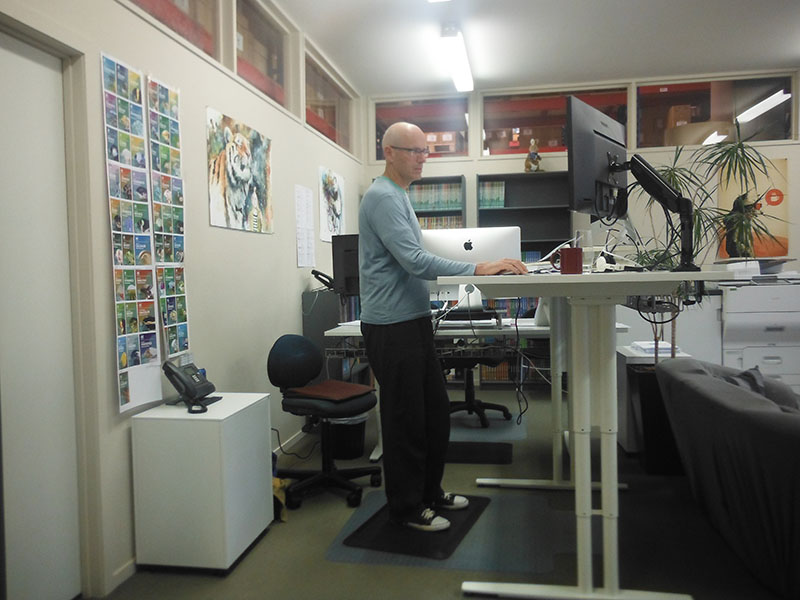 For the last twenty years I have worked for the largest (though still fairly small) educational book publishing company in New Zealand, designing and doing the layout of school textbooks.
It is odd that they call this a CV - a curriculum vitae – as if a list of jobs were a description of life.
As a child I had no intention or desire for such goings on. I wanted to be a great mystic lost in contemplation of divine reality in a cave remote from civilisation.
We may think that what we need is to withdraw to a cave in the Himalayas, a cabin in the Massachusetts woods, a quiet cloister where we can apply ourselves to our sadhana in order to attain to spiritual heights. But what is the world here for, the world of driving to work down the South-western Motorway, of working on your 4 GHz Intel Core i7 5K Retina, 27-inch iMac to produce Level 2 Earth and Space Science Learning Workbook, of running in the hills and visiting the cows; why is this world here if our only goal is to escape it? No, rather, it is these very mundane things that are our sadhana.
There is a story of one of the ‘desert fathers’ – the early Christian monks who lived in the deserts of Egypt in the third century – who had a great temper. Living in community with the other monks sparked in him an anger that he knew was contrary to what he aspired to but that he could not control. Things that his confreres did and said provoked in him great anger. He withdrew, therefore, to a lonely hermitage where he could be undisturbed.
It was not long, however, before his water jar fell over and broke. It was then that he realised that his anger was not the result of his brother-monks’ actions – it had followed him into solitude and could be provoked there even by the ‘actions’ of an inanimate object.
He packed up his hermitage and returned to the monastery – only there could he work out his perfection.
It is in working with our colleagues, it is in putting up with the Boss, in dealing with annoying editors and recalcitrant authors and printers who take too long and do a bad job on paper which is too thin, it is in the satisfaction of creativity and the delight of a job well done, it is in all these that we make our progress.
Burger King with Angels on the Side
by Sharani Robins
Driving home from work at the end of a long week, I felt tired and ready to call it a day. Almost home, I took an exit off the highway that emptied onto a strip of small shops, big box stores, restaurants, gas stations and motels. One thing I knew for sure was that I didn't feel like cooking dinner once I got home. I asked myself the question - where should I get dinner tonight? Clear as a bell, I heard the words Burger King. Not necessarily my favorite since there aren't lots of choices for vegetarians but I said ok Burger King it is. And it's one of the first restaurants I come to after I exit off the highway.
I went inside instead of doing the drive-thru with the thought that a vegetarian order at the burger joint might be better placed in person at the counter. Once inside, I found myself waiting in a line that didn't seem to budge and a puzzling atmosphere seemed to prevail. Someone who appeared to be the boss was barking orders at his crew amidst a mood of mayhem.
As the time ticked by with no food in sight, I thought that this fast food restaurant was anything but fast. There was a group of about 5 people who were off to the side of me who had apparently already ordered and were getting vocal and boisterous about how long it was taking for their food to arrive.
The boss looked exasperated and the workers who were visible to us looked confused. Next the boss told the workers to speed up because there were people getting mad and upset about how long they had been waiting. This seemed to get the group over to the side more agitated because they took what he said as an insult, as if he was saying they shouldn't be mad. Then someone came inside and said that they had just come through the drive thru and were given completely different food than what they had ordered. A perfect storm was on the menu at Burger King tonight. I almost left without waiting for the food I had ordered and paid for just to escape the chaos.
I felt bad for the supervisor because I could tell that the other group waiting inside had misunderstood his comment. He was just trying to get their order to them more quickly and they got upset with him, asked him his name and threatened to complain about him to his superiors.
By the time I finally received my food and left, I felt like I had just participated in a drama and wondered if I had taken too much for granted that a fast food restaurant transaction is ordinarily a speedy affair.
The next morning as I sat at my shrine for meditation, prayer and singing the Burger King experience came back into my awareness. I was wishing that I had thought of something sympathetic to say once I finally picked up my food from this person in the thick of the situation. A feeling came over me that this boss badly needed encouragement after all the things that went wrong while I was in there the prior night. Still I doubted myself and thought what I could possibly do as a complete stranger in this chance encounter at Burger King.
I encouraged myself to brainstorm further by remembering several unique experiences I had after reading the book Angels in My Hair by Lorna Byrne. The author describes that she has an ability to communicate with and see angels and that this ability began when she was a child. One theme that stayed with me after reading it was the notion that angels really want us to be kind to one another. I began to feel awareness of angels too after reading this book and even had an angel encounter that included this notion about kindness balanced with the idea that we bear no personal responsibility for others, even our closest family because their care and transformation is God's task. At the time I was concerned about my mother and it felt very freeing to adopt this perspective. A paradox then unfolded where God could use me to help others more than ever because I felt I was just an instrument.
With the influence of that book and my subsequent experiences returning to my awareness, I inwardly asked if I should try to think of some gesture of kindness to offer related to the Burger King incident. I heard and felt a very strong yes and attributed the answer to be another angel experience. Somewhat surprised by the notion to take this chance encounter that seriously, I repeated the question a couple more times to a continued resounding affirmative response.
The next question became what in the world to actually do? Finally I settled on the idea to bring a bag of Easter chocolates that I had in the house to Burger King and purposely go through the drive through order and pickup window in order to offer them. So again I ordered food, this time from the car. When I got up to the window to pay, I asked if the supervisor from the prior night was at the restaurant today. The young person at the pick up window left to find out and came back with an older woman who turned out to be his boss. She said no he wasn't here this morning.
I explained that I was in the restaurant the prior night and there seemed to be quite a lot going on that was difficult to manage and I felt bad for the man in charge who seemed somewhat overwhelmed. She replied yes and added that he had called her on the phone about it. I held out the bag of candy and said I wanted to give him this to cheer him up. She smiled, took it and emphatically answered that she would make sure he received it.
When I returned home, I felt as if I had accomplished the task I was supposed to do and had been perhaps an instrument of a situation larger than surface understanding. Later when I replayed the whole experience in my mind's eye, I glanced at a picture of myself as a young child that I keep on my shrine and it was gleaming/radiating light. I picked up the photo off the table, looked at it and it felt like light was coming out of the photo as if to confirm that following the inner prompting was a valuable lesson.
The encounter made me think of the song performed by Joan Osborne on her 1995 album Relish called "One of Us" which includes the lyrics "what if God was one of us" and "just a stranger on a bus trying to make his way home." Sometimes it is easier than others for me to practice kindness in ordinary daily activities. Honestly I didn't return to that particular Burger King again for quite some time. However, the memory stays with me to this day even though several years have gone by since then. Angels can provide guidance and instruction in unusual ways when you keep an open mind, an open heart and a willingness to lend a hand even amongst the burgers, fries and soda at the neighborhood Burger King and beyond.
Andrea Marcato wins the Self-Transcendence 3100 Mile Race 2020
The 2020 edition of the Sri Chinmoy Self-Transcendence 3100 mile race has ended in Salzburg Austria, with three out of the five runners completing the nearly 5,000km distance within the alloted time.

This year's first place was Andrea Marcato (38) who grew up in Lughetto, a suburb of the city of Venice. His time of 43 days, 12 hours, 7 minutes is a record for a first-time entrant. He also set multiple Italian distance records during his run and is now ranked fifth worldwide.
I am really happy that I basically covered all the distances, which are available in the world. So I am really happy and satisfied now. The feeling of deep satisfaction, inner peace and joy, which I perceived for a whole month after finishing 10-day races motivated me to run the world's longest certified road race. A feeling which I did not get after 24-hour races.
Andrea Marcato
after finishing the race

Second was local Salzburg resident, Austrian Ushika Muckenhumer (52), who works as a manger of a music instrument shop in Salzburg. He finished with a personal best time of 49 days, 14 hours, 13 minutes.

Nirbhasa Magee (41) from Ireland also completed his fourth consecutive race. This was despite a mid race sickness that forced him to walk for several days. Fortunately, he had enough miles in the bank from earlier in the race.
Ananda-Lahari Zuscin, 45, from Slovakia and Milan Javornicky, 46, from Czech Republic could not finish within the allotted time, but cheerfully raced for 51 days finishing with 2799.6 miles and 2,713.9 miles respectively.

The world's longest certified road race took place on a 1 km loop at Glanspitz Park along the river flowing through Salzburg, Austria. The race involves covering the equivalent of over 118 marathons - 4989 km - in succession. They can run or walk as much as they want between 6 am and midnight. Usually the competition takes place in New York, but due to covid-19 it was shifted to Salzburg.

To give an insight into this unique endurance test, Andrea Marcato went through 9 pairs of running shoes and the pain of burning feet. To ease the pain in his feet, he soaked them in ice for 5 minutes every day. The vegetarian lived only on whole-wheat toast with avocado and cheese to achieve the goal of eating 10,000 calories per day and to avoid digestion problems. Despite that, he lost 10 kilogrammes of weight. Second placed Austrian Ushika Muckenhumer gained 3 kg of weight. He preferred ice cream, cakes, whipped cream and mascarpone shakes with chocolate or fruits to take in the necessary calories. When mental crises appeared which slowed him down he listed to or sang meditative songs to regain his speed.
The 3100 Mile Race was initiated by Indian born meditation master, athlete and musician Sri Chinmoy for talented runners in 1997. He himself participated in many marathons and ultra races. Sri Chinmoy describesthe benefit of a multi-day race with the following words:
“Self-transcendence is the only thing a human being needs in order to be truly happy. So these races help the runners tremendously, although outwardly they go through such hardship. Eventually, when the race is over, they feel they have accomplished something most significant.”
The race received significant interest from Salzburg locals and the national press. Many locals remarked on how the race brought a special energy and happiness to the local park where the race was held.
Related
- 3100.srichinmoyraces.org
- Highlights of the race
- Salzburg.ORF.at - English translation and link to news article
- Irishman on verge of completing 3,100 miles(link is external) at Independent.ie
Sri Chinmoy Self-Transcendence 3100 Mile Race 2020
On 13 September 2020, the Sri Chinmoy Self-Transcendence 3100 Mile Race began in Salzburg Austria, with five intrepid runners from Italy, Ireland, Austria, Czech Republic and Slovakia taking to the start line.
Over the next seven weeks, the runners will endeavour to complete the epic challenge of running 3,100 miles (just shy of 5,000km) which means they must maintain an average of 60 miles ( 96 km) a day.

For the past 23 years, the race has been run in Jamaica, Queens, New York. However, it was clearly not possible to run the race this year in New York as usual. But many runners and race supporters were keen to maintain this special annual race, and so finally (after exploring courses in the Czech Republic and Slovakia) a venue has been found in Salzburg, Austria. The race field has been limited to five runners and will strictly adhere to local health standards to ensure the safety of runners and helpers.

The race was founded by spiritual teacher and ultra-runner pioneer Sri Chinmoy, who saw distance running as a vehicle to enable runners to bring to the fore their physical, mental and spiritual capacities to complete this unique challenge. This year will mark the 24th edition of the race.
“We have to believe in a higher Power.
Only by believing in a higher Power
Can we go beyond and beyond
Our limited, human capacity.”– Sri Chinmoy
In this year's race, these are the five runners:
- Nirbhasa Magee, 41 (IRL), living in Reykjavik, Iceland - 3 finishes, ranked 22nd
- Ananda-Lahari Zuscin, 45, Kosice Slovakia - 6 finishes, ranked 25th
- Ushika Muckenhumer, 52, Salzburg, Austria - 1 finish, ranked 30th
- Andrea Marcato, 38 (ITA), living in Zurich, Switzerland - first-time runner, two times over 1000km in 10 day race
- Milan Javornicky, 46, Celakocice, CZE - first-time runner, 569 miles in ten-day race
Over the next two months, you will be able to follow the race through photos, videos and race reports. Definitely we welcome visitors trackside, so if you are in the area (or if it's safe to travel) please come and stop by! We hope you will be inspired by the efforts and inspiration of the runners in this race. Race Director Rupantar Larosso who lives in NY, US said on the eve of the race "It is great the race is going ahead and I wish all the runners and supporters the best of luck"
Canvas for Peace honoured in Italy
The Canvas for Peace is a unique 160-meter long patchwork of artwork created by a wide variety of local people and community groups in Palermo, Italy. Recently, the canvas was accepted by the President of Italy, Sergio Mattarella as a token of peace, friendship and unity.

The Canvas was paraded through the streets of Palermo as part of the Peace Weeek. The artists shared aphorisms on peace by Sri Chinmoy and their own artistic interpretation of their hopes and dreams for a more peaceful world.

May each and every
Human being on earth
Pray for a universal peace-torch.Sri Chinmoy
The Peace Week in Palermo included many activities broadly based around the hopes and aspirations for a more peaceful world - it included events from art exhibitions to concerts and running events. A team of runners from the Sri Chinmoy Oneness-Home Peace run also took part and were deeply moved by the warm and enthusiastic reception of the local community.

In 2020, large scale events have been more difficult to organise, but those who participated in this memorable week are keen to keep the spirit and hopes of that event alive. Whilst large gatherings are difficult this year, we can still each, in our own way make a contribution to a better world. This year, the Peace Run has continued with small scale runs where possible and individual runners making their own efforts to keep the flame of peace going.
In this respect, the Peace Run team are most grateful that this banner has been accepted as a token of appreciation by the President of Italy.
Drawings of Love and Gratitude
The Oneness-Heart Tears and Smiles service was established by Sri Chinmoy in 1993. This project grew from an initial heartfelt request from Sri Chinmoy's dear friends, President Mikhail Gorbachev and his wife Raisa, for help with the first modern hospital in Russia for children with leukaemia and other haematological diseases.
Now the humanitarian project is involved in over 40 countries, and shares not only medical and material supplies, but also has come up with many unique ways projects to share joy, concern and across borders.
Drawings of Love and Gratitude
Doctors and nurses who are working in challenging conditions often mention the need on their units for more hope, especially, but also for courage, strength, endurance and cheerfulness – for the medical staff as well as the patients.
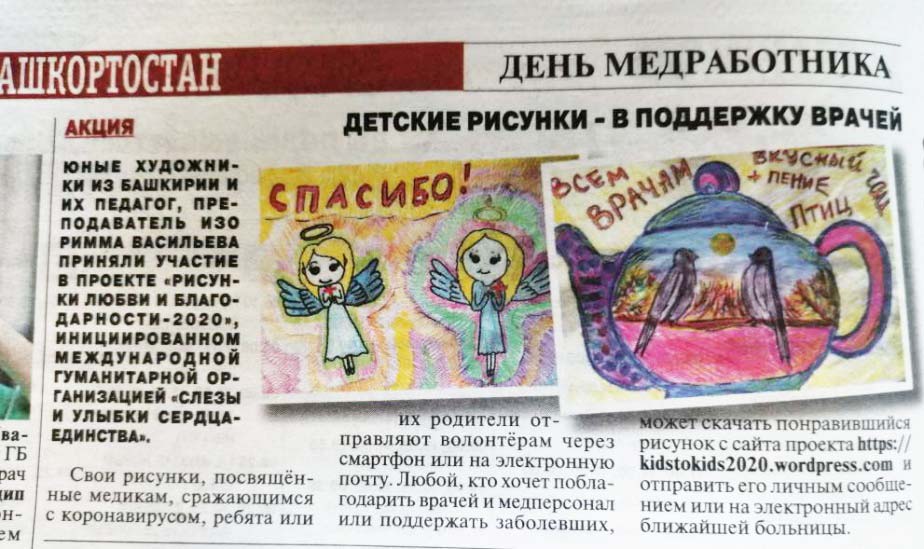
In addition, children have also found dealing with the fear and isolation particularly challenging. One way to help them deal with these feelings is to show them a way in which they can help. In these challenging times, we decided to collect children’s drawings to support our doctors and medical staff. Doctors and nurses often cite the need for more hope, courage, strength, endurance and cheerfulness - both for themselves and their patients.

In cooperation with the city officials of Nur-Sultan (the capital city of Kazakhstan) over 40 posters were placed in bus stops around the city with these drawings and Sri Chinmoy’s inspiring and encouraging poems.

Another example of this kind of cooperation is the Russian city of Stavropol, where we placed similar posters in city parks.
A fun interview with our Guinness World record holder Ashrita
Ashrita Furman became a student of Sri Chinmoy when he was just 16 years old, and has now been practising meditation for over 50 years. In 1979, he started using the power of meditation and concentration to break Guinness World Records. Since then he has broken over 800 world records, 200 of which still stand - he holds more records than anyone else on earth.

This is a light-hearted interview with a local news station where you can see Ashrita attempt some records in his back garden....
Big me. Little me
by Bhashini
London, England
Your mind has
A flood of questions.
There is but one teacher
Who can answer them.
Who is the teacher?
Your silence-loving heart.– Sri Chinmoy
This was the dream:
It’s the early hours of the morning.
The sound of the doorbell ringing wakes me from my alcohol-induced stupor.
I get out of bed, still in my clothes from the night before, make-up smeared on my face.
Over the full ashtrays and piles of dirty clothes, I step, past the fallout from a late night, drunken game of indoor cricket, played with an empty wine bottle and a tennis ball. Broken things litter the floor.
I open the front door.
The instructor from my meditation classes is standing there. He gives a polite Japanese bow.
He speaks softly and reverentially, “I’d like to introduce you to Sri Chinmoy.”
He gestures towards a tall, athletic-looking Indian man in shining blue robes.
Before I can say anything, the tall man strides past me into the flat.
Purposeful. A man on a mission.
“He’s come to clear up,” I think.
I turn round and look at the mess behind me.
He’s got his work cut out.
* * *
I got off the train in Berlin. No plans, no direction, nowhere to sleep that night. All I had was a Lonely Planet Guide and the firm conviction that it was time for my life to change.
As part of my degree course in Modern European Languages, I’d spent the previous eight months in the south of France with two of my fellow students. With very few assignments to do and the French government paying most of our rent, we’d had more money in our pockets and more time on our hands than we were used to. The wine was far too cheap. Although I’d spent some of the time productively – learning to ski, giving up smoking, volunteering for a homeless charity – the rest was a hazy blur and those things I did remember I was now trying to forget.
A friend had lent me Herman Hesse’s Siddhartha, recommending it as a “good book.” In the retelling of the Buddha’s journey from Prince to Enlightened One, I came across the concept of reincarnation for the first time – being born again and again in different bodies, each lifetime taking us closer to the ultimate goal of spiritual realisation. For me it was more than a good book. It was a call to action, a call to start searching for life’s deeper meaning, to strive for something higher and more fulfilling than the ‘normal’ life had to offer. Why hadn’t this book had the same effect on my friends? Was I weird?
Soon enough I’d found accommodation and a part-time job in the kitchen of an Irish pub. At the market I bought a book about meditation and a cassette of Tibetan singing bowls. Back home, I lay on the floor and listened to the cassette. An hour later I woke up unsure whether I’d had a deep meditation or just an afternoon nap.
In the museum at Checkpoint Charlie I’d seen a display of some of Gandhi’s writings. In one he said that if you don’t know what to do with your life, try fasting for a day. This will take you inwards to a clearer mental state and help you find direction.
I decided to try it once a week. My kitchen shift finished with a pint of Guinness – it was free. Who says no to free Guinness? After that, I’d fast for 24 hours. There’s an island nature reserve called Pfaueninsel (Peacock Island), a short ferry ride from Berlin. I used to go there on my fast days to walk slowly and commune with nature.
If I had to define what I was looking for, I thought, I’d call it a sense of oneness with all around me, a feeling of connectedness with all of nature and humanity.
One day, walking to work, my head full of my new spiritual ideas, I spotted a poster. It was stuck to a wall, slightly set back from the road. It showed an Indian man in purple robes, with his eyes closed, playing a stringed instrument I didn’t recognize. There were trees in the background. He looked as if he were in a kind of a trance. My immediate thought was, “He has what I’m looking for.” Somehow I could tell he’d achieved the elusive state of oneness with everything around him, of connectedness with all of nature and humanity that I myself had wished to attain. There was a timelessness about him, as if he belonged to the distant past, yet he was wearing a digital wristwatch. I was struck by this incongruity: he seemed so ancient, yet here he was, obviously living in the modern day world.
I gazed, mesmerised for a few minutes, and then looked at what was written underneath the picture. This man was giving a Peace Concert in Berlin. The only trouble was the Concert was in May 1992. It was now June 1993.
And I was late for work.
* * *
I returned to Edinburgh in September to complete my final year of university. For the past three years I’d done the minimum amount of study, devoting myself instead to alcohol, nightclubs and amateur dramatics. If I wanted to get my degree I’d have to work hard this year. At the same time I was beginning to see the limitations of the intellectual world. I sat in the university library – six floors packed with shelves and shelves of books – the collected knowledge of humanity. Was there even one book in this whole place that could show me what I was looking for? I’d spent most of my life developing my mind. Was I happy? Was I fulfilled? Books could only take me so far. If I wanted to go beyond the mind, I’d have to learn to meditate properly and that meant finding a class.
The first class I went to didn’t quite do it for me. Led by two women, we practised different techniques: walking round the room in silence, chanting, speaking in tongues, lying on the floor to release our primal screams. Somehow I knew this wasn’t what I was looking for. A final objection was the cost. Five pounds per class was a lot for a penniless student.
The next day in the lunch queue I was telling my flatmate I’d been to a meditation class. “Oh, did you go to that place next to Greyfriars Bobby?” (Our landmarks in those days were all pubs.) “You should try that one, it’s free. I think it’s called the Sri Chinmoy Centre.”
Later that week I saw a poster stuck to the noticeboard of the German Department. It showed a big square maze with a figure at the centre of it, seated in meditation. It was advertising a class given by the Sri Chinmoy Centre. I made a mental note of the time and location and duly showed up, only to find I’d gone to the wrong place. The class was being held at George IVth Bridge Library and I’d gone to George Square Library.
The enormous wave of disappointment which overcame me took me by surprise. On the face of it, this was just another class like all the other classes I attended on a daily basis. Why was this one so important to me? Fortunately, it seemed the Sri Chinmoy Centre was quite active, and I soon found another class I could go to.
About twelve of us sat on the floor round the edge of a blue-carpeted room, listening to a young man talk. He spoke about our existence as being like a huge mansion with many rooms. Most of the time we stay only in our mind-room. Meditation was a way of getting out of our mind-room and exploring all the other rooms we had inside us. This struck a deep chord with me, but by now I was impatient. I was already convinced of the benefits of meditation; I just wanted someone to show me how to do it.
After some relaxation, breathing and concentration exercises, the instructor asked us to look at a large framed black-and-white photograph that was hanging on the wall. He explained that this was a photograph of Sri Chinmoy’s face, and that it was taken when Sri Chinmoy had entered into a very high meditation. As such it represented an elevated state of consciousness in which the human personality was dissolved. It was called the Transcendental Picture. By meditating on it we could identify with that state and achieve a high meditation ourselves. This sounded like an unlikely story to me, but I was aware that I knew next to nothing about meditation, so I resolved not to rule anything out. I’d give it a try.
I relaxed and focused my eyes on the photograph. Almost immediately, extraordinary things started happening. As I looked at the face, the features began changing rapidly. I would see a baby, then the features would quickly change into those of an old man, then a young woman, then a small boy. The images came one after another. It was as if I were seeing a thousand different faces inside this one photograph – male, female, all ages, all the different races of the world, all of humanity in one simple photograph. Throughout this experience, my mind was telling me that what I was seeing was impossible, but in my heart I was feeling so much joy. Here was oneness. Here was connectedness. Here was what I’d been looking for, for such a long time.
The class was early in the evening, so there was time to go for a swim afterwards. Every time I closed my eyes to go underwater I could see the Transcendental Picture as if imprinted on my eyelids. Rather than scaring me, this reassured me. Here, I felt, was someone who was on my side, who’d be a very dear friend to me for as long as I wanted him to be.
That should have been the end, a happy ever after, but as it was my mind needed a lot more convincing. Was this the right path for me? Was it safe even? Everyone knew groups like these only wanted to take your money and force you to join a harem. My friends urged me to be wary.
After one of the meditation classes another attendee voiced similar doubts. “You have to listen to your heart,” replied the instructor. “If this kind of meditation gives you joy and a sense of peace, it’s probably right for you. If it doesn’t, you should look for another meditation practice.” Instantly this put my fears to rest. Surely, if they wanted to exploit me, they wouldn’t be telling me to listen to my heart! Right now my heart was shouting with joy and I ran all the way home.
The instructor told us that it was easier to meditate in a group than alone, because together we created a certain kind of spiritual energy which helped us. It definitely felt to me like this was true. My scientist friends disagreed. “That’s nonsense. You can’t create energy through meditation.”
I sat on the bus trying to puzzle it out. “Do you know how electricity works?” asked a voice inside me. “Do you need to know how it works to use it and get benefits from it? Do you know how this bus works? Do you need to know how the bus works to ride it and let it take you home?”
This was the first time I clearly saw the difference between big me and little me. Big me was my heart and soul, my deeper self, which wanted to love and embrace the world, the part of myself I’d been ignoring up till now. Little me was my limiting mind, which wanted to categorize and put things in boxes. It didn’t want to expand. It was all too easy to listen to little me when what big me was saying was challenging and uncomfortable. The instructor was advocating getting up at six o’clock in the morning to meditate, running to keep the body fit and giving up alcohol altogether. Big me was ready and willing. Little me was having a tantrum and wanted to give up.
In spite of this conflict, I always felt an underlying certainty which I couldn’t ignore. It was there when I woke up in the morning and when I went to bed at night. “If you give up now, you’ll spend the rest of your life regretting it.” It seemed if I stuck with it, I’d have a shot at happiness, peace, purpose and complete, total fulfilment. If I quit, I’d live a half-life, always wondering what could have been, what I could have become.
I imagined living the rest of my life in one small room, never having explored all the other rooms in my mansion. I started dreaming that I saw doors in my house that I’d not noticed before. They opened onto vast rooms, sometimes whole wings. They were dusty and unused, sometimes filled with outdated or broken furniture, but, as estate agents put it, they had potential.
In one of the classes the instructor told us that Sri Chinmoy had just completed one million bird drawings. “What a waste of time, drawing one million of the same thing!” said left-brained, little me, fresh out of the debating room. But as I walked out of the front door, my heart exploded with joy. “He’s drawn ONE MILLION BIRDS!” I shouted with delight at no one in particular and once again ran all the way home.
My exams were getting closer. Every Tuesday I would sit in the library and think to myself, “I’m not going to meditation tonight. I have to study.” As eight o’clock approached, I would tell myself again, “I’m really not going to meditation tonight. I really do have to study.” At five to eight I would throw my pen down and run down the stairs, out of the library and across the university grounds. I’d arrive at the class late and out of breath but with joy in my heart.
The instructor told me that ideally I would meet Sri Chinmoy in person at this stage of my involvement, but as that wasn’t possible – he lived in New York – I could send Sri Chinmoy a photo of myself and he would meditate on it and connect with my soul. The instructor was leaving for New York in a few days’ time, and if I dropped off my photo at the Sri Chinmoy Centre before then, he could take it with him.
More nonsense. I definitely wasn’t going to do that. Nonetheless, on the day the instructor was due to leave, I found myself running to the photo booth in the student union, cutting a photo of a panting, slightly surprised girl with messy hair off from a strip of four, putting it in an envelope and posting it through the Centre letterbox. As I walked home I looked at the three remaining photos. I could barely recognise myself. I was smiling.
Two weeks later, my flatmates and I had a party. Around two in the morning we were playing cricket in the hallway with an empty wine bottle and a tennis ball. I fell asleep in my clothes. That night I had a dream....
* * *
Alcohol was a big hurdle for me. University social life revolved around beer. I’d seen too many brilliant people destroy themselves with drink though, and secretly, I’d wanted to stop for a long time. Now I was determined to give it a try. I wrote on a piece of paper: ‘Wendy Neve has given up alcohol 2/8/94’ and stuck it on my mirror.
I tried.
“Why are you drinking water? Just have a half. Go on, just have a half,” my friends chorused.
“Why are you drinking halves? Have a pint, what’s wrong with you?” Soon the piece of paper looked like this:
Wendy Neve has given up alcohol 2/8/94
- 3/8/94
- 4/8/94
- 5/8/94
- 6/8/94
Eventually, there were no more crossings out. I took the piece of paper down. I didn’t drink anymore.
Running was the next hurdle. I’d never been athletic. Shorter and weedier than my classmates, I’d always been picked last for teams and had spent much of my school-life devising ingenious ways to get out of Games. Still, I could see the sense in it. Meditation was keeping the inner me healthy; running would do the same for the outer me. So I put on my clubbing trainers and headed for Edinburgh’s Peace Mile. Twice I sprinted round it at breakneck speed, collapsing at the end in a nauseous heap, my muscles on fire.
It hadn’t occurred to me I could just jog.
By now I was meditating when I woke up every morning. Six o’clock was still far too early for me, and I only managed it when I’d just got home from a long night out. My mind was becoming clearer and my heart lighter. In the meditation classes, we practised singing some of the thousands of songs Sri Chinmoy had composed. Some were slow and soulful; others light and joyful – they made me smile; still others were dynamic and energising. I sang a few of them at home every morning after I meditated. They brightened my day. It didn’t bother me so much when my flatmates drank all the milk and left me none for my morning cup of tea.
One day as I was walking home from the shops, a woman smiled at me; a little further along another woman smiled at me, then an old man, then a teenager, then some children. At first I enjoyed it but as it continued it started to unsettle me. This wasn’t normal. Was there something wrong with me? Had I put my clothes on back to front? Was there something stuck to my face? Maybe they were all laughing at me. By the time I got home I was completely freaked out. Dropping my shopping in the hallway, I slumped against the wall. On the wall opposite, at head height, was a mirror. I caught sight of my reflection – I was smiling the biggest ear-to-ear grin I’d ever seen on myself. That explained it, I supposed.
Later, I was hanging out my laundry.
“What’s that?” asked my flatmate.
“It’s a sari. We wear them for meditation. Sri Chinmoy says it helps to wear something specific you don’t wear for anything else.”
“Not a very nice one is it?” He was right. It was bright orange with big pink, yellow and green flowers printed all over it. It looked like a pair of curtains from the seventies.
Why did I like it so much?
Sri Chinmoy had several requirements for his students. I’d been a vegetarian since I was sixteen and I’d quit smoking the previous year. Alcohol was now taken care of, and I hadn’t even wanted to do drugs for quite a few months. Now it turned out that relationships were also on the banned list. If you were single he expected you to stay that way. No more boyfriends.
“OK, well here’s the perfect excuse to give up,” I thought. “It’s ridiculous to expect people to live like monks in today’s world. Besides, it’s impossible, surely.” I’d quit this meditation lark straightaway and find something else to do with my life. They’d pushed me too far with this one. As I walked home, I expected to feel relieved, as if a weight had been lifted off my shoulders. Instead I was hit by another enormous wave of disappointment. I’d got so much out of this. I’d cleaned up my life and I was happier and healthier than I’d ever been. Was I really ready to abandon it now? Why did I get the impression I’d be throwing away something precious, irreplaceable even?
If I were honest with myself, wasn’t I a bit fed up with the whole relationship game anyway? It had always felt a bit like acting. I felt like I was playing the role of so-and-so’s girlfriend: lines to be learned and recited at the appropriate moments, particular behaviours to be adopted in particular situations, codes of conduct to be adhered to. I’d seen so many of my friends morph into their boyfriends’ counterparts – taking on his likes and dislikes, his turns of phrase, even his mannerisms sometimes. Wouldn’t it be nice to live just for myself for a while? To find out who I really was? Did I really like Jimi Hendrix’s music? Iain Banks’ novels? Mexican food?
I’d finished my degree by now. Most of my university friends had moved away, which had made adjusting to my new lifestyle a little easier. I was working temporarily in a vegetarian restaurant and planning to travel to Egypt in the autumn to study to become an English teacher (the Cairo teaching course was half the price of the UK one and the qualification was the same). I’d already had the inoculations I needed and arranged to stay with a friend of a friend who had a flat there. Maybe I could postpone it for a year? I could give the spiritual life a try. Just for a year. If it worked out, well and good. If not, I’d just pick up where I left off, but with a deeper sense of who I really was. I made my decision.
It was now that I felt relieved, as if a heavy weight had finally been lifted from my shoulders.
* * *
In October 1994 I heard that Sri Chinmoy would be going to Rome to meet with Mother Teresa. I would finally be able to see him in the flesh. A group of his students decided to hire a bus to drive us there. We met at Kings Cross Station – a disparate bunch: male, female, young, old, different races. One young woman, about my age, greeted me with, “Welcome to your first nightmare disciple trip.” The route took us across the Channel and through France and Germany. There was plenty of time for singing, meditation, joking and telling stories about life with Sri Chinmoy, stories which filled me with wonder and anticipation. They seemed to me like an alien race; they spoke a different language. They didn’t say they didn’t like someone, they said they didn’t “feel much oneness” with them; they were never in a bad mood, instead they were in a “low consciousness.” Nonetheless I couldn’t help feeling at home with them, comfortable and safe.
When we arrived at the campsite in Rome where we were to stay for the night, I had a St. Peter moment. As I watched the others play frisbee, one of the campsite workers, who happened to be English, came up to me. He inquired, “Are you with that bunch of weirdos?”
“Not really,” I replied. “I just came along for the ride.” Later, as one of the girls helped me put on a sari before the function with Sri Chinmoy, my conscience pricked. This bunch of weirdos had been kind to me. I saw sincerity in them. They were genuinely trying to improve themselves and make the world a better place.
I was far from relaxed about seeing Sri Chinmoy for the first time. My questioning mind was resisting with all its might, shouting louder than ever, making me confused and nervous. When we arrived at the function hall where we were to meet with Sri Chinmoy that evening, I saw him standing on the stage, meditating with folded hands. I tried to feel my heart, but it was as if it were totally blocked, drowned out by the commotion going on in my head. Around me were several hundred women in saris and men in white. They all seemed to know each other. I felt completely out of place, a square peg in a round hole. Sri Chinmoy was talking now and I tried to listen but I couldn’t hear anything. All I could feel was the pain in my head.
I gave up and picked up a book someone had left on the chair next to me. It was a book of talks Sri Chinmoy had given to seekers. I opened it at a random page, where Sri Chinmoy was saying that if any of them wanted to become his disciples they could send him an application. If he was the right teacher for them, he would accept them. If not, he would tell them to look elsewhere. My chaotic mind snatched this information and turned it on its head: I’d never applied to be a disciple. Sure, I’d sent him a photo six months ago but that was something different – something to do with contacting my soul. If I’d never applied then I’d never been accepted. If I’d never been accepted then I’d been rejected. If I’d been rejected then I wasn’t good enough, I was useless, unworthy, unlovable. All my insecurities came to the fore and I spiralled downwards. I slumped in my chair and let the dark cloud of self-created misery envelop me.
All of a sudden I heard Sri Chinmoy’s voice. “I have accepted you,” he said in loud, clear tones! Those were the first words I’d understood all night. “I have accepted you and you have accepted me,” he continued. “Now we must prove ourselves to each other, prove that we are worthy of our mutual acceptance.”
Instantly the cloud of misery dispersed.
* * *
I stood on the ferry’s deck and gazed at the sunlight reflected on the water below, my heart lit with hope. Silently I spoke to Sri Chinmoy. I thanked him for accepting me and promised to do my best to prove myself worthy of him. As England’s shores came into view I knew that this time it was a new me coming home.
At Dover we compared passport photos on the bus. Mine had been taken a year previously. “It doesn’t look like you,” said one of the others. “Now you’ve got a disciple consciousness.”
* * *
I ended the year in Cambridge with a group of Sri Chinmoy’s disciples who’d got together to meditate for the New Year. The meditation room was decorated with paper snowflakes. Orange-blossom incense filled the air. We sang Sri Chinmoy’s song, ‘Vishnu Debata’ – O my beloved Lord Vishnu. In the Hindu trinity, Vishnu is the preserver, the one who sustains us. My heart was full of gratitude, my happiness complete. Tears fell.
As I left the meditation room I saw a poster on the wall that I hadn’t noticed before. It showed an Indian man in purple robes, playing a stringed instrument with his eyes closed. There were trees in the background.
A memory stirred.
More tears.
- ‹ previous
- 61 of 337
- next ›

Except where explicitly stated otherwise, the contents of this site are licensed under a Creative Commons Attribution-NonCommercial-NoDerivs 3.0 Unported License. read more »
SriChinmoyCentre.org is a Vasudeva Server project.