
The Random Dog
It wasn’t following proper etiquette. The dog had given a short, happy bark and was standing there wagging his tail, ready for a pat. He was not strictly following the doggy code of behaviour that every dog is instinctively born with (which I knew well because up until I was 14½ years old my family had handled many dogs) and a slight variance could offend and earn a small nip. There were rules and he wasn’t following them. We had not formally met - I had sized up this confident middle-sized dog and was willing to bet that I had never seen him before in my life - and he was being way too casual. So I ignored him. So he barked again, “I’m here!” I was surprised because dogs do not usually make a social gaffe like this – their keen sense of smell remembers better than their sight, and he was treating me very familiarly. I was in a tricky position. The dog had obviously made a mistake and if I bestowed the pat, the shock of understanding could result in a horrified yip or even a bite. On the other hand, I didn’t want to hurt his feelings so I looked at him, smiled and said, “Hello little doggy!” He was really happy and wagged so hard his whole body wiggled. He moved closer to more easily facilitate a patting. However I did not, for I did not know him, and he yapped again.

Suddenly his owner appeared. “I’m really sorry about this – he’s usually so shy with strangers. He has never done this before.” I said, “It’s all right – I really like dogs.” The owner removed the dog and I heard him being ordered into the car. I was outside my downstairs flat, packing my own car, which was parked behind the dog owner’s car. The dog owner was finishing a visit to the upstairs flatters. I felt something on my leg. Looking down – the dog was back! Standing next to me with one front paw extended, resting on my leg. I was really baffled. His owner was calling him and he moved away for a second, then came back, rearing himself up on his hind legs, balancing himself with one front paw on my leg – and looked up into my eyes with a puzzled, slightly hurt expression. That was too much. I patted him. Really properly. I scratched his neck and everything – and he was ecstatic! He wagged his tail so hard and licked me as far as he could reach. Then his flustered owner appeared, grabbed him and shut him into her car, apologising profusely, “He has never done this before. I’m so sorry.” Out of the back window the dog was looking at me and I waved to him. He looked at me adoringly and wagged violently back.
Back at my car, packing it for an outing, I heard the dog owner and upstairs flat lady talking about it, bewildered about the dog’s behaviour. “He has never been here before except for that time you went away when you first got him...” The penny dropped.
All of a sudden memories flooded in and I flushed hotly with embarrassment. I had been out-polited by a dog!
A little over a year before, I had uprooted my life from Hamilton and moved to Auckland. The small downstairs flat had been available immediately and I started looking for a premises to open a café in. In the meantime I was taking a small business course and getting the requisite hygiene certificate and behind-the-scenes organising and planning necessary for such a venture. I was also doing voluntary work for the Sri Chinmoy Centre, flyering for their free meditation classes – sitting in on those same classes and even teaching some classes myself! As well as errands – like delivering Sri Chinmoy’s books to libraries all over Auckland, which helped me to orientate myself in the enormous metropolis that was my new home. (I had some terribly lost – but ultimately beneficial – experiences along the way!) At 2pm each day I would arrive back to my flat, prepare some lunch and a cuppa, and enjoy it sitting on the back step, having some peace.
One day shortly after arriving in Auckland, I sat on my step and heard a small mournful yodel. Upon investigation, it was a tiny puppy. Having no idea where it could’ve come from, I called it and it came over. After a hug and a small comforting suck on my fingers, it fell asleep in my arms. It was out cold for a full 20 minutes, then it awoke and made it’s stumbly way upstairs. Obviously the people in the flat upstairs had very recently acquired it – but in my eyes (having had a lot to do with puppies during my childhood) it was just a spot young (by maybe a week or two) to be removed from it’s mother. I thought nothing more of it until the next day when he came for a pat, a cuddle and another 20 minute nap in my arms. At exactly the same time every day for two weeks, that was the routine. And then he came no more. And I missed him. Fearing something had happened to him, I asked the upstairs flat. They had only been looking after him for a friend who had been called overseas suddenly, immediately after acquiring him. So that was it. I sent the puppy my love and goodwill in my prayers and that was that. Until now, over a year later, when the grown puppy had shown more courtesy than I had, and remembered me!
So again he was remembered in my prayers, only this time I felt more confidence in his future. As the polite and alert little gentleman he has turned out to be, he will go far.
Return to: The Homepage of Toshala Elliott
Inspiration-Letters 16
 Not too long ago, I went to a thrift store in my neighborhood to buy some nice posters (Van Gogh’s Wildflowers, and a couple prints of Cezanne’s), as well as some cheap chocolate bars. As the cashier was checking me out, I happened to glance at her name tag: “Karamvir” it said.
I knew “vir” means hero in many Indian languages. I asked her what “karam” meant. She told me that “karam” means fate.
“So “Karamvir” means “she who is the master of her destiny, the one who is victorious over her fate!”
Apparently she had never thought about the meaning of her name before, so she just nodded, smiled shyly and handed me my merchandise.
The name “karamvir, karamvir” echoed over and over again in my mind as I left the store.
The one who is the master of fate.
Sri Chinmoy once said (please note: I am absolutely paraphrasing him here) that Western names sometimes do not carry the same kind of mantric, spiritual power that Sanskrit and Indian names do. He said that he often comes across names like “Buffy” and asked ironically if we thought anything divine would happen if we tried chanting “Buffy” hundreds of thousands of times.
But what a name that young Punjabi girl has! And she does not even appreciate it!
To preach a little, I might say that everyone who comes to the spiritual life can give her or himself a little pat on the back. To reach out to the inner Light in this world of suffering and sorrow is no small feat. All of us, whatever path we follow, have conquered our fates enough to let some divine Light into our systems.
I went to Sri Chinmoy Library and searched for “destiny”. I was awed and moved by Sri Chinmoy’s beautiful poetic outpouring on this theme.
“O God-seeker-heart,
Aspire, enjoy your inner epiphany.
Permit not your life
To be eclipsed by the sounds of destiny.”
—Sri Chinmoy, from Sail, My Heart-Beat, Sail, part 2
“He lives in a world without a plan.
His is the destiny grandiose.
From the cradle unto the grave
He sings and smiles and dances.
His beginning is beautiful.
His ending is soulful and fruitful.”
—Sri Chinmoy, from Transcendence-Perfection
As I read more and more of the poems, it struck me that Sri Chinmoy usually interprets “destiny” in a literal way- that which is destined to happen, or fate. He emphasizes that fate and destiny are realities that can and must be changed for us to grow into God’s highest Dream.
In the late Spring of 2006, Sri Chinmoy asked his musical students to sing his simple English songs in parks, on the weekends.
These songs are very short and sweet, with lyrics like:
“He who loves never grows old—
God is a shining example.”
“I must be the winner in the race of life.”
“Each soul is in transit to the unknowable.”
Most news is unfortunately quite negative and distressing. By encouraging his students to sing these uplifting, haunting songs in the parks, Sri Chinmoy sought to offer a positive vibration to the world. Of course he offered his love and joy in many ways. But I was inspired by his suggestion to sing these beautiful songs in public. People do not need to know who wrote these songs, or anything about the Master’s spiritual philosophy, he told us then. Just by listening to sweet and soulful music we can change our thought patterns and our lives.
Leonard Bernstein once said that he cherished a secret desire- to hear someone whistle just one of his melodies, accidentally, somewhere. As I go about my daily life, I often hum or sing Sri Chinmoy’s songs to myself. His poems and songs are like pole stars to guide my life towards a new destiny, founded on faith, optimism and courage. What a special and unique legacy Guru Sri Chinmoy has left for mankind!
To quote the Master himself:
“No more teeming problems
Will be able to crowd
Along my life's path,
For I can clearly see
That a new age of love and promise
Is dawning within me.”
—Sri Chinmoy, from Twenty-seven Thousand Aspiration-Plants, part 229

Welcome, dear friends, to our “Destiny” issue!
Mahiruha KleinEditor
Title photograph: Pavitrata Taylor at Sri Chinmoy Centre Gallery


It Is Written
 It is written.
These are three powerful words familiar to any who have gone to church or temple, touched on philosophy, astrology, prophecy, in other words, just about everybody. As the theme in the 2009 Oscar winning movie, Slumdog Millionaire, those words undoubtedly spur lively discussion. It is good. Destiny is a concept encouraging and stretching imaginations, fantasies and realities. It is a power that drives individuals to accomplish great things.
I had a lengthy discussion with a genius recently about destiny. I asked many questions because, at first, I did not agree with what he had to say. While I think of fulfilling destiny as an inner compulsion to an ultimate end, he insisted that there are many destinies during our lives. He first noted that the root word of destiny was the same as destination and that in a lifetime we reach many destinations by accomplishing varied things, some of them nothing we ever thought we would or could do such as the classic catch that wins the game or the miraculous water landing of the 737 jetliner on the Hudson River in New York. How many people said no other pilot could have landed the plane so perfectly? Destiny places the right individual in the right place at the perfect time.
He also believes, we cannot know what a destiny is until it is achieved. Destinies may be thwarted, but are ultimately reached because we would not know that something achieved was a destiny until it was manifested.
Free will is the intrusive obstruction to destiny. With free will we control choices. The heart says one thing and the mind vetoes. It is the human condition. As the genius points out, people veer from the path to their destiny, but may find the way back in fantastic or mundane ways. A choice to go left instead of right leads to a chance meeting with an old friend who knows of a job opening. Going right would have led to slipping on a banana peel and breaking a leg or nothing remarkable at all.
Are there are sub-destinies? Slumdog Millionaire clearly demonstrates that a series of experiences, some which can be thought of as sub-destinies can lead to a destiny of a greater magnitude. The actions or non-action of others are also an important influence.
Say you attend a religious event. Over a hundred people are there, most of them unfamiliar with what is going on, but totally absorbed in the experience. They all want to be there as a witness. The occasion is solemn and there are intricate rituals and chanting taking place. Suddenly the priest performing the ritual stops and asks for a volunteer to perform a rite. Everything goes silent. No one looks at the priest who waits patiently. Time is passing, people are shifting in their places, now looking back and forth at one another anticipating a leader from the group to assign someone. More time passes and the group realizes, there will be no assignment. Slowly a figure stands, most of the group does not know the person, but he stands to present himself. The priest summons him.
What went through that person to compel him to stand and take ownership? Was this a destiny that only he out of all those present was to fulfill? Was there a giant force on the group to stay seated?
And what about the opposite destiny? The bad seed, destined to be no good, destined for a life of crime. The unfortunate reality is the forces of evil exist, however, the criminal may create a situation in which the victim can triumph. The kidnapping and death of 6 year old Adam Walsh motivated his father, John, to start the longest running television program of any kind in history, America’s Most Wanted, which put many heinous criminals behind bars. His website helps to find missing children and is a “most wanted” poster for hundreds of fugitives.
The catch that won the game caused the apparent winning team to lose. Was that their destiny too, that an entire team of people and their fans were asked by the universe to sacrifice for one person to reach his destiny.
Even the genius intimately knows God’s will. God can do what He wants, he says. He can play by His own rules or break them. For good or not so good, the universal laws are His, after all. There can always be divine intervention.
My concept of destiny is the ultimate end. There is a quote by Sri Chinmoy that says, “Countless people are on earth, but you are chosen to be in my boat, and I am chosen to be your pilot.” (Unofficial) This quote is on my wall and I read it frequently, but inevitably I see the word destined instead of chosen.
As a disciple of Sri Chinmoy who lives remotely from the group, I am in a unique situation. I have the opportunity to connect with the group only a couple of times of the year. These times are like a booster shot, however, even without them, my life would remain the same. Some disciples marvel that I stay on the path as it is has a high standard that many people, without support, might be unable to sustain.
Not too long ago a couple of people from another country came to me with suggestions of how I could stay connected. When this happens I smile. I tell them I have been meditating and following Sri Chinmoy’s philosophy for 19 years and I cannot imagine life differently.
I believe I am destined for my path. There is no doubt in my mind, not in any part of my being. It simply is. Without the path I could crumble. Recalling life experiences and my reactions to them before joining this path makes my stomach knot up. There is nothing for me there in the deepest sense. It is the continual inner urge to progress spiritually that keeps me alive.
While I would never claim to be a great disciple, I hope my path and disciplines today will eventually, in God only knows what future lifetime, lead to the final destination, God-Realization. This is destiny. This is all of our destiny.
Palyati Fouse
Alaska, USA
There Was A Child Went Forth
 The journey from child to man is said to be a passage, but for me childhood and adulthood were separated not by distance but a straight line, worlds cleaved apart as if by sharpest knife.
My childhood was idyllic for the most part. I grew up in an outer suburb of Wellington, New Zealand, city in name but near rural in nature, farmland on one side, motorways and city the other, green and blue, sun all around. I do not have unhappy childhood memories—perhaps in this day and age I am a little unusual in that. Mine was a simple upbringing, an only child of a solo-parent, little money but also little need, and other than at times being lonely I was usually happily self-occupied, and satisfied. Reading, writing, art and sport passed my time; outings to friends houses and return visits planned as frequently as parents would allow.
Not entirely appreciated at the time—such ingratitude is the human way—this childhood now looms like a golden age against that which followed, a purple mountain majesty receding across the horizon of a sea that no longer shines.
My trauma of heart is trivial compared to many, but the first of something is always the hardest to endure, and shifting house and country for the first time was for me just like a first broken heart—a rawness of pain and despair that, in the manner a burn causes a scar, in some ways never fully heals. At age eleven, with almost no warning and no small augury, my mother uprooted our tiny family unit for overseas, tore me out of the nurturing soil of the only home I had ever known, completely against my will. Friends had names and faces that could not be replaced, and like a timber native to a particular soil and land, I simply could not imagine taking root anywhere else, could not accept that love, like the sun, might shine upon every land.
Not that I was really consulted—one doesn’t pause to barter, discuss the terms of God’s offer or will. In answer to my mother’s prayers, destiny was delivered one mid-winter evening, fate sealed by a thin, rain-soaked envelope, placed in our letterbox as if by Providence Himself. Unaddressed, no writing inside, there was an untraceable, slightly sodden $8000 bank cheque within.
The only home I had ever known, surrounded by the only friends and city ever loved, were suddenly to be no more. Already possessing sufficient measure, this cheque gave my mother the means to be a missionary for a year, in voluntary service of an international Christian organisation. I would be placed in involuntary servitude, sent to Canada and the father I had never known.
I remember well a living room conversation not long before the hammer of destiny fell. A friend of my mother paid a visit for tea and talking, of matters presumably beyond my junior years. Not a part of the conversation and not even in the same room, I remember somehow the grasped fragment, “When the time is right, one door will close and another open, in answer to your prayers.” An $8,000 door did open soon afterwards, and the all-reaching, all-guiding hand of fate was framed within. First gained at this early age, the intuitive knowledge that I was not fully in control of my destiny would stay with me for years.
As has been the case so many times in my life, I did not willingly greet nor reach for the beckoning hand of fate, did not walk of my own volition across the threshold of destiny’s door. Just as many years later, when I became a student of spirituality, life conspired to choose the path I would follow, without signature or consent, a fait accompli served as if dinner upon prison cell plate.
“Superiority to fate
Is difficult to learn.
'T is not conferred by any,
But possible to earn
A pittance at a time,
Until, to her surprise,
The soul with strict economy
Subsists till Paradise.”
–Emily Dickinson
* * *
To say that my father and I hit it off immediately would not exactly be correct. Although at heart a good, kind man, he was, perhaps from the example of his own father, acutely uncomfortable in expressing his feelings or love—something of a shock for a child accustomed to a mother’s love and warmth. Years of being told how much my father loved me were never confirmed in person, shown neither in word nor deed.
Although by no means Dickensian, things were hardly easier at school. Technically the same age as my peers, I was younger physically and emotionally by at least several years. I felt inwardly, stood outwardly an inch smaller, and culturally, with my strange, hard-to-place accent and shabby, out of date clothes, I was not even on the same page. The schoolyard affairs in which I was an expert—sport and games—were now all hopelessly immature, sidelined by the new, unfamiliar playing fields of sophistication, romance and fashion. Being academically successful was also derided. Where in New Zealand being the best with words or numbers had been sought after, and a point of pride, I now found myself first in everything, yet nobody’s friend.
I remember being shocked every time some schoolyard disagreement would come to blows, schoolmates literally running to form a circle around the protagonists, chant “fight, fight, fight” with more bloodlust and passion than those actually blooding noses. Perhaps I was from a world more innocent than most, perhaps my little corner of New Zealand more Garden of Eden than Mitonian paradise lost, but in the face of this not so brave new world I was nothing but unworldly, and hopelessly ill-equipped.
Neither entirely at home in my new home or school, I made much of my glass being half-empty, although such was hidden stoically from family and classmates. At times drowning in self-pity, I swam quietly in a sea of never admitted home-sickness, lost in remorse for what could no longer be. If this dislocation, alienation in a foreign land was bitter medicine administered for my own benefit, it would be years before I had heart or wisdom to recognise it, for like a butterfly in a cocoon, I had not wings to fly beyond the happiness of an only known home.
“Stay near me--do not take thy flight!
A little longer stay in sight!
Much converse do I find in thee,
Historian of my infancy!
Float near me; do not yet depart!
Dead times revive in thee:
Thou bring'st, gay creature as thou art!
A solemn image to my heart,
My father's family!”
—William Wordsworth, from To a Butterfly
I had always been a city boy, and after living in Canada, would be once more again, but for one brief year I lived in the country, in an old farmhouse surrounded by farms, on the outer edge of a town not at all big. I would leave our property and roam when it all got too much, discover a new tree to climb, or lie atop a giant bail of hay, ponder, bemoan my fate to empty fields of sun-gold wheat. Walking as far as I could, to the edge of homes and other lives to which I could not escape, I would hope against hope that paradise might be found somewhere unexplored, like the lost city of Atlantis, a golden age of the past to be rediscovered beneath the waves.
Yet those times alone in nature were like early moments of meditation. On my back, doing no more than watching clouds drift unhindered overhead, my self-pity, mourning for happiness lost would be scattered by the wind, dissolve into the nothingness of an infinite blue sky.
That such comparatively small dramas caused so much misery and angst may seem looking back absurd, but one should not be too harsh a critic of childhood self, still without the tools or means to influence, shape his own fate. And I was yet to realise that such tools were, even then, within grasp of flailing hands.
Soon after I began my year’s sojourn with my father he became a vegetarian. Meat was banished from the table in his presence, and semi-vegetarianism became my unwelcome lot. Junk food too gained a meaning broader than of any dictionary I would look up: hot dogs, served once a week at school, were banned because of “carcinogens;” McDonalds was too salty, white bread too unhealthy, soft drinks and chocolate bars the same. Already without much missed family and friends, it was as if the ingredients of life had all sweetness and taste removed, and the missing flavour of the food I was forced to eat—tofu, guacamole, chickpeas and tabouli—absolute horrors all to this child’s palette—further compounded the blandness of the world I was forced to consume.
I didn’t discover until years later that my father had become a vegetarian in order to join an Indian spiritual group, and he had given up smoking and alcohol as well. I do recall strange, new books appearing, with metaphysical titles and authors unpronounceable, but, judging a book more by the man reading it than cover, I was more than suspicious of each and every page.
Fate may at times be cruel, but destiny is more kindly—a mistress with a sense of humour, prone to poetic flourish and cosmic joke. Who but she could have known that in less than a decade I would have read all the books upon my father’s shelf, and be vegetarian as well.
* * *
The end of my year in Canada came with a trip to England, to join my mother for a month of holiday and summer before returning to New Zealand and school. Getting on the plane for London was my own flight across the Red Sea. No pharaoh or tyrant was my father, but all I had dreamed of that year was the day I would pass over the Atlantic, escape from unwilling bondage in a foreign land. And after the snow and ice of Canada, my mother’s warm heart and an English summer really were promised lands.
I spent most of that month in the West Midlands, in an old reform school for wayward youth transformed into headquarters and home for wayfarers to God, centre of operations for the international Christian organisation my mother had dedicated her year to. Idyllically nestled amongst sheep and castles outside the town of Oswestry, birthplace of Wilfred Owen and bordering Wales, I did not find a great deal of Christianity in the traditional sense—in fact I do not recall once going to church. But I do remember meeting people for the first time who had been truly touched by God—you could feel it quietly, like a silent, hidden strength within, or slowly radiating love. There was a brotherly, sisterly oneness: single, married, young and old—all were demonstrably part of the same family.
I still remember clearly a man well into his seventies, enthusing unbidden about the goodness and greatness of God, on the shore of a Welsh lake. He would point to rocks, pebbles, the water and slowly rippling waves as if carried away in private rapture, lost in contemplation at the beauty of what he saw. Many would have called him mad, or more kindly eccentric. I now call him sane.
There were miracles too, talk of the kind of coincidences that seekers of all religions claim as happenstance and everyday, once feet are planted firmly upon chosen path. Talk of prayers being answered, oft-mentioned doors opening and closing, as if by hidden hand; even a photograph of Jesus, arms outstretched, divine protector amidst lightening and clouds, picture taken through the window of a plane caught in a tumultuous storm.
I was touched by God in England. The touch wasn’t anything concrete, did not come in words or angels singing, but I felt a new, compelling inspiration to do something with my life, to have a purpose and somehow be of service. I fell in love with England that summer, and upon returning to New Zealand never felt at home again. I had craved New Zealand every one of three hundred and sixty-five days away, almost held my breath until returning, but when I did everything was different. Like a square peg into a round hole, my memories no longer slotted into the reality of the present. My childhood was gone, and I would never be the same again.
“You can see the summit but you can’t reach it
it’s the last piece of the puzzle but you just can’t make it fit
Doctor says you’re cured but you still feel the pain
Aspiration’s in the clouds but your hopes go down the drain”
—Howard Jones, from No one is to blame
* * *
Back at the same school I had left, old friends were more or less as worldly, as mature as my Canadian peers across the waves, and all seemed to be adrift, seemingly without misgiving or regret, in a grey mist between childhood and adulthood, where innocence or simplicity can never navigate again.
As months and years passed, the calling I had felt in England, as those Christian missionaries would have called it, was still there, but it had no outlet, or discernible place to claim as home. Several churches were tried, but without success—I would sooner or later flee the stilted atmosphere so unlike that experienced in England. I found the people dull, as if atrophied, and without love.
Yet the calling would always be there, to a greater or lesser extent, the burning fire of inspiration to be and do. I can remember it arising most powerfully to television images of Gorbachev and Perestroika, the end of the Cold War and dismantling of Iron Curtain; also when watching the Olympics or listening to music.
I remember a vivid dream not long after I returned to New Zealand, of a most beautiful young woman who took me to house where many people were meeting, and above the head of each a small, shining speck of light. The woman, whom I instantly felt a deep, wordless love for, explained this point of light as the soul. Her name may well have been Destiny, for that was what I found upon joining Sri Chinmoy’s path.
There would be another seven long hard years before I discovered meditation, two more until I became a student of Sri Chinmoy, and childhood joy in my heart was born again. From this distant vantage of surmounted wisdom and knowledge, it seems as though I was unerringly, inexorably drawn towards my present point, as if all along I was riding the tale of a giant snake named Destiny, whose head had already reached where I stand today.
From the time when I was torn from New Zealand until when I learned, through meditation, to seek happiness within, it was as though I was in a race to get somewhere, and all the major events of my life, consciously unplanned, mostly unexpected, were hurdles to cross on the way. Now they are like barriers to prevent me ever turning back.
“Because you are a born-heart, My child,
I tell you for sure,
No, not even the greatest doubter
Can blight you.
Because you are a child-heart, My child,
I tell you for sure,
No, not even the worst possible rogue
Can spoil you.
Because you are a oneness-heart, My child,
I tell you for sure,
No, not even the most powerful
Hostile force
Can divide you.
A born-heart, a child-heart
And a oneness-heart
Are unparalleled treasures
Here on earth.”
—Sri Chinmoy, from Aurora-Flora, 10 October 1980
John-Paul Gillespie
Auckland, New Zealand
Magical Mystery Tour
 We are casting for a short film. One role calls for a young woman. (There’s more to her character, of course, but I’ll spare you the details. That’s not why I’m writing.) One actresses impresses us with her demeanour, her cordiality and her obvious intelligence. “I read the part,” she says, “and I wanted to add something to the role, make it slightly different from what you’d usually expect.”
As the screenwriter, I’m intrigued. What does she plan to do with this character I’ve so proudly created? I’ve heard of an actor taking a part and “making it their own”, but her pronouncement is especially bold. She reads the lines, and I see that – as she reads my words – she’s not giving me what I imagined. Instead, she’s adding something, enhancing the role. The cameraman is impressed; he later says that, when he saw her audition, he saw a character that went beyond the words on the page. I agree. She won us over – but she hasn’t won the role. Not yet.
A couple of days later, another actress auditions. She plays the role exactly how I imagined it. Perfect. Yet we’re still at a dilemma. Should we cast the actress who gives us what we wanted, or the one who gives us something more?
Eventually, I surrender to the producer’s decision, as I have trouble making my own. We go for the second actress, the one who didn’t overturn our expectations. It probably won’t be a career-making role, but let’s play with possibilities: what if this happens to be the greatest film ever made? (I said “possibilities”, not “likelihoods”.) Both of these actresses could easily have played the role. If this becomes huge, one of them might become a star, the idol of millions, while the other might be destined to anonymity – and possibly another career – simply on the whim of a producer. For all I know, their fates were determined by the toss of a coin.
Or perhaps the success of the film hinges on this role. Did we choose the actress who will give this film something special, to set it apart from all others, or the one who will doom it to obscurity?
Possibly the world’s most desired job. There are many talented actors out there, working in restaurants until they turn thirty, when they give up in favour of a “real” job in accountancy or real-estate, limiting their substantial talents to community theatre or local radio plays. Another decision, following a single audition, might have made them rich and famous. But they can resign themselves to an old adage…
“It wasn’t meant to be.”
Wasn’t meant to be? Many authors have imagined worlds that were dealt a different fate from the ones we know – where wars had different victors, assassinations were prevented, or men and women, destined for greatness, died before their time. Science fiction has given us stories in which ambitious time-travellers attempt to change the past, preventing a well-known calamity before it becomes part of history.
But what of that phrase: “It wasn’t meant to be”? Is everything utterly, inflexibly preordained, as certain philosophers and astrologers might suggest? Is our fate decided from the moment we are born? Even earlier? And is there nothing whatsoever that we can do about it? If I am destined to be the next St Francis of Assisi, should I stop working so hard to be the next Steven Spielberg? Indeed, if I’m destined for anything, do I need to work toward it… or can I sit back and surrender to my fate? Surely, if this is our fate, it is foolish to challenge it.
Suddenly, casting decisions don’t seem so crucial. The chosen actress might well start a career, while her rival – who came within inches of the part – might look back at this moment in twenty years from now, sighing: “It wasn’t meant to be.” Unless, of course, she is more successful at her next audition, proving her undoubted talent to the next casting agent. Whatever the case, her fate is not in my hands – and nor is my own. I was a mere instrument.
This concept might seem worrying, especially if you like the cosy idea of free will that helps us determine our own fate. Otherwise, it might be strangely comforting, if you like the idea that everything is prearranged, so you needn’t fret about each decision, surrendering instead to the Will of Fate.
Of course, if someone intends to sit back and calmly accept their fate (perhaps with a remote-control and a few cans of Coke), chances are that their fate will be something less than greatness. It is perhaps not for us to know our destiny (or the prediction would have been made easier), but to simply work towards wherever our hearts take us.
Occasionally, airlines and tour organisers speak of mystery tours, for which adventurous travellers pay for a tour to a place unknown. It might not be where you wanted or expected to go, but you will hopefully enjoy the destination. Life, of course, is the greatest mystery tour of them all – and however much you might influence your pilot, you never know where he will take you.
Be sure to pack for any destination.
Noivedya Juddery
Canberra, Australia
How I Came To The Spiritual Life
 When I was nineteen years old one day I discovered that I was no longer happy. It was a revealing, somewhat shocking discovery. The childhood behind me had been full of happiness. I was a lucky kid: plenty of friends, loving parents, a happy childhood. Even now you could safely say I was fortunate. I studied something I liked, I lived in Amsterdam, an exciting and ‘happening’ place, I had enough friends. All the ingredients for a happy life were there, you might say. Yet I was not really happy.
There was a persistent superficiality about my life, which I was dreading more with every passing day. Conversations were always about the same kind of topics. Life revolved around studying, going to the theatre and hanging out in bars to talk and drink. It felt like a record playing the same tune over and over again. I was missing something, although I couldn’t really put my finger on it. I guess I hungered for a deeper profundity than could be scraped from the daily grind of student life. I guess you could say I was spiritually hungry. At the time I was already meditating, just by myself. It was nice, but nothing special. The meditation practice was very separate from my daily dealings in the university.
It was during this period that I attended a lecture given by the Sri Chinmoy Centre in Amsterdam. How I got to that lecture in the first place is a funny story. At the university I had heard about an Indian guru who was supposed to give a lecture in a well-known church. It triggered an immediate response. This was what I was looking for, I thought, and decided to go. The lecture started at seven but for some reason I could not find the church, which was really weird because I was sure I had seen it many times. It was already past seven and I was still circling around on my bicycle. Suddenly a tiny poster caught my attention. The poster was hanging on the iron grating of a city park entrance. On it was a small picture of a friendly Indian man and a short poem about inner peace. The name underneath the picture read ‘Sri Chinmoy’. It advertised a meditation lecture, although not the one I had planned to attend. Cool, I thought, another Indian guru giving a lecture in town. I looked at the information underneath. The lecture was starting at seven thirty, about half an hour from now. The venue was nearby. ‘All right, then let me just go there,’ I thought. I jumped on my bike and pedaled my way over to the venue, which I had no trouble at all to find. I arrived well in time. There were only a handful of people there. Flute music played and incense wafted. It was very low key, you could say. That lecture changed my life.
Sri Chinmoy wasn’t there, which disappointed me a little at the start. The speaker was a Belgian man of about forty years, exuding a marked inner poise. As soon as he started speaking my disappointment vanished. He talked about a spiritual life, a life of peace, love and happiness and the ways to bring these qualities to the fore through meditation. The man was very nice, humble and likeable. And his words were like music to my ears.
I left the lecture feeling a deep sense of peace and a joyful, exuberant feeling in my heart. This really was what I had been looking for! It was as if a curtain was drawn from my eyes and suddenly there was this beautiful view on a new and promising future. It felt natural and totally right. I guess it was destiny.
During a couple of months I followed the meditation class offered by the Sri Chinmoy Centre. Gradually I became more inspired and enthusiastic about Sri Chinmoy's philosophy. What really appealed to me was the combination of a profound and soulful inner life with a dynamic and versatile outer life.
I also had my doubts. I was only twenty years old at the time. Was I ready to become a spiritual person, a modern monk so to speak? My heart was definitely telling me to jump into the spiritual life, but a more conservative part was holding me back. It took me a while to decide. And I would have lingered on even longer if it wasn’t for two dreams I had in which Sri Chinmoy vividly appeared. In the first dream he was teaching his students songs and I was listening in. In the second dream Sri Chinmoy was in a Dutch town called Leiden, but in my dream it was spelled ‘Lijden’, which is the Dutch word for suffering. It was totally symbolic. Sri Chinmoy was there and I remember he shook my hand and smiled at me, as if to say, ‘I can take all of your suffering away.’ When I awoke I felt a very spiritual energy and I knew I had to become his student. So I did. It turned out to be the best decision of my life. But I guess it was destiny.
Abhinabha Tangerman
The Hague, The Netherlands
Photograph by Karpani
On The Train Towards Destiny
by Suchana Cao
“The power that fore-ordains man's ultimate End or Destination is called Destiny. God uses this power in and through the Master. A real disciple's Destiny is undoubtedly the Destiny of his beloved Master.”
—Sri Chinmoy, from Rainbow-Flowers, part 1
 “The power that fore-ordains man's ultimate End or Destination is called Destiny. God uses this power in and through the Master. A real disciple's Destiny is undoubtedly the Destiny of his beloved Master.”
Inspired by these uplifting teachings of my spiritual MahaGuru Sri Chinmoy, I would like to offer the following short poems to the ever new Inspiration-Letters site:
On the train towards Destiny
On the train towards Destiny,
The slow earthly desire-speed has led me nowhere.
The heavenly aspiring soul-speed has allowed me
To cross the borders of impossibility,
And even beyond.
The all-pervading Supreme´s Speed has transformed
My human travelling into a dynamic running soul.
May my runner-passenger’s faith
Be always devotedly grateful to His Golden Grace.
28 February 2009
The Supreme’s Destiny-Ocean
With my human eyes
I woke up
And saw a destiny-wall.
With my Master’s Love-Light
I was awakened
And have felt the nectar-delight
Of the Supreme’s Destiny-Ocean.
28 February 2009
Suchana Cao
Argentina
Drawing by Sri Chinmoy
Some Thoughts On The Way Forward
 Reclining on a deckchair on this beach in Bali does not lend itself to reflecting on ‘destiny’. In this introverted, contracted world of leisure, the subject seems too weighty and over-reaching. After the morning rain, humidity and heat and the blazing midday sun bear down—the air is syrupy with moisture, your clothes stick like cellophane.
In this beachscape of calm clockwork tides and pale horizons, the lurking currents of destiny, of some inviolable pre-determinism, do not excite. You press a keepsake of your Indonesian travelogue, a yellow-throated frangipani flower, into the pages of your book, summon a cool drink, doze through another languid afternoon.
Horizoned and other-worldly, magnified by haze, the grey pencil sketch of Mt. Agung soars up to improbable altitudes, its ragged bulk cloud-garlanded, mysterious and remote from the far-below, scrambling destinies of man. Beyond the shoreline grey skeins of wrinkled seas crest and break—long ocean rollers at their journey’s end. Away from our usual melodramas, Bali’s peace and languor and the heavy gravity of the afternoon conspire, press you down supine.
“Every day I pray to God
To make me worthy
Of my God-manifestation-destiny.”
—Sri Chinmoy, from Seventy-Seven Thousand Service-Trees, part 20
Guru often told us that we were chosen by the Supreme to be his disciples –and the first stage of our discipleship was surely the personal training we received from Guru during his years on earth. He undertook the great task of our awakening and our transformation—those golden years of catalytic change; brought God to life for us; gifted us with many experiences and showered us with grace; led us to the knowing that God discovery is the highest purpose of human existence. He was himself the most powerful proof of Godliness in man and our pathfinder in man’s quest for God, breathed life into philosophy, resuscitated religion, animated the ever-widening and deepening canvas of our spiritual understanding. From within our souls he drew forth the conscious knowledge of our God-manifestation-destinies.
“Spiritual history will bear witness to what we are doing” Sri Chinmoy once said. “Each of you is of paramount importance. In spiritual history our love of light, truth and oneness will be inscribed in golden letters. If we dedicate ourselves consciously to the supreme cause with our aspiration, prayer, meditation and service, then in and through us will grow a better, more illumining and fulfilling world.”(Unofficial quote)
What of the second stage of our discipleship now that our Guru’s ‘eternal journey’ has taken his physical presence from the earth plane? I do believe it to be the rigorous application of everything he taught into every part of our lives. “Make me worthy of my God-manifestation-destiny.” Now surely we must represent and embody Guru in everything we do and say to a degree we have not achieved before. We need a profound knowledge of his teachings, an intense sincerity to do well and to rigorously apply these teachings, a determined aspiration to rise up to a whole new level in our discipleship. For we have been entrusted with the manifestation of his legacy and its continuing unfoldment within ourselves. “Be as spiritual as possible while you work... this is true sadhana, true meditation. It requires utmost discipline in your body, vital, mind, heart and soul. As you work, always try to be inwardly and outwardly perfect. This intensity, this one-pointedness is what the Supreme wants from all of us.”(Unofficial quote)
“A hero-warrior
Achieves extraordinary things
In his life
Because he does not allow himself
To be pushed by destiny's wind.”
—Sri Chinmoy, from Twenty-Seven Thousand Aspiration-Plants, part 240
Guru writes:’From the highest spiritual point of view, everything is predestined and, again, everything is not predestined, because God Himself is not bound by any law. He is eternally free’ ( from Dipti Nivas). One of the gifts bestowed by a Master with their God authority is to free their disciples from the pre-ordained—they have that power to erase karma and redirect the course of our life river.
Another among these priceless boons and a distinction of discipleship is the gift of a constant awareness of our inner life—that edginess of spirituality that is omnipresent, inescapable, will simply not go away. It forms the very matrix of our existence and everything emerges out of this and is measured by it. It is the nagging urgency of the soul, the constancy of the Guru inside us, the whispered promptings of the ‘inner pilot’, the deeply embedded knowledge of our quest, the fretting sense of time wasted, time passing, the self-recriminations that our personal failings can attract. This ineluctable, inner realm of aspiration and its confrontation with our shortcomings is also the coalface of our progress and a fate-changing force majeure— Sri Chinmoy writes:
“Your heart's aspiration
Does not have to follow
Your destiny.
It is your destiny
That has to follow
Your heart's aspiration.”
—Sri Chinmoy, from Twenty-Seven Thousand Aspiration-Plants, part 84
In the light of this task of self-perfection, it seems clear that the growth and future of our centres will depend less upon physical resources and outer things than the greatly underestimated power of each disciple’s consciousness—which Guru described as the most significant manifestation of all. It is this power that is and will always be the foundation of our centres, the embodiment of our teacher’s message, the way forward, the real beacon for seekers, for we are each a one man/one woman walking, breathing, 24 hours a day, non-stop manifestation machine with the power to change our world… we are each a ‘special dream of God’, entrusted with an unremembered divinity and the remembering of our purpose in its manifestation.
So it is that someone with great poise or peace, purity or compassion can walk into a room and change the whole feeling in the room , or onto the world stage—a Nelson Mandela, a Gorbachev or a Mother Teresa—and uplift, inspire all of humanity. Or onto a concert stage before an audience of 18,000 people, as Sri Chinmoy so often did, and simply by folding his hands and through the power of his God-oneness bring an instant , profound and spiritually charged silence. And unknown Himalayan yogis in remote caves can influence the destinies of man; disciples with prayerful hearts (300 and more of us in the New York City Marathon) elevate for all of the participants the experience of the race. For as modern quantum physics and the ancient Vedic seers both assert, it is consciousness that is the fundamental, unifying fabric of the universe and all activity and manifestation arises from and is shaped by this originating energy.
Of its concentrated form as human aspiration, Guru writes: “Aspiration can conquer everything. It can go and help your brother and sister disciples in far-off centres, and your lack of aspiration unconsciously weakens the inner strength of some of the good qualities of others. If one person is in his highest, it helps his dear ones, no matter where they are, and also the earth planet. The whole world makes progress as we go higher and deeper.” (Unofficial quote)
What a wonderful opportunity we have each been given, the privilege of discipleship; remembrance of our God-appointed task to powerfully serve in the world; stewardship and guardianship of the Master’s legacy; the challenge of conscious self-transformation in each unraveling moment of our lives. Plus the redeeming grace of aspiration: for
“your aspiration to conquer and transform your imperfections will bring down the highest Light and Power”. (Unofficial quote)
Jogyata Dallas
Auckland, New Zealand
Overcoming Destiny
 When I think of the mistakes I’ve made in life, of the people I may have inadvertently hurt and of the promises I’ve broken, I am disheartened. But Sri Chinmoy teaches that our shortcomings ultimately must surrender to our higher destiny. As I look back at my life, I can provide three examples of this.
For a long time, the only thing I liked about myself was my intellectual or academic aptitude, as measured by my achievement in school. If I got good grades, or did well on standardized tests, I liked myself. If I didn’t do well, I felt like a failure. Ultimately, my goal was to get accepted to a certain preppy college. I didn’t get accepted and I stopped sleeping normally. I started pacing my room at strange hours of the night. I wanted to stop eating also, but ended up just bingeing on sugar.
Someone gave me a copy of Beyond Within, by Sri Chinmoy, and I read it and understood that I didn’t have to measure my worth as a human being by how well I did in school. Who I am in the eyes of God is what matters. In His eyes, I am what I am and nothing can change that. That realization, which Sri Chinmoy conveyed so elegantly in that book, changed my destiny.
A few years later, I saw Sri Chinmoy at one of his Peace Concerts, specifically, the one he gave in Philadelphia. It was a cold November night, and I had no idea what to expect. I cannot adequately describe the experience of the concert, except to say that Sri Chinmoy filled the auditorium with an aura of love. It was a love that made you forget your fears, hurts and anxieties, and participate in some kind of higher realm of calm peace and joy. I never had that experience before.
All right, I told myself- I am in the presence of a real spiritual Master, whose very presence can transform a hockey stadium into zone of heavenly bliss. But, was I ready to become his disciple, and commit wholeheartedly to his path?
I agonized over the question. I thought and thought about it. I spoke to my friend, who had been Sri Chinmoy’s disciple for a long time. He told me that thinking would not accomplish anything. He told me to follow my heart and to act accordingly.
Eventually, I sent in my photograph, along with my disciple application, to Sri Chinmoy. When I learned, a few weeks later, that Sri Chinmoy had accepted me, I got a similar experience to what I had felt at the Concert- a well of joy and happiness. But I also felt Sri Chinmoy’s promise that he would guide me and protect me with his spiritual light. I had not given up anything by accepting him. I had only recognized and embraced a truth which had always existed inside my own heart.
In spite of all of the good I have enjoyed in my life, I still sometimes find myself wallowing in deep funks. I was in such a funk the evening of 10 October 2007, which happened to be Wednesday night meditation. I had a lot of problems that I couldn’t find answers to, and therefore leaned on my old friend, depression, for support.
Sri Chinmoy announced at the conclusion of the program that people could stay for an additional two hours for a prayer session. We could stay behind to pray for the Master’s victory in a certain field of his manifestation. As he was leaving, he turned to us and said, “Hope is sweeter than the sweetest. Sweeter than ambrosia.” I thought he was talking about the project.
I stayed behind for the prayer session because I didn’t have to work the next day. It was then late, and cold, and I could smell a whiff of rain in the air. But it was one of the most extraordinary meditations I have ever had- I felt almost as if I had gone to Heaven without dying, and that all of my problems were as light and as inconsequential as pigeon feathers on the wind.
That was the last time I ever saw Sri Chinmoy. He passed away the following morning, quite early. But his last words to us, that hope is sweeter than ambrosia, touched me deeply. My Master told me in that phrase to keep a positive attitude, to stay happy and well, and to remain hopeful. Sri Chinmoy’s first message to me was to forswear anxiety about what people think of me or how I am judged in the eyes of society. His last message to me was to keep hope alive forever.
Like my favorite classical composer, Johann Sebastian Bach, Sri Chinmoy proved that love of God is the ultimate source of all artistic achievement. As a creative artist myself, I can say that Sri Chinmoy inspired and uplifted me beyond my imagination. His life of love and faith changed my life and my destiny profoundly.
Mahiruha Klein
Chicago, USA
L'Angolino Di Stefano Lanzalone
Ho iniziato a 12 anni a sviluppare interesse per il buddismo e la meditazione. Più tardi, per alcuni anni, l'attento ascolto della musica classica è stata la mia spontanea meditazione. Ed eccomi qui; nel '93 ho frequentato un corso di meditazione a Roma...
Cari amici, benvenuti di cuore nel mio Angolino! Desidero offrire la mia gratitudine a Sri Chinmoy, senza il quale nessuno di questi straordinari siti da lui ispirati sarebbero stati possibili (vai a Sri Chinmoy.org). Sri Chinmoy in italiano si pronuncia: Sri Cinmòi.
A cosa servono i miei "racconti", su uno dei siti dedicati a Sri Chinmoy? Io direi che a me possono servire per offrire in qualche modo la mia vita al mondo; una vita, come tutte le "vite" del mondo, insignificante ma allo stesso tempo unica e preziosa. Ai lettori invece potrebbero servire per passare il tempo, per divertirsi e forse per apprendere delle esperienze in più, le esperienze di un loro "collega" di vita -tutto fa brodo!
<<---- Puoi vedere tutte le mie paginette, scegliendole dal riquadro "Navigation", qui a sinistra.
Tutte le pagine che scrivo esprimono naturalmente solo la mia opinione. E’ chiaro che le mie affermazioni su tanti aspetti importanti possono essere sbagliate, o immature; però trovo noioso scrivere questo concetto ogni volta sulle singole pagine. Quindi tratterò tutti gli argomenti in modo naturale, dicendo direttamente quello che sento, senza aggiungere “secondo me”. Ma queste due parole sono sempre sottintese!
...Sono felice!...
Eccomi nella foto. Mi sembro felice... si, in effetti di solito sono sorridente; forse perché la vita è troppo bella ed è troppo divertente trovare il modo di risolvere i problemi. Qualche momento terribile l'ho passato naturalmente anch'io...
...momento terribile...
Una volta sorpassato un "momento terribile", l'effulgenza della nuova gioia è assolutamente abbagliante! Tutto ciò ha tipicamente a che vedere con la meditazione...
...sono felice di nuovo!
Nelle mie pagine ogni tanto propongo della musica. Basta cliccare su:
Per ascoltarla, hai bisogno dei seguenti programmi gratuiti:
In the morning the Roses are the lightening smiles of my soul" "Al mattino le rose sono i sorrisi illuminanti della mia anima" -Sri Chinmoy. In the evening the roses are the bleeding tears of my heart" "A sera le rose sono le profuse lacrime dell'anelito del mio cuore" -Sri Chinmoy. To silence enthusiasm At any moment Is absolutely wrong. Azzittire l’entusiasmo, In qualsiasi momento, E’ assolutamente sbagliato. -Sri Chinmoy.Gennaio 2005.
Irish World Harmony Run 2009
The Irish World Harmony Run got off to an auspicious beginning on 21st March. Former Taoiseach Bertie Ahern offered the runners his appreciation for their mammoth task of running around the coast of Ireland in 14 days.
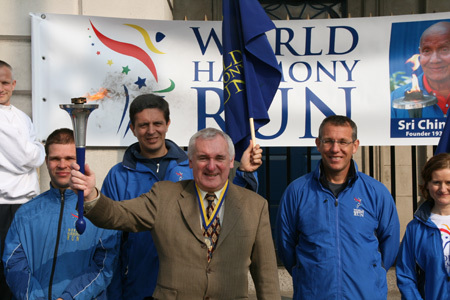
Irish World Harmony Run opening ceremony
The team is running 1400km around the coast of Ireland, visiting Belfast, Dublin, Cork, Limmerick amongst many other smaller towns and villages. The international team includes runners from US, Australia, New Zealand, Scotland and Europe.
You can follow the run at the website - Ireland World Harmony Run
For the first two days the run has benefited from dry sun, often a rarity for Ireland at this time of the year!
Inspiration-Letters: writing by Sri Chinmoy's students
A forum for inspired writers with a multitude of backgrounds and interests.
| On this page: Introduction • Browse issues • Meet our contributors |
Introduction

Inspiration-Letters seeks to offer interesting and original articles on any topic. Authentic, well-written prose is hard to find on the Internet; and we hope that our magazine may help to fill that gap. We warmly welcome our fellow word-lovers and yarn-weavers to join us in this great project.
The word "letters" immediately implies disclosure or revelation. "Inspiration" ultimately derives from the Latin word "inspirare", 'to breathe in'. Taken together, the phrase "Inspiration-Letters" suggests a magazine that features uplifting personal narratives. But, like most literary journals, we're not seeking articles on just one topic or theme. We're hoping to offer prose pieces which will appeal to readers and writers of all spots and stripes!
Franz Kafka once wrote that "writing is prayer". And Jean-Paul Sartre expressed in an essay that we never write for ourselves alone. Without a real or at least an intended audience, the writer is meaningless. I sincerely hope that the stories and articles featured here ring true. Like Cezanne, we strive to offer inspiration and joy by telling the simple truth of our lives and dreams.

Issues

Inspiration-Letters 21
Open Issue: our writers were free to write on any topic of their choosing, and the results range from soulful meditations on travel and friendship to a wild and funny take on Lord of the Rings. Read on...

Inspiration-Letters 20
Dreams Issue: Reflecting on dreams, their human and spiritual significance.

Inspiration-Letters 19
Time Issue: Reflecting on the issue of time, timelessness and what time can mean for spiritual seekers

Inspiration-Letters 18
Creativity Issue: Reflecting on the expressive urge from both mystical and pragmatic points of view...

Inspiration-Letters 17
What is the 'Sunlit Path' of devotional spirituality? Find out from 8 different writers' experiences.

Inspiration-Letters 16
Overcome it or roll with it? 8 writers pipe up on one of life's constant companions: Destiny...

Inspiration-Letters 15
In the Silence Edition, 7 writers recall places and times of quietude, and reflect on their influence...

Inspiration-Letters 14
This edition is all about Grace, and the various ways it touches our lives, reaching from the simple everyday to the life-changingly profound...

Inspiration-Letters 13
Six writers talk about their travels with Sri Chinmoy, from Ofuna to "Tobulu", Manhattan to Buffalo, including sheep, cows, and a Wurlitzer organ...

Inspiration-Letters XII
Six tributes to Sri Chinmoy, who passed away on the 11th of October 2007.

Inspiration-Letters XI
What is a sacred space? A temple? A meditation? Could it also be a bike path, a run, a wilderness, a school room, or a dumping ground? Find out in the Sacred Space Edition.

Inspiration-Letters X
Miracles: From Mexico to Hollywood, from oceans to glaciers, and Koto the Clown to JS Bach.

Inspiration-Letters IX
Book Reviews: featuring a humble horse, an extraordinary egg, oodles of heroism, and a generous helping of grace.

Inspiration-Letters VIII
Great Poets Issue: William Shakespeare, Ralph Waldo Emerson, Emily Dickinson, Walt Whitman, Virgil, Hafiz and... Paul Simon? Well... why not.

Inspiration-Letters VII
Skiing scrapes, racing cars on ice, a 3100-mile run, upside-down juggling, a dauntless swimmer and...how did butterfly collecting get in to the Extreme Sports Edition?

Inspiration-Letters VI
Via popcorn, pianos, chocolate on a mountain-top, a lost novel, and a dropped handkerchief, a diverse group of writers talk about their meditation experiences...

Inspiration-Letters V
From John Cleese to Shakespeare, via tree branches, cookies, tennis racquets, mountain rangers, the World Cup, and chocolate fish, it's the humour issue...

Inspiration-Letters IV
Getting to the heart of a prolific photographer, a sentimental collector, a great Czech master, some profound Italian frescoes, and a group of very mysterious Romanian visitors...

Inspiration-Letters III
Einstein to Marx, via saints and rabbits, stars and revolving cars, instincts and intuition, a statistical look at birthdays, a naturalist slant on artistry and spirituality, and a great deal of water...

Inspiration-Letters II
Climb the mountains of Western China and Europe, run the Philadelphia Marathon, see inside the soul of a house, follow the fate of a tartan scarf, and find God in a chestnut...

Inspiration-Letters I
From Kung-Fu to treacherous mountaineering, contemplate the sacredness of birthdays and music, run across Italy with a flaming torch, win cycling races, gaze at rainbows...
Meet the Inspiration-Letters contributors...
I write mostly because I would like, in some small way, to emulate those great writers that I so admire. I particularly admire Herman Melville and Somerset Maugham among novelists. My favorite poets include Emily Dickinson, Adrienne Rich and the ancient authors of the Iliad and the Mahabharata.
I was born in New Jersey, which is fitting because it is a transitional place. You pass through New Jersey to get to where you want to go. But if you stop on any one of the hundreds of miles of highways which criss-cross the state, you will see that it is filled with green parks and rivers, summer opera festivals and a college on every corner. It's a state that is always struggling to define it's own identity. I can identify with that!
Writing is an act of self-discovery. For me, writing has always had very important therapeutic uses. By setting my feelings down on paper, they no longer overwhelm me. I can make sense of them and put them in their proper context. Writing is also useful to me to make sense of who I am and what I'm supposed to do with my life. It's a way for me to understand myself better and I am fortunate if my journey of self-discovery through writing can inspire others at all.
- Arizona Strings • Philadelphia Marathon • World Harmony Run: Reflections On Water • Memories Of Collecting • Milk And Cookies • Why Do I Meditate? • Ben Jonson On Grief And Faith • An Extraordinary Egg by Leo Lionni • A Miracle Story Told In Music • Spaces And Learning • Sri Chinmoy, Bach & Beethoven • Silence • Overcoming Destiny • Reflections on the Sunlit Path • Beethoven and Spelling Bees • Time

Sri Chinmoy expresses the essence of meditation and spirituality through his art and writing, which is a constant source of inspiration to me in the Sri Chinmoy Centre. There is always a lot of scope for channelling creativity here, and always a chance to enjoy the creativity of others. My favourite form of creativity is writing. I write about whatever inspires me. It seems the longer I try to lead a spiritual life, the more I observe the beauty and happiness in the simple things around me. I write about nature, about people, and about ordinary things that happen in my life, from which I derive extraordinary value. I am very glad to be able to share these writings through Inspiration-Letters.
I became a student of Sri Chinmoy in 1998. Being a member of the Sri Chinmoy Centre has enriched my life in many ways, offering me the opportunity to discover, unfold and develop qualities and capacities I never knew I had and giving me a sense of spiritual well-being and fulfilment. I like the idea expressed by Sri Chinmoy of combining an inner, spiritual life with a dynamic and versatile outer life. As an art-lover I enjoy writing prose and poetry - both on this forum and on the Sri Chinmoy Inspiration Group - and also like playing music, singing and acting, but my main passion in life is running, especially the marathon. In my daily life I am a freelance journalist living in Amsterdam, The Netherlands.

Arpan DeAngelo
New York, USA
I started writing many years ago just as a way to express what was happening in my life from time to time. I usually just write whatever happens to come into my mind, hopefully from my heart. Although I do not consider myself as a serious or adept writer, I try to offer something meaningful, or at least of some inspirational value, through writing in my own simple way. Because I have been quite serious about running, meditation and spirituality for most of my life, that is what I usually am inspired express through words. I do hope that my words do not get in the way of truly expressing the depth and meaning of the experiences that I attempt to write about.

Ashrita Furman
New York, USA
Ashrita is the holder of the most Guinness World records. Find out more at Ashrita.com

When the great Pope John Paul II visited New Zealand in 1986, he pointed out that the Otago/Southland diocese in New Zealand was the region of the Catholic Church furthest from Rome. It is also true that the mosque in Christchurch is the mosque furthest from Mecca. New Zealanders like to think that living as far from the centre of things as it is possible to do, gives them a perfect perspective on things. From their little slice of clear-skied, green, nuclear-free, South Pacific paradise they can cast a clear and unjaundiced eye over the world. Barney McBryde was born in Invercargill, the southernmost city in New Zealand . . . the southernmost city in the world. This, he claims, is the only credential he needs to write about . . . anything.
- Of Saints And Rabbits • The Universal Language • Loitering With Intent • The Extremes Of Sport • My Friend Nick • The Year of the Horse by Sam Mahon • Cuauhtlatoatzin: The Miracle Of The Humble • Sacred Space Memoirs • Journey To A Lamb's Heart • Lessons from Laetitia • Seven Drops of Silence • Sunless Wood: Sunlit Path • Ten Days To Learn About Time

Vilas Silverton
Bristol - England
I am a ceramic artist and part-time visiting instructor and research assistant in enamel at the University of the West of England. My work is based upon and flows from my inner life of prayer, meditation and service, during which I focus on the spiritual heart. This is for me the source of joy, love and oneness. These qualities I hope to offer to people who see the work. Focusing on the spiritual heart also encourages a childlike simplicity which I feel shaping my life and work. This may also explain my preference for bright colours, simple shapes and cheerful, beautiful things. As a medium, I am particularly drawn to clay because of the infinite ways it can be shaped, treated and used. Its scope and potential are a continual inspiration to me. Ultimately, I like to make pieces that make people smile. In this way I hope the world to be a happier place. You are most welcome to visit my website
Jogyata Dallas
Auckland, New Zealand
They say that putting pen to paper's turning blood to ink
and others scrutinize your thoughts—you really need to think!
With paints you're fine, a six year old can obfuscate, conceal,
while others think their dabblings do a genius reveal.
Take poetry too, e'en though you fail to scale Elysian heights
the mysteries of your quirky style will always bring delights.
But prose! Your very souls's laid bare, the critics draw their knives,
they carp and quibble, nitpick, send us fleeing for our lives.
So gentle reader, overlook my literary transgressions
and if my thoughts show symptoms of a cranial regression
encourage me to paint or sing, choose anything at random,
I'm really not much good at prose, quod erat demonstrandum.
(Yikes!)
- A Spiritual Memoir • At The Beach • Myth And Moment • Stories From The Path • Fast Track To God • Living On The Edge • Tears For Dead Children: An Incident From Malaysia • Grace by Sri Chinmoy • Four Mini-Miracles • Sketches From A Traveller's Journal • A Few Reflections • Inner And Outer Journeys • Of Grace and other Secrets • Remembering October • Some Thoughts On The Way Forward • Down by the River: Remembering My Grandfather • New York Interludes
Writing is something I never considered myself to be particularly good at, but practising meditation as a student of Sri Chinmoy has changed my conception of self, writing included.
Meditation teaches us to put aside attitudes and ways of thinking that limit our potential; it opens to those who seek it a whole new world of imagination and creativity. So it has in my life: graphic design, web-development, video-editing and writing are just some of the creative activities I pursue—even make a living from—and all have emerged from my daily practise of stilling mind and opening heart.
Writing for me is all parts inspiration and self-discovery. It is inspiring to do, inspiring for others to read—hopefully—and by approaching it as another form of meditation, it helps me to uncover a wiser, deeper, more illumining part of myself—an inner voice of inspiration.
I'm a student of Sri Chinmoy, based in Canberra, Australia. I also happen to be a freelance writer, and some of my work can be found on my website, which was recently updated for the first time since about 1964. Also, I write regular articles about Sri Chinmoy Centre activities.

You are most welcome to visit my photography gallery

Sharani Robins
Rhode Island, USA
As a librarian and bibliophile, I especially resonate with the written word. I began studying meditation as Sri Chinmoy's student in 1985 and my spiritual strivings and creative expression are primarily a spirit of delight in the supernal beauty of God. I often find an act of centering prayer in artistic expression, especially when harmonising with Nature. I am happiest when the writing of prose and poetry or the taking of photographs leads me to a hushed place of kneeling in awe of a universe of oneness much vaster than myself. I live and work in adjoining New England states, both located near the Atlantic Ocean's coast. As a transplanted New Englander, I find that living near the sea nourishes me deeply and sparks creativity on many levels.
- Rainbow Visions • Finding the Right Portrait • Artistry In The Sand • Paris, Je t'aime! • Say No To Woe • Meditation Is A Wisdom Messenger • Change Ringing • RX: Write a Poem, Read a Poem, Find Vision's Shore • The Divine Hero by Sri Chinmoy • Miracle In Jamaica, New York • Nothing To Declare? • The Tallest Tree • The Perfect Day • Pennies from Heaven or The Coin of Grace • Solo Style Silence • Devotion to the Feet of God • Creativity is a Pineapple Omelette • 2 Hours 40 Minutes - Timeless Trek
 Suchana Cao
Argentina
The world of languages beckoned to my present lifetime when I was a child. Letters and postcards were the only messengers to unknown horizons in the dialogue among cultures.
Having received later the influence of three great South American women poets—Gabriela Mistral, Alfonsina Storni and Juana De Ibarbourou—I rather felt the inspiration to write short rhyming poems on spirituality in Spanish at the time Maestro Sri Chinmoy founded the first Meditation Centre in Argentina nearly 27 years ago. Since then his ever transparent and sublime poetry has invited me to undertake a new challenge—writing in the English language.
If you empathize with any of these poems, it is all due to my Guru´s unconditional and benevolent guidance, which is carrying me to share the music and images words may convey in their celebration of Life.

Tejvan is a cyclist and sometimes writer.


Purnakama Rajna
Canada

Priyadarshan Bontempi
Italy
Mein Xylophon und ich

Als ich Schülerin von Sri Chinmoy wurde, hatte ich schon sehr früh einen engen Bezug zu seiner Musik. Tatsächlich war es so, dass mir das Singen spiritueller Lieder viel leichter fiel als die stille Meditation. Ich war damals in Salzburg – der Stadt der Musik – und auch im Center waren viele Musiker. Das hat mich inspiriert nicht nur zu singen, sondern auch ein passendes Instrument für mich zu suchen.
Meine Wahl fiel dabei ursprünglich auf das indische Harmonium, ein Begleitinstrument mit Tastatur und Blasebalg (vereinfacht ausgedrückt), das ein wenig wie eine Orgel funktioniert und mit dem man verschiedene Grundtöne erzeugen kann.
Kurz bevor ich jedoch eines kaufen wollte, geschah etwas Lustiges. Ich war in einem anderen Centre zu Gast und eine meiner Freundinnen lieh mir ihr Harmonium, damit ich das gemeinschaftliche Singen mit begleiten konnte. Ich konnte schon einige Begleitakkorde und auch das Melodiespielen viel mir leicht. Nur an diesem Abend war es so, dass ich jedes mal aufschreckte, egal, was ich spielte. Es war ganz komisch. Ich spielte zwar die richtigen Noten, aber es klang immer schräg und gefiel mir gar nicht.
Ich fand nur eine einzige Antwort auf dieses seltsame Phänomen: Das scheint wohl doch nicht das richtige Instrument zu sein. Wie ich dann dazu kam, mich für ein Xylophon zu entscheiden, weiß ich nicht mehr so genau. Vielleicht waren meine Kindheitserinnerungen wieder wach. Ich habe lange Zeit im Schulorchester Xylophonbegleitung gespielt.
Jedenfalls fand ich mich ein paar Wochen später mit einer sehr musikalischen Freundin auf einer Musikmesse ein, um zu schauen, was es an Xylophonen gibt. Ursprünglich schwebte mir eines aus Palisander vor, das sind die, mit den Holzstäben. Aber beim Ausprobieren gefiel mir ein großes Altmetallophon mit hellem Klang am besten. Natürlich hatte ich teuer gewählt, es war ein Konzertxylophon und eigentlich war mein Budget sehr begrenzt. Schließlich hatte ich als Student kein regelmäßiges Einkommen.
Ich wusste aber auch, dass ich eine langfristige Investition tätige und es immer bereuen werde, wenn ich jetzt sparen würde. Und so kaufte ich es.
Es ist ein wunderbares Instrument und ich liebe es, mich in die Reinheit seines Klanges zu versenken. Ich staune immer noch, dass ich nach so vielen Jahren immer noch neue Klangvariationen kreieren kann und mir dieses Instrument nie zu langweilig wurde. Wenn es mir mal nicht so gut geht, ist Xylophon-Spielen die beste Medizin für mich.
Mein Xylophon ist mit mir schon viel gereist, vor allem auf den zahlreichen Touren mit meiner Musikgruppe Silence-Hearts. Sein Klang hat viele Menschen berührt und vor allem Kinder begeistert. Die kommen gern nach dem Konzert und dürfen natürlich mal selbst ausprobieren.
Leider ist es kein Instrument, das man einfach mal so in die Tasche steckt. Ich habe mir von einem Schreiner damals zwei Holzkisten machen lassen, damit es jeden Transport übersteht, aber damit füllt man oft bereits zwei Drittel eines Kofferraums. Zug fahren ist gänzlich unmöglich. Ich kann immer nur eine Box tragen und wenn man dann noch Gepäck dabei hat, geht das einfach nicht.
Oftmals muss ich höhere Kosten für ein Auto in Kauf nehmen, das groß genug ist, oder mir werden die Arme lang, wenn ich es von einem Parkplatz zu einem Konzertort trage. Das sind so die Momente, in denen ich mich frage, warum ich mir diesen Aufwand antue. Aber sobald der Klang meines Xylophons dann im Konzertsaal erklingt, weiß ich, dass es kein besseres Instrument für mich geben kann, und sein Zauber jeden Aufwand rechtfertigt.

Ich war idealistisch und wollte die Welt verändern
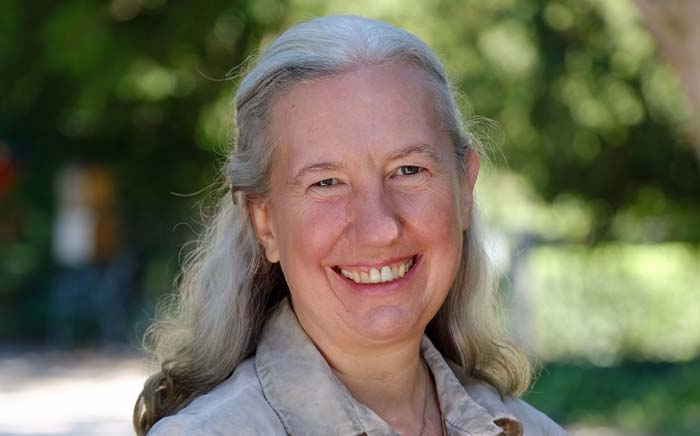
Ende 1990 habe ich mich dafür entschieden, Schülerin von Sri Chinmoy zu werden. Diese Entscheidung hat meinem Leben endlich den Sinn gegeben, den ich immer gesucht habe.
Ich war immer idealistisch und wollte die Welt verändern. Ich war daher stets nach außen gerichtet. Als leitende Funktionärin einer Jugendpartei hatte ich aber häufig die Erfahrung gemacht, wie wenig ich doch trotz einer angesehenen Position erreichen kann.
Es war ein großer Schritt für mich, mich nach innen zu richten anstatt ständig im Außen eine Veränderung herbei zu führen. Da ich stets im außen gesucht hatte, fiel es mir schwer mich auf mein Inneres zu konzentrieren. Aber ich war konsequent und legte kurz nach meiner Entscheidung für diesen Weg alle politischen Ämter nieder.
Ich habe diese radikale Änderung nie bereut. Meditation hat mein Leben seither unendlich bereichert. Ich spüre nicht nur einen Sinn, in dem was ich tue sondern habe auch entdeckt, wie ich wirklich bin.
Nein, ich bin keine Heilige und ich führe ein sehr normales Leben, in dem ich genau wie alle anderen Menschen, mit vielen Problemen – oder sagen wir lieber Herausforderungen – konfrontiert werde. Aber mit der Meditation und natürlich der Unterstützung durch meinen Meister habe ich ein effektives Werkzeug an die Hand bekommen, um mein Leben mit einer sehr optimistischen Haltung zu meistern.
- ‹ previous
- 171 of 337
- next ›

Except where explicitly stated otherwise, the contents of this site are licensed under a Creative Commons Attribution-NonCommercial-NoDerivs 3.0 Unported License. read more »
SriChinmoyCentre.org is a Vasudeva Server project.