Before sending a message, check if there are local contact details for a Sri Chinmoy Centre in your country (see the list below). If you don't see your country, then please use this form and we'll make sure it gets to the right person.
For copyright and media requests, you can also use this form.
The Parliament of the World's Religions began in 1893 in Chicago, as an initiative to bring the different religions and spiritual paths together. This gathering became famous for announcing the great Indian spiritual figure Swami Vivekananda to the world, and in doing so became a landmark in introducing Eastern spirituality to the West. A century later in 1993, the Parliament was once again reconvened in Chicago, and Sri Chinmoy was asked to give the opening meditation.
Video Content
Playing this video will load cookies from Vimeo. Please accept cookies to view this content.
Video
Sri Chinmoy meditates at the Parliament of World Religions in 1993
Since 1993, the Parliament has been held in multiple locations around the world. This year Toronto in Canada was the host, and members of the Sri Chinmoy Centre joined with members of many faiths and spiritual paths around the world in offering concerts, meditation events and talks.
Sangit Surabhi, a female instrumental group based in Ottawa, performed a selection Sri Chinmoy's meditative songs
Sri Chinmoy's Jharna Kala Art
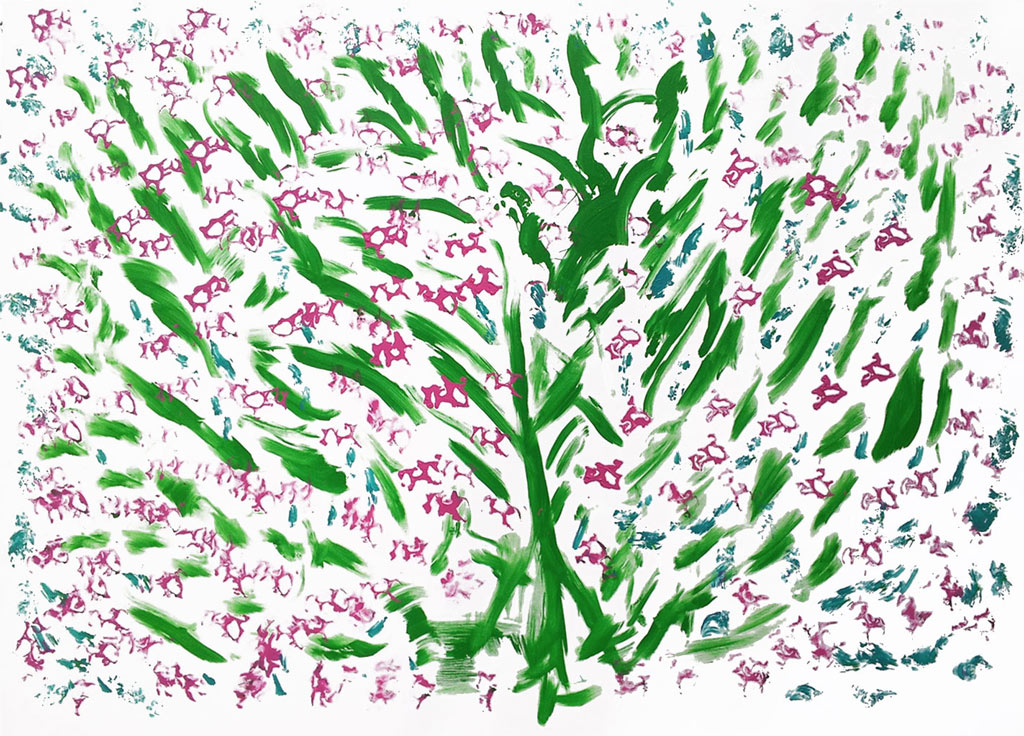
Today, November 19, marks the 44th anniversary of Sri Chinmoy's bgain painting his Jharna-Kala artworks. Jharna-Kala, in Sri Chinmoy's Bengali mother tongue, means 'fountain-art' - art springing forth from an inner source of creativity and spontaneity.
As many observers have commented, the art of Sri Chinmoy expresses a great freedom and joy of movement, unencumbered by the confines of artistic trends or mental concepts.
Sri Chinmoy begain his painting odyssey in 1974, with a drawing of a simple rose while staying in Ottawa. Up until that date, Sri Chinmoy said he had never felt any particular inclination to paint, but after receiving an inner inspiration from his Inner Pilot, he sought to give expression to this inner direction. In addition, Sri Chinmoy never received any formal training - his artistic endeavours came naturally from his own inner meditation and prayer. Explaining his approach to painting, Sri Chinmoy said:
“I try to make my heart a receptive instrument so that God, the Supreme Artist, can paint in and through me.”
From these humble beginnings, Sri Chinmoy soon became a prolific artist, painting countless abstract acrylics - in the first year alone, he created over 100,000 paintings. Talking about the prolific output, Sri Chinmoy explained:
“It is a continuous, spontaneous flow. Without any obstruction. It comes from within. Anything that comes from the very depths of our heart will have no obstruction on the way. But if it comes from the mind or the vital, there will always be some obstructions, for the capacity of the mind is very, very limited, whereas the capacity of the heart is unlimited, precisely because it is in tune with the soul... If we go beyond the mind we create infinitely more beautiful things.”
Drawing by Sri Chinmoy to commemorate the completion of 70,000 soul-birds
In 1991, Sri Chinmoy's art took a new direction when he began spontaneously drawing birds. He gave this project the name Dream-Freedom-Peace-Birds, and also often referred to these effortless, free-form creations as Soul-Birds. In total, Sri Chinmoy drew 15 million of these unique birds.
“These birds represent unity in multiplicity. Here we have 70,000 birds. Each bird is different, but when you look at them, you feel unity. As soon as we think of the bird-consciousness, it is one. The bird-consciousness represents the consciousness of our soul’s inner freedom.”
Over the years, Sri Chinmoy's paintings and drawings has been exhibited in galleries around the world, such as the Carrousel du Louvre in Paris, the United Nations building in New York and the national parliaments of Australia, Ukraine and New Zealand.
Exhibition of Sri Chinmoy's Art in Ottawa, Canada
“These are among the most beautiful and stunning paintings I have ever seen. I see in Sri Chinmoy's art the joy of creating beauty. His art is the classic example that creating not only is joy, it should be joy. Through his art he takes his joy and shares it with others.”
Hans Janitschek Former president, United Nations Society of Writers
Video: Sri Chinmoy talks about his art
Video Content
Playing this video will load cookies from Vimeo. Please accept cookies to view this content.
Sri Chinmoy encouraged us to come together every so often for Joy Days - spiritual gatherings that contain plenty of meditation, music and spiritual activities, but also games, the company of spiritual friends and a definite emphasis on happiness.
Singing and theatrical performances, ping-pong and tug-of-war competitions during Sri Chinmoy Centre Joy Days in Mongolia
These Joy Days could be as small as a few friends meeting together for an outing, or much larger meetings lasting a few days with several Centres or several countries meeting together.
Games galore during a Joy Day in our Dublin Centre
The largest Joy Days take place in Europe and Russia, often with over 700 students of Sri Chinmoy from many different countries taking part. In Europe, the Joy Days usually take place over a weekend, and is quite an organisational feat, with students from many countries giving soulful singing and instrumental performances, as well as sweet and funny plays and humourous sketches. On the Sunday morning, there is usually a group meditation at six o'clock in the morning, followed by a fun two-mile race - Sri Chinmoy loved running, and felt that the outer running and the inner running (i.e. meditation) complemented each other very nicely.
The 2-day schedule for for one of our recent large European Joy Days, with students of Sri Chinmoy coming from all over continental Europe.We often hold Joy Days in picturesque settings, with plenty of time to explore natureDuring a recent Joy Day in Curitiba, Brazil, nine of Sri Chinmoy's students ran the city marathon.
Sri Chinmoy believed that happiness and spiritual progress should go hand in hand:
If you are happy, it will help you to a great extent. If you are unhappy, you won't make any progress at all. On the contrary, you will be marching backwards. Real outer happiness is not self-deception. It does not come from wasting time and indulging in pleasure-life. Real outer happiness is something totally different. It comes from inner joy and inner satisfaction.
Meditations on the beach, delicious food and body-surfing during Joydays in our Centre in Accra, Ghana
As well as Joy Days, Sri Chinmoy's students often meet together outside of our regular meditation for more formal occasions, for example to mark our teacher's birthday, or the anniversary of his passing on October 11, 2007.
Sri Chinmoy's students in Bali gather at his statue in Ubud to mark his Mahasamadhi (passing)
Shankara, and her sister Dipika, are co-managers of Run and Become, an independent chain of running stories that have become well known for the personalised service they give the running community.
I don’t know what I’ve done to deserve the blessings I receive in this life, but I know how lucky I am. Every day I get to work hard, try to do the best I can at work, along with all the other things I’m involved in. I feel fulfilled. My life is pretty simple. I know, too, the only thing that brings this feeling of satisfaction and worth is spirituality.
When I was younger, I thought the only way you could really change the world for the better was to go into politics or find some way to sway influence on a big scale. I must admit I never really understood Sri Chinmoy when he said the best way to change the world was to change yourself. Hmm … that could never have a big impact on the world, surely? However, the older I get, the more I laugh at my younger self. Now, I’m convinced the best thing I can do is try to change myself; to chase illumination, not world politics!
Growing up
How did I start? My parents joined the London Sri Chinmoy Centre when I was 5 years old, so I grew up with my family meditating together. I find it significant that the very first conversation I can recall as a child was my Mother telling my sister and I that she had found a spiritual Guru and was going to start meditating with him. She said we could join her if we liked. I can still feel my legs swinging on the chair that was too high for me, and see exactly where we were sitting in our house. Although I was so young, some part of me found the conversation very significant.
Shankara and Dipika, with Sri Chinmoy.
Our parents (Ongkar and Vinodini) took us along to Centre meditations. There were a number of children in the Centre and we would play together while our parents meditated. We would also join in the meditation for at least 10 minutes. Sri Chinmoy always involved us children in activities, that were very much part of Centre meetings. Children are always cherished and made to feel important as Centre members.
Sri Chinmoy’s love, care and concern have touched every part of my life and continue to do so. I am no great aspirant, far from it; but I have faith in my spiritual life and in Sri Chinmoy. This faith protects and enlightens me. I guess my love and faith have deepened and expanded over the years. On this spiritual path, you never stop learning, which is so satisfying.
My spiritual practice
Meditation does not give you a predictive experience, because it changes the whole time. Throughout my life, inspiration has ebbed and flowed. At different stages in my life, I have found the need to call on different aspects of the spiritual life for guidance and support. My Pole Star is devotional singing. Sri Chinmoy wrote thousands of devotional songs 1 that I find indescribably beautiful. Singing at my meditation shrine, I am always transported from the incessant drumbeats of my mind to the sweetness of my heart where peace resides.
Shankara is the leader of the Temple-Song-Hearts music group, which gives concerts all over Europe.
I’ll be honest. Regular discipline isn’t my forte. I tend to buzz around the place trying to do a million things at once, which quite frustrates my long-suffering family! Sri Chinmoy’s path works for me because it’s so varied. If you love meditating soulfully and silently, there’s plenty of opportunity for that. If you like to meditate, but sitting for hours is a kind of torture, then you can meditate first, then go and do “selfless service.” Serving soulfully can be anything from helping out or organising running races, working at a restaurant operated by students of Sri Chinmoy, or getting involved in the many projects the Centre organises.
However, despite my love of action, I really treasure my morning meditations as they inevitably give me the best experiences of the day. I probably sing more than I sit in silent meditation. My meditation shrine is simple and lovely. It’s the one time in the day no one is asking anything of me, except hopefully, God. The rest of the day, I try to remember my spiritual life, my Spiritual Master, and moments of beauty and divinity. Such as on the bus, as I walk to the kitchen, or as I notice something beautiful, in connecting my inner and outer life.
Meditation increases awareness and sensitivity to our surroundings. Meditation strengthens our instincts. By which I mean, as our souls come to the fore during meditation, the Soul’s Light and its guidance do not withdraw immediately, but continue into the day. This awareness, I feel, leads me to be more considered and thoughtful in my decisions. The aim is to do the right thing; one’s instinct or intuition is a hugely helpful tool for this to happen. I also believe my meditation, or rather my spiritual life as a whole, offers protection against falling foul of insecurity and other negative forces. Ha, but I have a long way to go on that!
Shankara is also a race director of the many races that Sri Chinmoy's students put on in the London area, ranging from 5 and 10k races to the UK's only 24 hour race.
A life of significance
I’ve never known a life without meditation or spirituality. The spiritual life is normal to me. I perceive my life to date as challenging, very challenging at times, but also wonderfully full and rewarding. My greatest fear as a teenager was to have a life where I couldn’t see the point of what I was doing, of a life with no achievement - and by 'achievement', I mean living a life of deep significance, rather than becoming a big-wig. I clearly remember being so grateful in my late teens that I had meditation and a spiritual life, as I was happier in myself, and less confused or frustrated than some of my friends. When I feel my heart open during meditation – or more commonly when I sing – I taste the sweetness of life (while worries and frustrations caused by politics, confrontation and the sheer hardness of life, lessen their intensity), and I gain perspective.
If I didn’t meditate, my choices in life would be so different, along with my priorities. I want to meditate. I want to live a spiritual life. For me, there is no set divide between the inner and the outer. I just want to do my best each day. I meditate every day and I try to serve in my daily life. My meditation with Sri Chinmoy shows me the way to live, which gives meaning to my life.
1. During his lifetime, Sri Chinmoy wrote 21,300 devotional songs (including 13,625 Bengali; 7,462 English; 180 Sanskrit and 33 French songs)
No prior experience needed
Samalya Schafer
Samalya explains how he was completely unfamiliar with spiritual concepts when he first took meditation classes, and how he feels that helped him because he had no preconceptions. He also talks about how the idea of having a spiritual Master slowly grew on him, and how he had a powerful experience that convinced him Sri Chinmoy was his Master.
How Sri Chinmoy appreciated enthusiasm
Prachar Stegemann
Sports, especially running, is a big part of life in the Sri Chinmoy Centre. Prachar recalls a fond memory of his Guru, Sri Chinmoy which took place during a one-mile race, which taught him a valuable lesson about enthusiasm
What meditation gave me that I was missing
Purnahuti Wagner
In this wide-ranging interview, Purnahuti Wangner talks about how, despite being successful in many fields, there was something missing in his life. He talks about his journey starting meditation, growing a new meditation centre, and giving classes in Guatemala and South America. This interview is part of the LIFE Voices series, created by Kedar Misani.
How can we create harmony in the world?
Baridhi Yonchev
In answering this question of questions, Baridhi recalls Sri Chinmoy's well-known aphorism:
Try not to change the world.
You will fail.
Try to love the world.
Lo, the world is changed.
Changed forever.
The relationship between Guru and disciple
Baridhi Yonchev
Baridhi explains how the affinity between a spiritual Master and his students is something that grows in silence, and talks about a few of his experiences in that regard.
What is it like on the Peace Run?
Nikolaus Drekonja
Freshly returned from running with the international team in the US, Nikolaus talks about how spending every day on the road with the Peace Run has changed him as a person for the better.

 As many observers have commented, the art of Sri Chinmoy expresses a great freedom and joy of movement, unencumbered by the confines of artistic trends or mental concepts.